


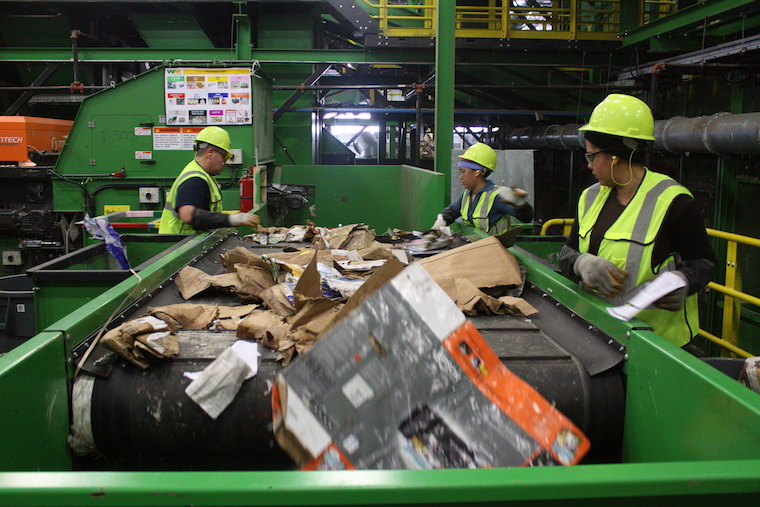
About 500 jobs could be created if Australia domestically remanufactured 50 per cent of the material formerly sent to China before a ban on waste imports, according to a new report.
The report, commissioned by the Australian Council of Recycling (ACOR) and conducted by MRA Consulting, found that investment in domestic remanufacturing could also significantly reduce carbon emissions equivalent to taking 50,000 cars off the road.
The release of the report has been timed to occur before state and federal environment ministers meet next week to consider a national response to the waste crisis caused by China’s national sword policy banning certain waste imports.
China had previously imported about 600,000 tonnes of Australian waste a year.
ACOR, along with the Waste Management Association of Australia (WMAA), is calling for a $150 million “one-off” investment to implement a National Circular Economy & Recycling Plan designed to create new industries from waste products through investment in infrastructure and innovation.
ACOR chief executive Pete Shmigel said, given the circumstances, government funding was an appropriate solution.
“Other industries are regularly supported in transition or crisis,” he said.
“This sector – largely free-market based for decades – needs support now or services and jobs could go, including in country towns.
“While state governments have rightly focused on the system’s short-term survival, it’s time for all governments to jointly act for recycling’s future success.”
Mr Shmigel said the funds could be spent on a range of programs, including:
- New technology to support more Australian reprocessing of mixed paper, mixed plastics and glass cullet
- Enhanced methods and machinery at recyclate sorting centres
- Support for government and corporate purchasing of recycled content products
- A national centre for recycled content product development
- Education to ensure what’s collected is clean enough for recycled content product making
He said people expected that what they recycled would not end up in landfill.
“Our political leaders, through the policy targets they have set, are part of delivering on that promise and should continue to do so on April 27th.
“We need to make and buy more recycled content products here in Australia. Closing the loop is what’s needed for community confidence, job growth and environmental results.”
WMAA chief executive Gayle Sloan said the waste crisis was an opportunity to build up a circular economy approach to waste.
“It is absolutely the case that the industry’s future direction is at an important crossroads, with an opportunity to grow more Australian-based manufacturing jobs, and actively build on the 20 years’ worth of environmental gains in Australia, however a concerted effort at this critical point in time is required by all,” she said.
The use of recycled products manufactured here in Australia through government departments and legislation would make a huge difference. Apart from funding private enterprise requires a market for the end product to make it truly sustainable long term.