


When Martina Linnenluecke wanted to do her PhD on business strategy and sustainability, she was warned off: it was not appropriate for a serious student of business, she was told.
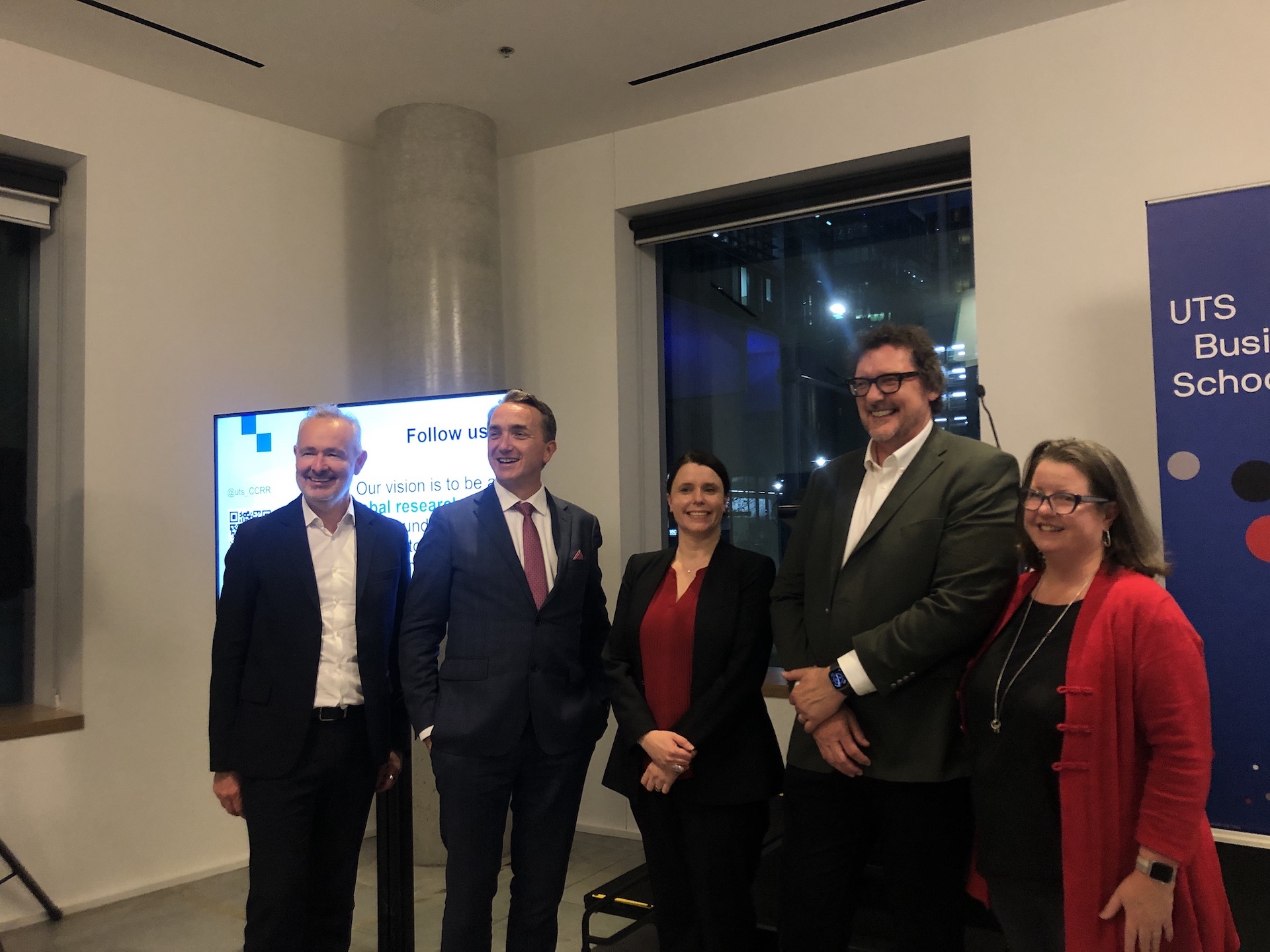
On Wednesday night she proved her naysayers wrong when the UTS Business School launched its new Centre for Climate Risk and Resilience that she will head, as director.
Presiding over formalities on stage were the school’s luminaries: Dean Carl Rhodes, pro vice-chancellor of research Chris Turney, associate dean research and innovation Kathy Walsh and industry professor John Lydon.
“UTS has always been known for being innovative and being very connected to industry but we wanted to add a third pillar to what we do and contributing to on social impact and purpose….the role that business can take on climate change,” Rhodes told The Fifth Estate during an interview on Thursday.
“There are a number of other centres on climate. The difference we can bring is we are absolutely connected with business. And that idea of collaboration to make a big difference.”
Industry professor Lydon could well be an example of what he’s talking about. His background includes 25 years with McKinsey & Co, including five years as managing partner, roles with the NSW government’s Net Zero Emissions and Clean Economy Board, the NSW government, the Greater Cities Commission and Climate Leaders Coalition.
Linnenluecke’s new centre will cut an interesting space in the business landscape. It aims to bring together the experts needed by top level businesses and government on the transition we have to have, and to offer the evidence based research to provide confidence about the results.
Most importantly it wants to educate the students that can influence the broader business world.
Sustainable finance will be the first topic offered and research will focus on adaption and resilience, decarbonisation, sustainable finance, climate analytics metrics, targets and disclosure, policy impacts and resources.
Three research case studies are also part of the offering: Climate Risk Disclosure – Measures for Best Practice, (funded by the Australian Research Council Linkage scheme, and in collaboration with other universities, the Australian Accounting Standards Board and the Auditing and Assurance Standards Board); Creating Sustainability-Oriented Fin Tech Lending Platforms, and Physical Risks and Transition Risks.
Linnenluecke says the focus of this work is needed because there is so much about this transition that is still so new, so much unknown – or disaggregated.

Messy carbon credits need a lot of work
Carbon credits, for instance. Linnenluecke says these are “such a messy area, to be honest. We’ve been looking closely at carbon credits and there are better and worse approaches to doing the right thing.
“Some schemes are not as rigorous as they should be and companies are starting to realise that just offsetting is not going to provide the magic silver bullet.”
We may in the end need some serious strategies that shift the way we do business. “Some sectors will find it almost impossible to cut emissions. Airlines for instance.”
The big disclosure headaches
Another huge headache for business is how to manage the disclosure regimes heading our way.
“This is probably the least understood”, Linnenluecke told The Fifth Estate.
“We’re getting a lot of inquiries around this. Because it’s another piece of the puzzle: in the past companies have been good at financial systems but not very good on their environmental obligations.
“And when they get to the table there’s the question of understanding what they need to account for and what tools have to be factored in.”
When it comes to scope 1 and 2 emissions it’s hard enough.
When it comes to scope 3 there’s even more confusion and lack of understanding out in the market, she says. “Especially those who do a lot of travelling – what’s to be included and what not – and especially across the supply chain.”
The rigour of a university – and impartiality
What LLL’s centre will do is provide research to companies that is “conducted with very rigorous methodology behind it. Because research institutions are impartial to any desired outcomes. And we can provide outcomes with rigour and research on these issue with what are the best methods”.
Some of the bigger consultancies are pushing hard into this space but the question, Linnenluecke says, is “What methods are you using? What are your data points? What are you evaluating?
“We can essentially provide research to companies that is conducted with a very rigorous method behind it because as a research institution we are impartial to any desired outcomes.”
Others have questioned whether some of the organisations putting out data have the expertise to be confident of their product.
There’s also the issue of trust in private corporates, given the scandal surrounding government contracts with PwC (and that this week Carl Rhodes was asked to comment on in an interview of ABC radio).
Linnenluecke says that the old cliché of “win-win” for business and the environment might not be as easy to achieve as its earliest proponents suggest.
Rhodes told The Fifth Estate that the idea behind the creation of the centre was to allow the university to “take the expertise and experience we have, to galvanise and unite the different capabilities we have” in order to make a bigger impact than it’s possible for the sum of the individuals to have.
“Knowledge is our business,” he said. “We’re a university; we don’t have ulterior motives for for partners – we’re a public institution.
“There are a number of other centres on climate. The difference we can bring is we are absolutely connected with business. And that idea of collaboration to make a big difference.”

Australia is coming from a long way behind
What does he expect of the appetite from business to take up the new opportunities?
The appetite is strong, he says but that’s in the sense of Australia being a “bit of a laggard” on climate.
“It wasn’t long ago that Scott Morrison [former PM] was wielding a piece of coal in parliament. So there’s some rapid catching up to do now. We are here to help satisfy that appetite.”
There’s so much to do that Linnenluecke reckons she could easily put to good work another 100 people. But so far there’s just two post doctoral appointments and 20 staff.
The numbers of students will be small too – just 50 in the sustainable finance course with two intakes a year.
“It’s a small number, but let loose into the big wide business world, she’s counting on a much bigger “multiplier effect”.