


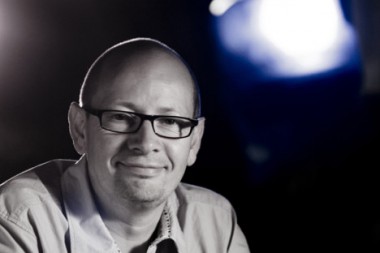
24 April 2014 — The lighting master planner for Lend Lease’s Barangaroo development, Mark Major, thinks how we relate to cities after dark needs a rethink.
Major, cofounder of UK-based practice Speirs + Major, told The Fifth Estate artificial lighting has been taken for granted.
“There’s an expectation that light is just free and widely available. Very few people think daily about their lighting experiences. Actually, people tend to notice the absence of light far more,” Major says.
“That process of taking electric light for granted over the best part of 100 years – we’ve got to a point where we perhaps need to rethink or reevaluate the role it plays in our lives – pay a little bit more attention to it… and what it means environmentally.”
Major will be speaking at this weekend’s TEDxSydney event on why darkness in design can be a positive thing.
“Darkness itself has a role to play, particularly in the city, and certainly the problems we’re experiencing of over-illumination, increasing light pollution and the overuse of light energy, are issues that unless we address them will become an increasing problem,” he says.
Major says sustainability has always been integral to his thinking as a lighting architect.
“Like everything in life, you need to get the balance right,” he says. “I have visited plenty of low-energy lighting schemes that have been awful places to be for people. It doesn’t follow that a low-energy scheme is always a good scheme.
“To get the balance right it has to be a successful experience.
“We as lighting architects have always spoken about two things. One is that on many projects less can be more. If you’re starting with a low background level of light, you generally need to apply very little in order to make things successful.
“The second thing we’re always concerned with is to make sure we balance the social and economic benefits lighting can bring to a community with the need to save energy and reduce environmental impact.
“So I guess you could say from our standpoint as designers, we would like to think that society can have its cake and eat it.”
Major has been appointed lighting master planner for Barangaroo, and is also working on discrete building projects in the precinct, namely the three commercial towers being designed by Rogers Stirk Harbour + Partners.
The key issue for working at the precinct scale on lighting is safety and security, Major says.
“It’s the reason we light our streets in the first place,” he says.
“But what we’re trying to do in developments like Barangaroo is ask very fundamental questions at the beginning of the project as to how much light is needed, and when, and how is it best controlled? And we’re trying to… not drive lighting standards down – that makes it sound like we’re trying to produce a lesser delivery of light – what we’re trying to do is spread the message that brightest is not necessarily always best.
“What we need to do is get a good quality of light – plenty of vertical light so you understand the spaces you’re in, and to deliver an intensity of light that makes people feel comfortable, so you can recognise each other in the street, but which doesn’t suffer from being very bright in one area and then making adjacent areas dark by contrast.
“A lot of cities suffer from that, where a street gets brightly lit but the streets off that street get darker. So people will say, ‘These streets are too dark now by contrast,’ so they light those streets up and the next street looks darker, and off you go. And before you know it, you’ve over-lit the city.
“So what we’re trying to do, particularly given the waterfront proximity of Barangaroo, is to ask questions about what should the lighting levels be at the waterfront versus what should the lighting levels be up on Hickson Road, and try to go forward with a strategy for both safety and security that gets the balance right.”
Major noted that lighting at night was a highly emotive subject. He said that when people are out on the street at night they needed to feel safe. But he warned against knee jerk reactions to artificial lighting in response to individual or specific events relating to crime that could then result in other impacts.
“For example, parks are highly sensitive areas in terms of biodiversity,” he says. “So if we start lighting up our parks in a response to security or safety, for that sole person who decides to make the walk through that park – and why shouldn’t they? – there are implications to that. And the implications are they can make an impact on everything from bird migration to impacts on flora and fauna. And it’s not saying that we shouldn’t light things, but it’s a process of managing these issues sensibly. I’m sympathetic to the problem but at the same time I think we need to evaluate very carefully the reasons we are doing things, and not make knee jerk reactions.”
At TEDx, Major’s key message will be around the role and value of darkness in cities. While darkness often has a negative connotation in the context of the city, particularly around safety and security, if we filled every square metre of our cities with light in response to safety, our cities would become very unattractive and problematic places to be after dark, he says.
“We have to allow the city to sleep. We have to allow the city to breathe. It’s a little bit like landscapes. We wouldn’t dream of concreting over every part of our city and having no natural landscape. I mean, Sydney itself is a beautiful example with its botanic gardens, its wonderful parks, of how green space plays a fundamental role within the life of the city of introducing natural elements into the cityspace.
“Well for me darkness is a little like that in the sense that it is the natural quality of the night. And if we eliminate it totally from our cities, or seek to eliminate it totally from our cities, we will all be the much poorer for it.
“In order to make our cities pleasant after dark, we need to strike the right balance between areas of brightness where you have high footfall, creating areas that are naturally dark, and that includes parks and gardens – I’m not saying they shouldn’t be lit but I’m saying they have to be lit with care – and also recognising that you don’t necessarily need to use a lot of light in order to see. People can see in moonlight, given the right circumstances, which is extremely low levels of light. What we need to do is get the balance of light right in the city, such that we don’t over-illuminate it or visually pollute it.
“Actually, if you have lower background level of light in the city, all the lighting of architecture and features of trees, and all the things people tend to like to see illuminated, you can use a hell of a lot less light energy in order to achieve your aims than if you’re constantly competing with this high level of background lighting.”
Mark Major will speak at TEDxSydney on Satuday 26 April at the Sydney Opera House.