


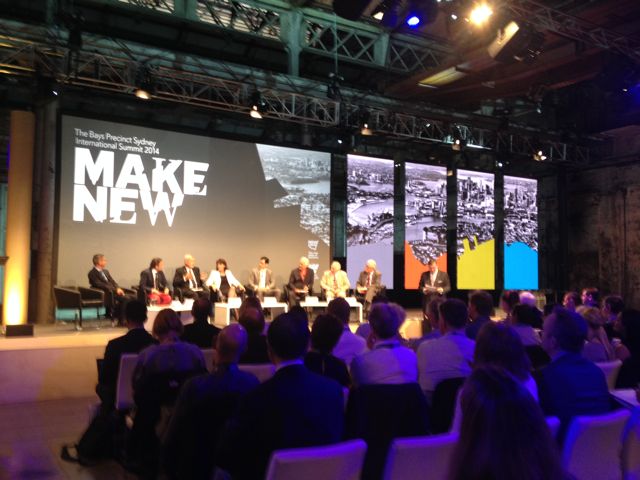
The NSW government this week held the Bays Precinct International Summit, a three day event at Eveleigh Technology Park in Redfern, to work on how to shape up redevelopment for this major site two kilometres from the CBD, containing 80 hectares of land and 94 ha of water. Following are impressions of the parts of the summit on Wednesday attended by The Fifth Estate. Others to give their impressions are the Australian Institute of Landcape Architecture, which had some strong recommendations, and the Greens, already angry.
Wednesday 19 November – 9am Sydney’s Bays Precinct international summit is kicking off with a raft of experts flown in for the invitation-only event and already there’s a maze of controversy hitting the papers.
- See our article last week about how the state government wants to go about redeveloping these waterfront areas it says are degraded but represent one of the most outstanding redevelopment opportunities in the world
- UPDATE: 21 November 2014 – According to Curtin University’s Professor Peter Newman UrbanGrowth’s Bays Precinct international summit this week has delivered on the optimism that has surrounded this event. Here is his take on five principles for the project, Bays Precinct: five principles emerge from summit
A heartfelt story in Fairfax Media about the potential loss of “the beating heart of critical industries” spurred 18 Tweets and 16 “shares” in Facebook by the time we write this at 9 am Wednesday.
Another article, only eight hours old, flagging that 16,000 new homes are planned the Bays Precincts, had 52 Tweets and 112 Facebook shares.
First to hit the press though was Rochelle Porteous, the feisty mayor of the feisty Leichhardt Council on whose patch a big chunk of the 94 hectares of waterways and 80 hectares in the four bays reside.
Porteous said on the front page of last week’s Inner West Courier that she was “extremely concerned” about the plans for the Bays plans. On Wednesday she had upped the ante and said the summit was “nothing more than a sham” in light of the housing “targets” revealed, apparently by the Treasurer Andrew Constance on Tuesday, the newspaper report said.
By the time The Fifth Estate got to the summit the premier had already flagged the treasurer was wrong. No plans had been made; that’s what the summit was for.

10.08 am We arrive at the Eveleigh Technology Park in Redfern and need to show photo ID to be permitted access. (Are the organisers expecting Leichhardt residents to turn up?)
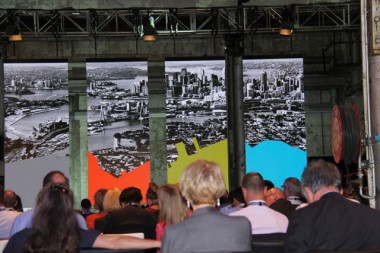
Inside it looks a bit like a theme park, with sets and displays of White Bay power station and other slightly dangerous raised plywood walkways no doubt inspired by bayside boardwalks already snaking around “The Bays.
The staging is strong and colourful.
But more impressive are the people. It looks like a Who’s Who of property, the built environment and placemaking. There’s UrbanGrowth’s David Pitchford; board member Matthew Quinn (previously Stockland’s chief executive), City of Sydney’s Lord Mayor Clover Moore and chief executive Monica Barone, Curtin University’s Professor Peter Newman and rising star Jemma Green (see Green’s current article for us here); Sydney Harbour Foreshore
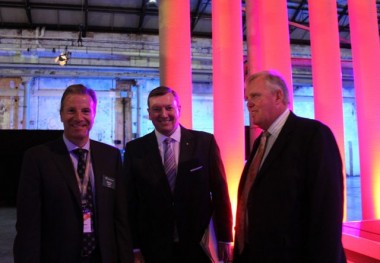
Authority’s Deborah Dearing; Hassell’s Ken Maher; UNSW and the CRC for Low Carbon Living’s Deo Prasad, Green Building Council founders Maria Atkinson and Che Wall. The new convenor of the Better Planning Network Jeanette Brokman is there. And that’s just the locals.
Among the more than 5o stars are: Jackie Sadek, policy advisor for the UK Minister of Cities; Alexandre Sorrentino, who worked for the Marseille development agency Euromediterranee; Charles Landry, from Comedia and author of the Creative City; Lincoln Leong acting chief executive of MTR Corporation in Hong Kong: John Campbell, Waterfront Toronto; Ann-Kristin Belkert, Swedish Green Building Council; Mark Randel of David Chipperfield Architects; Greg Nickels former Mayor of Seattle; Rita Justesen chief of planning and architecture, Copehagen City; and Dr John Keung University of Singapore.
Here’s the website for the Bays Precinct, with more detail.
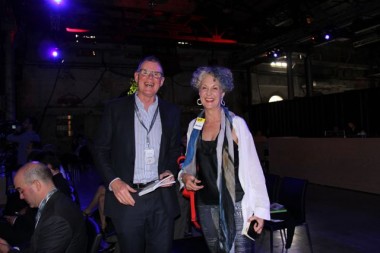
10.15: We bump into Rod Simpson, University of Sydney, who hopes all this attention on the Bays, great that it is, doesn’t leave Parramatta and the West stranded.
“It’s fantastic how they’ve started to look at how the picture for the city can be broadened but the question with the Bays Precinct will be more how we look at East Versus West,” Simpson says.
“This is the real issue because it is slightly a zero sum gain. The more you look at attracting investment to the East the less there is to go around. Yes, you can make the pie bigger but only so much.”
The West is doing it tough, he says. The big thing is to look at how we leverage off Badgerys Creek, and the light rail for Parramatta.
We need to balance the East and West, he says.
“Here is the opportunity to open that up the question of what is the metropolitan context for the bays precinct?”

Of course the residents of Glebe, Balmain and Leichhardt also think of themselves as the West, albeit “inner”, which clearly Simpson thinks a trivial bit of refinement; if only the true “Easts” thought so as well – many don’t know there is another world on the other side of Darling Harbour. Sydney is such a parochial town we think, all wedded to their own tiny villages. Perhaps this is exactly what Simpson is getting at.
(Simpson is always good for some out-of-the-box thinking. At the Waverley Council gig on precincts earlier this year, he took a refined scalpel to the impact of building cities to suit cars, which then gave birth to major regional shopping centres that are completely car dependent. We can create an overlay of walkable, cyclable villages, he said, which left a Westfield contingent squirming, imagining no doubt what would happen if you could walk to the local IGA and strip retail centre in your hood, and it was more fun than driving to the mall.)
We miss the premier’s presentation, which is a shame because we hear he in no uncertain terms ticked off the Treasurer Andrew Constance who announced the 16,000 homes. There were no plans. That’s the official line. That’s what the summit is for – to first discuss ideas, then to get about with planning.
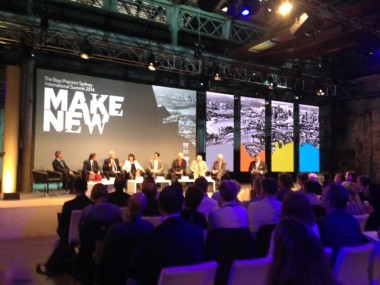
A Panel session
10:50: Panel session with Joe Berridge University of Toronto, professor Robin Hambleton, University of the West of England; Charles Landry, Mark McCrindle, Carolyn McNally, NSW Planning; Professor Peter Newman; Alexandre Sorrentino and Khoo Teng Chye.
Mark McCrindle, trends analyst and demographer, on stage, quotes a resident saying Glebe is like “living in the granny flat of the world but knowing we having global impact”.
Joe Berridge, University of Toronto, says all politics is local.
Before long some local residents demonstrate this. Emphatically. (More further down).
Curtin University’s Peter Newman – always a hit with his clear bell insights, usually ahead of the curve – says why not make White Bay a renewable precinct? Already 70 per cent of global energy investment is in renewables and only 30 per cent in fossil fuels.
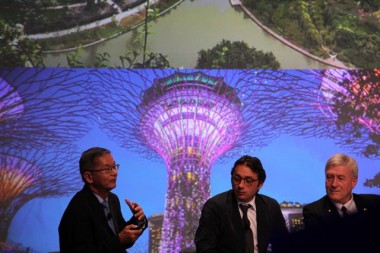
Make the precinct walkable, he says. There’s clear evidence coming through that it’s walkable cities that are steaming ahead, attracting talent and investment.
This gets a clap.
(Think about it, who wants to willingly move to a city where you need to spend an hour or more in a car or any other form of transport just to get to where you can start your working day. Okay, there’s an attraction if you can get to catch a classy train that has coffee aboard, wi-fi and power point for that dreaded short-life battery in the Mac).
Khoo Teng Chye from Singapore’s Ministry of National Development says Singapore likes to work with the private sector. Oh yes, and we do too. Usually to hand out squillions of public dollars when the projects don’t go to plan. And in the case of Victoria with the East-West Link, even if they don’t proceed. Why would the private sector take the risk? Surely that’s the government’s role. Somehow we don’t think the government in Singapore would do PPPs quite in the same way.)
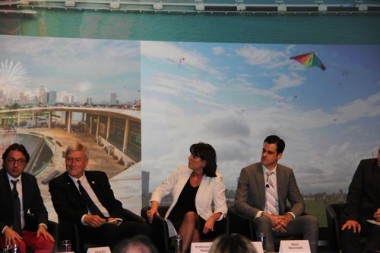
MC and UrbanGrowth chair John Brogden turns out to be quite a hoot and later engages in a hilarious rapport with City of Melbourne chief executive Kathy Alexander who tells us later that she’s soon to leave the post – just as we discover what a talent she is.
Brogden asks the really key question and provocation, “Will vision get mugged by reality?”
We’re a bit taken aback. That’s supposed to be the cynic’s view.
He points out the scale of this Bays patch: four bays, 80 hectares of government land, 5.5 kilometres of waterfront and 94 ha of water.
Someone says Sydney has a history of delivering extremely controversial architecture such as the Opera House – over time and over budget, sacking the architect – but in the end producing something beautiful and wonderful.
One big question is how to incorporate the harbour.
City of Sydney chief executive Monica Barone brings up the governance issue. (She was sensational at our precincts salon – ebook now in final stages).
Governance is something that “wants clear expression”, she says.
“How is this going to make Sydney better for everybody? We have to be able to answer that question.”
And by this, she says, she doesn’t mean the panicky reaction: “Oh my God, we have a whole lot of people who don’t agree; how are we going to organise this?”
One suggestion from the panel is that we need “place-based learnings, people coming together, and it means going into an uncomfortable place. Good leadership recognises that but creates space where that conversation can happen and we can grow.
“This is not the only conversation that is going to happen.”

And “not everyone is going to be happy”.
Alexandre Sorrentino: “Vision is not enough.”
Peter Newman says you can neutralise the community groups who inevitably rail against each other by inviting a third of the people from the electoral rolls.
“They’re the ones who are going to resolve those conflicts.”
Brogden – “Like a jury.”
Newman – “Because ordinary people can see the value in this kind of project. Ordinary people are very good… They’ve got a broad perspective.”
From the audience comes a questioner who wants to pick up on this line. She’s chair of the Leichhardt’s communities group and an academic with various other qualifications, “but also an ordinary person”. “Perhaps not,” someone chimes.
The speaker wants to remind the audience we’re talking public land here – “we’re talking about our local patch. Where is the community voice on this expert panel?
“We’ve been invited at the last minute but there’s no space up there on the panel for us. Where is your 30 per cent.”
Not so last minute, Brogden says.
“First thank you for coming,” he says. “There were a number of community people invited early,” he adds, a bit pointedly.
“How often have you walked on the public land? This is land that’s been sealed from public use.
“We’re talking about land that the public has been denied access to for a generation.
“I don’t think the panel can answer your question. I will answer it by saying there will be a consultation process.”
A suggestion from the panel again (Mark McCrindle?): get the activation happening early. It’s a good way to bring the community along.
“The current residents will not be residents when the project is completed”.
They will be aged about 10 now, he says.
In a city in Bordeaux, says another panellist, a proposal was to shut the roads to traffic on the weekends and bring in pedestrians was met with hostility by local business. But after just the first Sunday with family picnics and soccer-playing on the grass, business urged the practice to remain.
“So we recommend a lot of small steps.” And games or fun activities.
This is also easier on the authorities, who are frightened of big steps, someone says.
Newman agrees: lots of little things. “The public loves it.”
It changes the game.

Chief executive of the City of Melbourne Kathy Alexander stands and is provoked by Brogden who mentions the Melbourne Wastelands (instead of Docklands), saying something about how long Fishermans Bend will take to materialise.
Alexander loves the challenge and hilariously turns away to address the audience, instead, muttering something about the lack of courtesy. She too urges early and prolific intervention in Bays. Yes, Docklands is lacking, she tells the audience. The city was shut out of the process and it’s now engaged in retrofit of the precinct, “which is very expensive,” she says.
In some global cities, says another panellist, the residents have been known to vote for higher council rates, in return for better public benefits of course.
Malmo in Sweden is another exemplar discussed.
“They had this disaster. Then a very creative conservation process to create this new eco-label to transition from industry to eco-friendly and it was about a community vision. They got the cars out. A lot of people flock to see how they did it.”
Residents again – this one also a design academic.
The word from the stage is that the Bays is an area that’s neglected, she says.
“It’s not. We’ve been planning on this since 2005 and wrote our first plan in on 2006.”
In fact there were two more plans produced; the latest in 2010, she says.
“We should not be in any sense of the word thought of as an opposition to the experts.”
So don’t think this is your regular rat-bag fringe element protesters. (In fact we can’t see much of that cliché anywhere these days; from where we sit community groups all seem pretty well armed with professionals and strategic thinkers.)
The speaker from the floor continues – “This area is actually not derelict except in parts, a hundred metres around the edge; the rest is chock full of residents and we have one of the highest birthrates in Sydney and beyond.
“This is entirely public land.”

Lunch
We bump into the always immaculate always cool Sydney Lord Mayor Clover Moore.
We ask her to future-gaze. Don’t so many grand plans in Sydney start with such vigor, vim and optimism? And then fall into the rumpled mess when they cross the paths of the feisty increasingly smart, increasingly professional community groups that don’t like what’s happening?
The NSW planning “reforms” for instance? Or Barangaroo?
“What UrbanGrowth has organised for this conference is very worthwhile and some very worthwhile people have been asked to participate,” Moore says.
“We’ve signed a [memorandum of understanding] with UrbanGrowth to work together on major projects because they benefit the city as well as the state. And I’m hopeful planning can be done differently than they’ve been done in the past. I think we can learn a lot from Marseilles and Copenhagen and probably most cities around the world where infrastructure is put in first, not like in Sydney where it sometimes doesn’t go in at all [still battling to get mass transit to Green Square, with 54,000 residents proposed]. So I’m being optimistic here. I hope the government will listen to the recommendations of these quite inspiring people from around the world to inspire us.”
But will the Bays be controversial anyway?
It depends what the government does.
“I think the mayor of Leichhardt was probably very distressed to read in the paper that there would be 16,000 housing units on the site and we’re just at the beginning of a planning process.
“And why would the Treasurer be making a planning announcement at a time when we’ve got an international conference.
“Of course she would react, and I did too, until I was reassured that there was no basis for that announcement.”
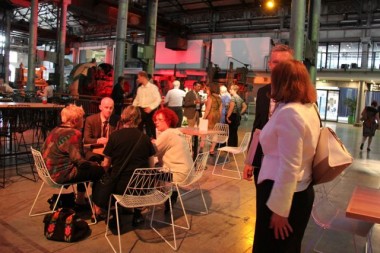
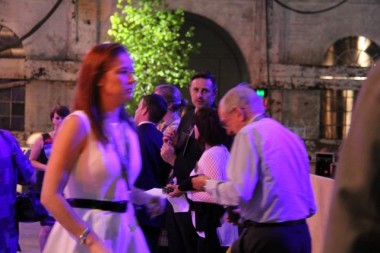
Over an amazing lunch – stunning seafood and other pickings, served in fibrous pocket plates that look they will compost in two day s– there’s generally positive optimistic responses to the summit.
That’s the thing about Sydney; always willing to put aside the past mistakes and problems and forge ahead with a new leaf.
It’s a great initiative, a good start, shows the right intention, so many say. The words tumble out, along with the exhortation that we need to give this a fair go.
Almost everyone feels that way, except for columnist Elizabeth Farrelly, who also picks up on the park vibe and wonders how long it will take until the whole positive show implodes.

Among the crowd there are those who keep trying to add up how much the event cost to put on. One says it’s $2 million (with some confidence). Others say more.
We think this is outlandish until a couple of people agree that nearly all these international guests “fly first class”. Like it’s some medical condition that must be accommodated. Gulp. That means the best hotels too, we say tentatively. “Of course,” is the answer.
A slight annoyance too is that we needed to bring out all these overseas people when so many Australians are in demand for the same expertise abroad.
Is this the cringe factor? We don’t think so. It’s more like marketing and comms in action. A signal that the Bays Precinct wants to prove it plied the world stage for input.
UrbanGrowth chief executive David Pitchford has been clear this is not just for the local community, but the city, the country and yes, maybe even the world.

Pitchford turns out to be a genial looking, kind of man, clearly with some passion for the job, judging by the way he keeps hovering on the edges keeping a bird’s eye view on all the proceedings. It’s a nice, comforting feeling – like someone in there really cares.
Nice to see.
The media releases start
4pm – back to the office and the media releases on the Bays have started to come.
First is from the Australian Institute of Landscape Architects, which says that “a failure to value public space as critical infrastructure would be a failure in planning our city for the 21st century”.
In a week that’s also seen the World Parks Congress take place in Sydney, that’s probably a good idea.

“The Bays Precinct is a once in a generation opportunity to be bold and innovative in creating a sustainable city of the future,” AILA said.
“To be an economically competitive city we must densify and be connected,” AILA NSW president James Grant said.
“This means treating public space as critical infrastructure – the life support for our city.”
“Any development needs to be matched with public benefit that addresses the changing demographic of our cities. We must plan for schools, parks, connected green spaces and connected public transport,” he said.
AILA firmly believes that physical and economic access to public land is an inherent right of the citizens of New South Wales.
In a 2012 review of the Bays precinct in which AILA took park it the conclusion was that “publicly owned foreshore should remain as public space”.
That sounds like disappointment.
20 November 12.17 pm – The Greens’ missive from the 19th finally arrives across the desk. They’re angry.
“Community already shut out before Bays precinct summit starts,” says the headline, written on Tuesday.
“Yesterday at opening of the Bays Precinct Summit – where no community members were invited – the NSW Treasurer announced that 16,000 dwellings would be built on the public lands of the Bays Precinct,” Greens MP Jamie Parker says.
“The Treasurer has exposed the government’s intention to hoodwink the community with bogus consultation,” Parker says.
“These comments confirm what I have been saying since July when UrbanGrowth NSW was announced as the landholder, developer and consent authority.
“Despite the spin and denials, it is clear the Government is determined to ignore the community and the international experts invited to this expensive and exclusive summit and hand over our precious harbour lands to developers.
“UrbanGrowth will turn the Bays Precinct into a developers’ paradise sidelining the community, strategic planning and public interest.
“We have already seen the public interest trashed in the most recent urban development at Barangaroo and it is clear this government has not learnt any important lessons from this fiasco.”
We think of the heartfelt article in the papers days earlier. About the cormorant “that dives for fish” as a “lone kayaker glides past the barges moored along the edge of Rozelle Bay”.
Some see this as “industrial clutter” the article says, but to others it’s “the beating heart of critical industries which are building new wharves around Sydney Harbour, overhauling the cruise ship terminal at Circular Quay and keeping the near-invisible sinews of the harbour in good working order.”
Not to mention the gritty beauty and peacefulness of this “degraded” waterfront land where you can walk and get lost in thought, untroubled by global urban greatness.
This might be a long fight yet.
I was the community representative who was shut down by John Brogden about not being invited to address the audience, to be counted as experts in our own backyards. My response to Brogden’s question about how often I spent time in the ‘utter and complete blank canvas’, the ‘derelict wasteland’ they would have us believe the Bays is, was every day. But this didn’t get picked up by Brogden, who was keen to shut me up – spoilt the ‘once in a generation opportunity’ to build lots of lovely expensive apartments to house his rich mates. Lucy Turnbull, no less, was less than convincing when she claimed we all wanted to live in smaller places, given she lives in a single dwelling unthreatened by a private tollway, aircraft noise, light rail link and the biggest bus depot in the southern hemisphere. Come visit us Lucy and John – we love our place. And, narry a mention of WestConnex at the entire summit, that is until a panel convenor shut me down when I asked Stephen Smith of the Premier and Cabinet Department, saying, ‘you just hate WestConnex’ in front of the entire audience, and then in private, ‘why are you so negative?’. Well, WestCon for one, Barangaroo another, Harold Park… where do you want me to stop? So let’s keep an open mind, you never know, Urban Growth might actually be serious about collaboration!
And to add to my previous comment I will mention the class warfare against Millers Point residents and the absurd, anachronistic and grotesque imposition of the Wasteconnex tollroad on an area that has fought and defeated similar stupid road schemes twice the past.
These roads were bad ideas then and are worse now, and like the equally idiotic East-West link in Melbourne, the Wasteconnex was dropped on the public with no prior notice after explicit election promises about public transport.
This government can’t be believed and can’t be trusted to deliver anything but a scam for its financial supporters.
The government’s agenda is flagrantly obvious here. The inner west is an area where the Liberal Party has no political skin to lose, therefore it’s an area they do things to, not for.
I agree with everything Jamie Parker said – this event was a bogus propaganda exercise. After the excrescence of Packer’s Pecker at Barangaroo this government has no reservoir of trust or goodwill anywhere with urban planning.
Thanks for this run down on the Summit. I was invited as a community member representing the older population. I was invited back in August. While there were clearly issues about how and when community members could or should get involved, it was good to spend two days listening and learning about regeneration projects elsewhere in the world. The key issues for me were the lack of focus on how a governance process would be devised, and no vision on which to hang any of the (great) ideas. I await the next stage and hope there is real consultation with the community.