


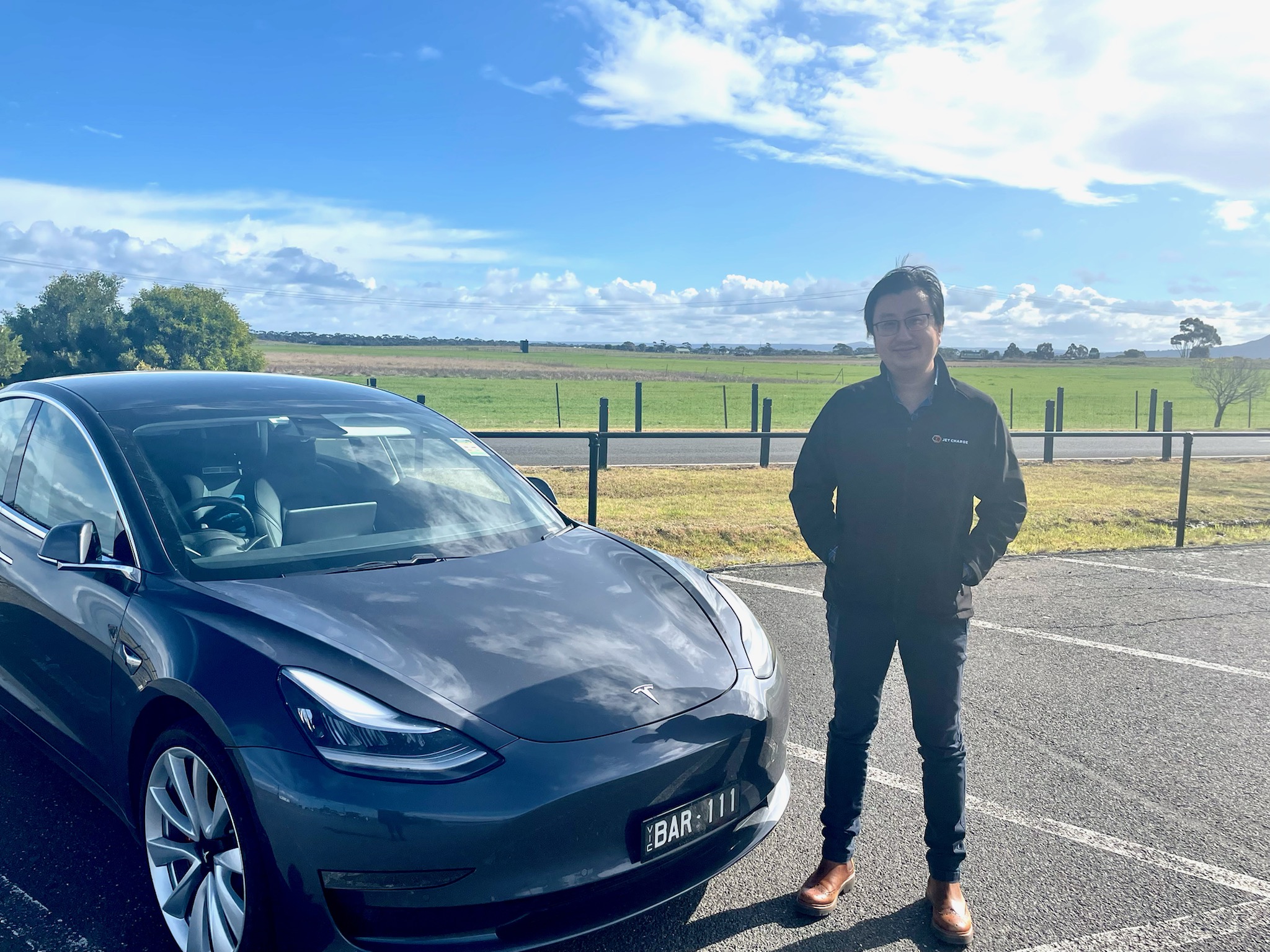
JET Charge started business in 2013 and since then the team has grown to 60 staff plus 150 electrical contractors and become the biggest charging infrastructure supplier in the country. But the company founder can see big issues emerge if too many EVs start drawing down electricity from the grid. But there’s a solution.
EVs: Company founder Tim Washington says it won’t be long before the batteries in electric vehicles (EVs) become a more compelling selling point than getting from A to B.
According to Washington, what’s key is the point at which batteries in EVs can send electricity into the grid at the same time as smart energy management becomes ubiquitous.
He calls this “the convergence of transport and energy”. It’s also known as vehicle-to-grid technology and bi-directional electric vehicle charging, he told The Fifth Estate.
“This will be the first time we can move large amounts of energy from point A to point B without poles and wires. It will give people a big sense of freedom.”
Washington’s company is involved with a couple of big projects to test the emerging technology, including a $2.4 million trial in Canberra, backed by ARENA. This involved a small fleet of Nissan Leaf hatchbacks paid to provide energy services.
The result was a load of 350kWh discharged into the market. “That’s from only 51 cars. We have 15 million cars in Australia.”
Washington doesn’t expect all 15 million cars to provide grid services but when each home can be powered by a car’s battery for two days, it won’t take so many cars to start improving grid energy storage capacity.
Not everyone is sold on the benefits of EVs as portable batteries. Recent research by Australian National University academic Kat Lucas-Healey found that customers, less interested in the decarbonisation challenges facing the grid, and more focused on their own personal environmental footprints, would have little incentive to hook their vehicle’s battery up to the grid.
The business of EV charging
Since Washington founded JET Charge in 2013, the team has grown to 60 (plus 150 electrical contractors) and become the biggest charging infrastructure supplier in the country. While installing charging infrastructure is the company’s bread and butter, it’s also involved with the energy management side of EV charging.
Washington, who is also co-founder of rapid charging infrastructure company Chargefox and chair of the Electric Vehicles Council, says decarbonising the transport and electricity sectors will be expensive if EVs continue to be hooked up to the grid solely as energy consumers.
“One of the problems with the EV transition is localised issues with supply of electricity for charging.”
Every EV charger in a building consumes as much electricity as a two-bedroom home, which poses infrastructure challenges for, say, a 300-apartment residential development that hopes to retrofit EV charging into each carpark.
“The electricity infrastructure is not built for it.”
Even in greenfield sites it’s burdensome as the infrastructure to handle EV charging in each dwelling is so expensive.
The only option, he says, is to upgrade distribution networks. “But that drives everyone’s energy costs up.”
“That’s why we need smarter ways to manage energy on a site. That means charging in off-peak times. When buildings are not using much power, all charging stations should fire up.”
Smarter management of EV loads also paves the way for more renewables in the grid. “You can have a situation where EVs don’t charge unless solar penetration is above 5 per cent.”
In this scenario, EVs are no longer burdens on buildings and the grid and are instead
“assets”.
“Those three hundred carparks are no longer a draw but a generator for the building.”
Washington sees bi-directional charging EVs disrupting the way consumers think about buying cars.
At the moment, people are prepared to pay 100 per cent of the retail price for a new vehicle despite only driving it for 10 per cent of the time.
“It’s one of the only assets that you use so little of, yet is so expensive.” Having the added benefit of bi-directional charging provides so much additional value, he explains.
The transition will take off quickly
Washington predicts the bi-directional charging shift will happen fast. Most EV manufacturers, including Volkswagon, are moving rapidly in this direction. His company will soon introduce the first bi-directional charger to pass Australia’s safety regulations.
Aside from the chargers and cars, Washington says there are no major infrastructure barriers. “There’s no forward planning needed, this will happen really quickly.”
He imagines people will soon get emails from their electricity retailers offering heavily discounted electricity bills if they are allowed to control the battery. This will need to come with the promise to not to ever drain the battery below 50 per cent, he adds.
The scale of the opportunity
Take up by fleets are likely to yield the best benefits.
Vehicles are typically back at charging stations by late afternoon, which is also the start of peak periods, when it’s still hot and airconditioners are on, but solar generation starts to decline, Washington says.