



Australia is at risk of handing control of its mobility system to private companies and foreign interests if it does not properly regulate the impending shift to autonomous vehicles (AVs), economist and commercial property analyst Brian Haratsis has warned.
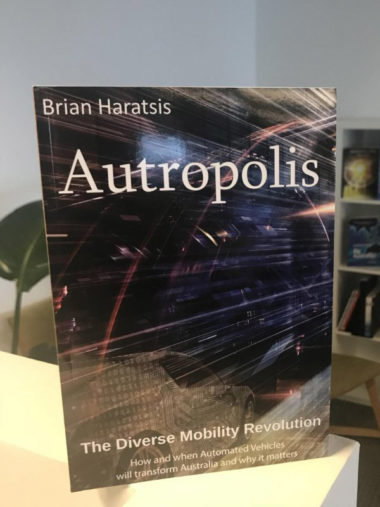
Haratsis has just released a book on AVs – Autropolis: The Diverse Mobility Revolution – which makes the case for a managed transition to AVs that takes a holistic view of mobility based on maximising economic, social and environmental outcomes.

Haratsis is executive chairman of MacroPlan Dimasi, and was formerly a board member of the Victorian Planning Authority, but resigned to focus his efforts on helping the country navigate the disruption expected from AVs, taking up the position of co-chair of the Australian Driverless Vehicle Initiative Policy and Risk Group.
Autropolis asserts that without proper regulation, Australia is in store for drastic increases in congestion – up to 20-25 per cent over the first 10-15 years – and the potential for another destructive “freeway building era”.
Of course there are interests, such as tollroad operators, construction companies and auto makers, that would like nothing more than this scenario, which would occur due to an increased uptake of private AVs, to the detriment of public transport, citizen health and even the entire shape and structure of cities.
“We don’t want to see international companies owning our mobility,” Haratsis says.
This echoes recent warnings from the University of Sydney’s Professor Robyn Dowling, who said a “private autonomy” scenario, in which the majority of AVs will be owned individually, was most likely to occur “if we let those really pushing autonomous vehicles across the world decide what’s going to happen”, entrenching car dependency, urban sprawl and congestion.
Haratsis’s book introduces the concept of “diverse mobility”, where governments work to integrate AVs into a mobility system – including ridesharing, walking, cycling and public transport – through a Mobility as a Service (MaaS) app that can integrate all modes of transport.
Already there is concern AVs could compete rather than work with public and active transport. Haratsis says in the US a rise in rideshare operators like Uber and Lyft has seen a nine per cent shift away from public transport. AVs threaten to increase this dramatically. For Australia, with its spread out cities and relatively low public transport patronage, such a shift could spell disaster, with forecasts of a 15-30 per cent decline.
So how do we get to a system that can successfully integrate all elements?
As an economist, it’s unsurprising his solution is all about effective price signals.
“It’s not that hard,” Haratsis contends. “Every level 4 AV [which can effectively do all tasks but requires a driver behind the wheel] should have a charging mechanism in it.”
Indeed, AVs could be a politically feasible way to introduce road pricing, as part of a shift to broaden mobility taxation strategies, especially as funds from fuel excise tax dry up as we shift to electric vehicles.
Pricing strategies could also include cost penalties to go into areas such as CBDs, and variable pricing.
“We need to build in disincentives.”
A mobility allowance
Haratsis is not in favour of congestion pricing on its own, however, as he believes there are equity issues, and he does not want to see further inequality in city transit systems. He proposes the idea of a “mobility allowance” that could work to manage congestion but also promote social inclusion, active transport and amenity.
He told The Fifth Estate that a household yearly “mobility allowance”, for example $4000 (about 30 per cent of annual household expenditure on transport), could be spent on a range of transport costs – including public transport, tolls and congestion charges – and what was not spent would go to the household’s pocket, taxed at the marginal rate.
“Those that want to use bicycles and walk get a big incentive,” Haratsis says.
He notes it is similar to some European income support models.
Shape cities the way we want
One certainty of AVs is that “the geography of cities changes forever”, but our governments can ensure that it’s done in citizens’ favour.
“We can shape cities the way we want them,” Haratsis says.
In a managed scenario, cities can be developed around parameters governments and communities decide upon. Key for Haratsis is safety, social and environmental outcomes.
He says AVs could lead to the end of the “hierarchy of centres”, with the potential for “inside-out cities” with nodes near the outskirts. The Greater Sydney Commission’s Western City concept could be a “major beneficiary” of this structural change.
In an unmanaged AV scenario, he says there will be “significant additional demand” to live further from the city centre, as people could effectively work in their cars, making longer commutes more attractive. This will cause periurban towns close to freeways to grow.
There will also be a massive increase in congestion points on the network, which could see major residential development shift to near these points (as the 45-minute commute limit is not expected to change significantly). Existing major nodal points, such as regional shopping centres, will also intensify.
Governments must respond
Autropolis contends that the negative consequences of AVs is a “strong rationale” for government intervention in the space.
Currently most intervention has been around removing legislative barriers to having level 4 AVs on the roads by 2020.
“If that’s your main focus then it’s essentially middle class subsidy. Congestion matters less to the rich,” Haratsis says.
“They need to be more proactive.”
He is calling for the introduction of a “National Diverse Mobility Authority” that can “set objectives, set frameworks and get the community involved when we start to deregulate”.
“Mobility crosses so many portfolios. No single silo can plug into it.”
UBER and LYFT are not “ridesharing”, they are simply a taxi service no different to already existing taxi services.
The Taxation Dept has already obtained a ruling from the Courts that “UBER” is a taxi service.