


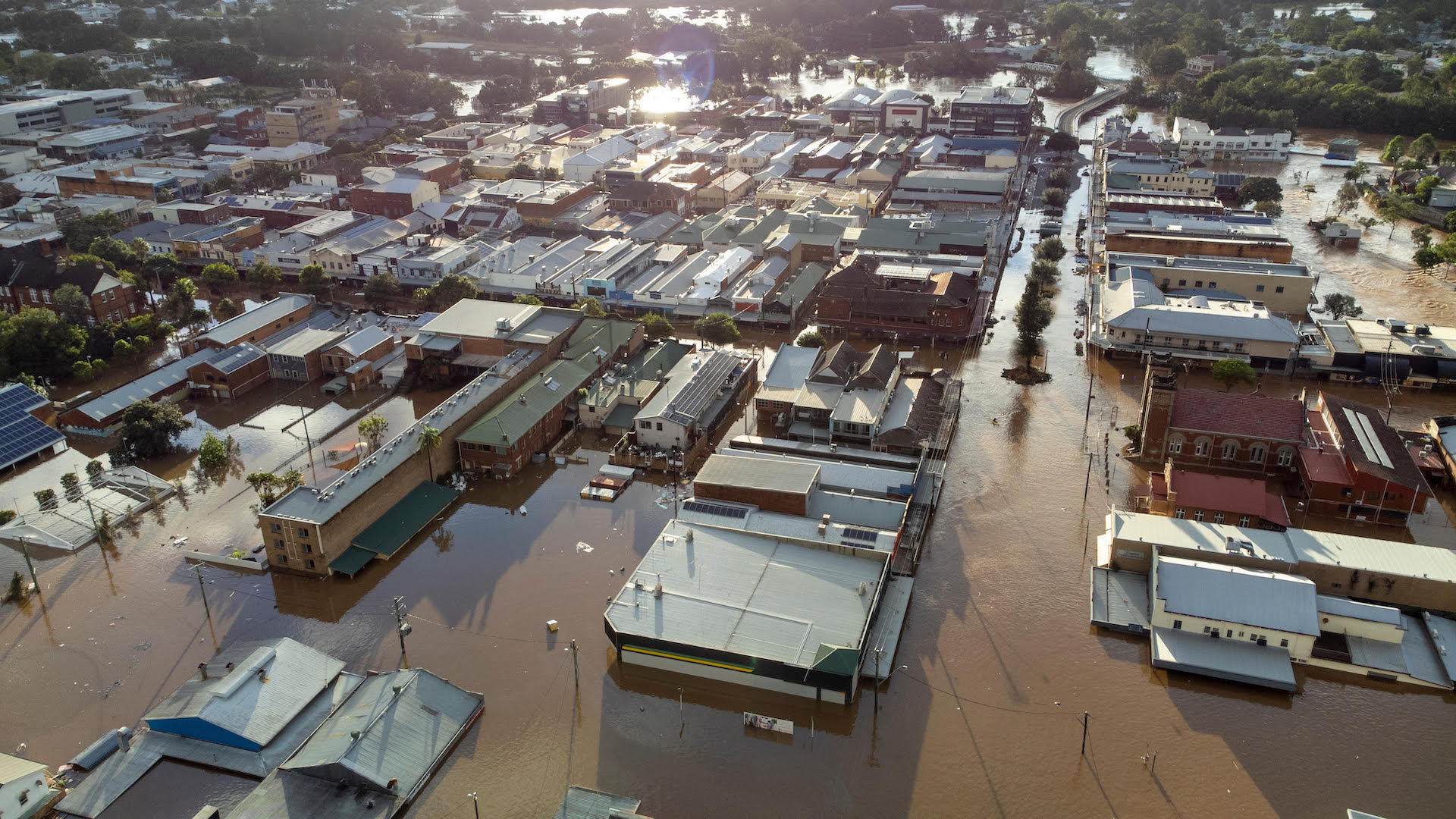
In its five-yearly Productivity Inquiry released last month, the Productivity Commission called for the government to force property owners to disclose physical climate risks when they sell. It’s something that has been on the industry’s mind for years, but few are brave enough to publicly show support for it. Kate Burgess unpicks this vexed issue for buyers and sellers alike.
Picture this: You’re about to buy a house in an exclusive beach side suburb of Sydney. It’s a few streets back from the beachfront, but you wonder whether the property may be exposed to any natural disaster related risks in the future due to coastal inundation from rising sea levels. And what about other weather-related impacts, such as riverine flooding or bushfires?
Urban Greening 2023 on 27 April at UTS, Sydney, will cover “disaster economics” including what happens to real estate prices in areas that are affected by climate disasters – with presenter Tim Lawless of Core Logic followed by a presentation by UTS Dean of the faculty of Design, Architecture and Building Elizabeth Mossop on the reconstruction of Lismore after devastating floods.
With more and more properties classified as high risk for extreme weather impacts from as early as 2030 under current greenhouse gas emission trajectories, this scenario is going to become de rigeur for property buyers all over Australia.
The issue of who should shoulder responsibility for disclosing physical climate risks to property buyers is a vexed question.
Right now, there is no obligation for an owner or their agent to disclose anything.
But if the federal or state governments adopt a recommendation from the Productivity Commission’s latest five-yearly Productivity Inquiry report, property owners would be required to disclose climate risks about commercial and residential properties to prospective owners.
The Productivity Commission wants compulsory building reports to list flooding, sea level rise, subsidence, fire and other natural disasters made more frequent and extreme by climate change
The PC suggests that climate disclosures could be detailed in building reports that are already compulsory in real estate transactions across the country, and lists flooding, sea level rise, subsidence, fire and other natural disasters made more frequent and extreme by climate change as physical risks that should be disclosed.
The influential government adviser went even further to say that cost projections for these impacts could be mapped into property charges such as developer levies to ensure the costs of climate change are being adequately reflected in property transactions.
Karl Mallon, chief executive of Climate Valuation, a firm which consults to banks on property-related climate risks, said both state and federal legislation would be needed to incorporate climate risk disclosures.
First, they would need to be incorporated into state planning instruments such as Local Environment Plan, where any disclosures about the location and nature of the threat could be made, such as the location may be prone to increased coastal inundation over time.
Second, any disclosures specifically applicable to the building’s ability to cope with physical risks would be captured in amendments to building codes, which are federal laws.
“For example, you may have a 149 certificate which certifies you are in a flood zone, but also have a building certificate showing that your house has been designed to withstand the risk,” Mallon said.
If the government acts on the PC’s recommendations, practical considerations will arise. Importantly, who owns the physical risk data and who can access it?
Mallon said the private sector holds most of the data because the government doesn’t have capacity to measure, manage or govern the information over time.
Mallon expects pushback from developers, who may not want to disclose
past behaviours like having bought and developed land on a flood plain
This means the data would not be freely available, raising the issue of who should pay to download a report for a property transaction. Mallon puts the cost of obtaining data at $200-300 per property, which is slightly more than the cost of a strata report for an apartment building.
Mallon said he expects pushback from developers, who may not want to disclose past behaviours like having bought and developed land on a flood plain.
On the flip side, however, he said it could be a point of differentiation for homeowners who have adapted their property to a given physical risk, and making a report freely available to prospective buyers would confirm that.
Climate Valuation and the Climate Council last year made public a searchable database which classifies the number of at-risk properties by suburb, LGA or electorate under a number of different emissions scenarios in 2030, 2050 and 2100 broken down by the five most common climate impacts – riverine flooding, surface flooding, coastal inundation, bushfire and extreme wind.
The accompanying report, “Uninsurable Nation”, classified 520,940 properties as “high risk”, meaning their annual damage costs from extreme weather and climate change would make them uninsurable by 2030 – this is one in every 25 properties across Australia.
Not disclosing such risks equates to misleading buyers”, argued Mallon. The federal government could recognise this by amendments to the relevant sections of the Corporations Act covering consumer protection that the Australian Competition and Consumer Commission administers.
“Should a seller be able to sell an unprotected house in a climate-sensitive area?”
However, placing the onus on the seller is not likely to be universally accepted. Tim Buckley, director climate energy finance at Institute for Energy Economics and Financial Analysis (IEEFA) notes that for building and pest reports, the “caveat emptor” (buyer beware) principle applies, and the onus is on the buyer to obtain any necessary knowledge.
“Sellers are going to be reluctant to provide this sort of information. They’ll be virtually admitting “I bought in a flood plain 40 years ago.”
Buckley believes it is up to the government to provide accurate information, although if they don’t already own it, they will either pay to acquire the data or cover the cost of reports from private providers.
Even more perturbing will be the impact of physical climate risks on a property’s valuation.
McKinsey’s predicts that efforts to de-risk physical impacts will “drive a historic reallocation of capital.”
These impacts are already being felt across the globe. McKinsey’s predicts that efforts to de-risk physical impacts will “drive a historic reallocation of capital.”
Currently, efforts to decarbonise or alleviate physical climate risks aren’t captured in a property valuation – they only appear as an expense on their owner’s profit and loss statement. But what if this spending could be viewed as an investment in the property’s future and be factored in as a capital appreciation?
Creating a NatHERS-style rating for existing homes that property owners could obtain following the installation of solar panels or flood proofing measures could provide objective evidence that could be used by banks in calculating a capital uplift in a property valuation, Buckley said.