

The Holcim Foundation Awards flips the script on the usual award winners and opens up the world for innovative smaller players. And contestants don’t have to be architects. Engineers, sustainability consultants, landscape architects, masterplanners, builders and developers can also submit their project. As long as it’s underway, viable and scalable.
For teams working on small, localised, social-value driven design and construction projects, most international awards programs probably appear quite out of reach. This means some of the thinkers and doers creating the most positive impact often fly under the radar.
The Holcim Foundation Awards aims to flip the script, with a pure play sustainability awards program that is free to enter, has a track record of celebrating scalable grassroots innovations and brings winners onto the global stage at the Venice Biennale of Architecture.
Plus, it gives four winners in each region US$40,000 plus travel and accommodation to the premier event on the global architecture calendar in Venice, Italy. Globally, a million US dollars is being awarded across five regions: Asia Pacific, Europe, Latin America, Middle East & Africa, and North America. The commendation winner gets $80,000.
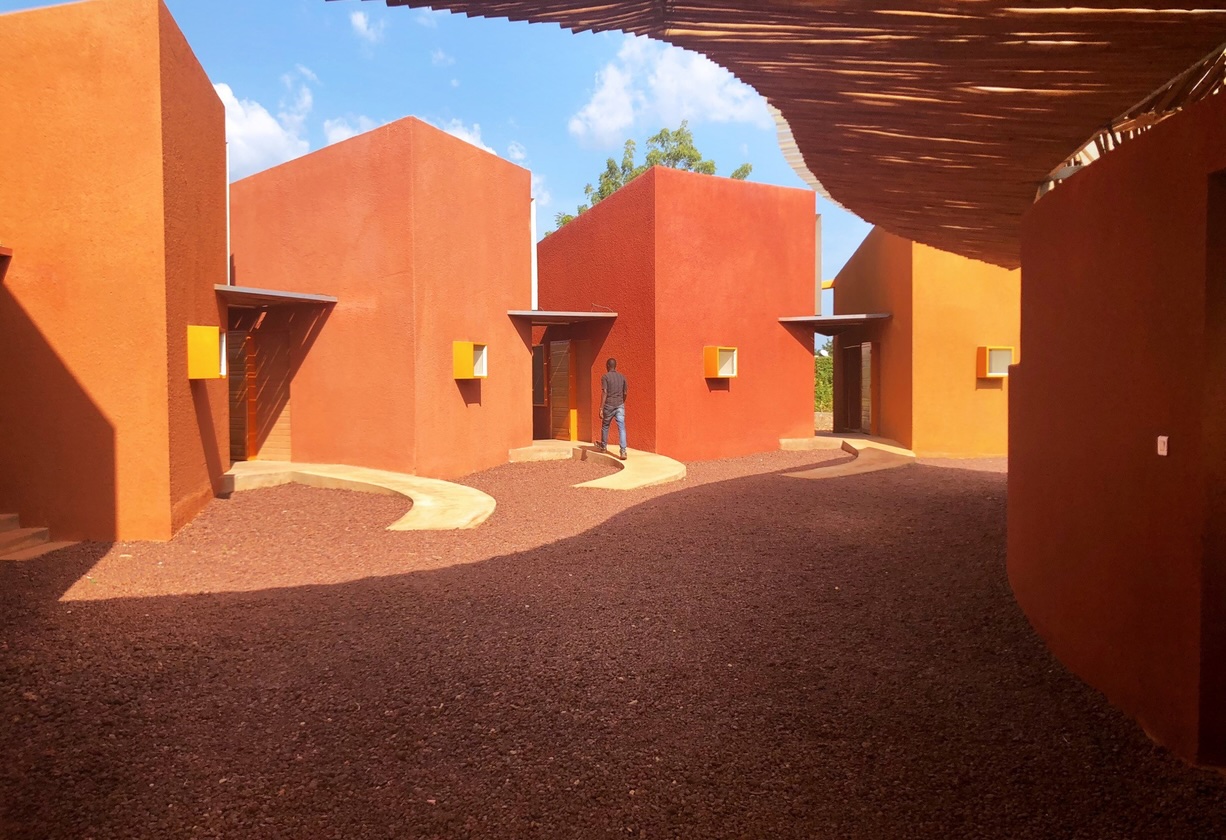
Past winners are testament to the credibility of the foundation’s approach. They include a designer of schools in Burkina Faso in West Africa, a veteran-built community centre in Sri Lanka, housing for the homeless in Vietnam and resilient low-income housing to rebuild a tsunami-destroyed community in Chile.
Atlassian’s new headquarters has also won a gong – one of the few Australia and New Zealand projects to have entered, something the organisers are keen to change.
Advocates for the big shifts
The Holcim Foundation for Sustainable Construction is a not-for-profit, based in Zurich. It advocates for interdependent goals and principles for sustainable construction. The main requirement is the project is underway and that it is scaled globally.

Laura Viscovich, executive director of the Switzerland based foundation says that over the 20-year history of the awards program, the judges look for projects that are the most environmentally sustainable, will deliver positive social impact in their community, and be economically viable.
“Our jury members are also looking at the economics of the project. Is it viable? How will it be operated and maintained, for instance.
“We ask them to look at this holistic perspective of a project, because we do want it to be wholly sustainable in the terms of sustainable development.”
Why it’s not about starchitects
Sydney-based sustainability leader Maria Atkinson who chairs the board of the foundation has been involved with its work for around a decade.
“The foundation started because there was a whole movement around sustainability and sustainable development, but there wasn’t a movement around specific sustainable construction,” she says.
“So, they decided that there were two pillars, and they were education to create awareness and engagement, but also action. And then they wanted to basically reward examples that demonstrated sustainable construction, or elements of sustainable construction.”

A good example is the work of Alejandro Aravena, a past winner of the Holcim Foundation Award as well as of architecture’s highest honour, the Pritzker Architecture Prize.
His Chile-based practice Elemental S.A. created an extremely low-budget, sustainable housing solution for the rebuild of a community destroyed by a tsunami in Chile. His idea was to design “half house” that included the plumbed services – the most difficult part of a house – plus the structure and floor for the other half, which could be completed as budget allowed.
This meant homes could be rapidly rolled out at a low cost, enabling families to be both housed and have agency for completing their homes home at a later date. This “incremental housing” idea has since been implemented in other communities.
Atkinson says the Holcim Foundation judges recognised that the combination of beautiful architectural design, community engagement and challenging the traditional economic model made Aravena’s project something very special.
All the Holcim Foundation Awards regional winners, including four from Asia-Pacific, will be given travel support to attend, giving them a front-row seat to hear about other design breakthroughs.
Telling an authentic story and social impact
The Asia Pacific jury chair is Sou Fujimoto, founder and principal, Sou Fujimoto Architects, Japan. He and the judges will be looking for entries from practitioners that “really have an honest and sincere approach to sustainable design,” Viscovich says.
Australian designers will be up against other designers from across Asia Pacific.
It is not only architects who can enter. Engineers, sustainability consultants, landscape architects, masterplanners, builders and developers may all be eligible so long as the project is client-approved and/or has been commissioned.
Atkinson notes that it’s not just buildings or real assets that are in with a shot.
“If there is an infrastructure project that delivers an environmental or social outcome and not just a piece of infrastructure as we think of it historically, I would encourage such a project to submit,” she says.
“I think what has changed in the last decade is that almost every infrastructure project needs a social licence to be delivered, and if they can have a positive impact on social and environmental outcomes, then we should see more of them.”
She also suggests that unique homes that respond to environmental and social criteria including affordability and innovative adaptive reuse projects should also consider downloading the entry form.
“Uplifting places is a key category, and that’s really about a building design that’s responding not just to the local environment, but also the cultural connection.
“There’re all sorts of things around embodied carbon, energy efficiency, the on-site generation. We’ve got plenty of projects that fit into that category, whether it’s residential, commercial, industrial, it doesn’t matter. It’s the project telling a story.
Projects that people should know about or that should be replicated are the types that “bubble up and attract the jury attention.”
A great career move
Viscovich says the experience of past winners is that the visibility attached to winning the award has been a massive career benefit. It also pays dividends for society and the planet.
“Winning a Holcim Foundation Award just gives an amazing amount of visibility to the project, to the project team and to the issue that the project might be trying to tackle,” she says. In many cases it’s been a real game changer for careers, or for the work that those firms or sometimes individuals go on to do.
“It’s a booster. Obviously, the prize money helps, but more than the money, it’s really the visibility and at a global scale. We also connect them into our global network of 250 winners across the 20 years.”
Enter now – it’s free
The Holcim Foundation Awards are free to enter and registrations to enter close on 11 February next year. But the advice from the organisers is to start soon as the lodgement portal can become quite busy for the final week.
Registrations close at 14:00 UTC, 11 February 2025.
See website for more details.