

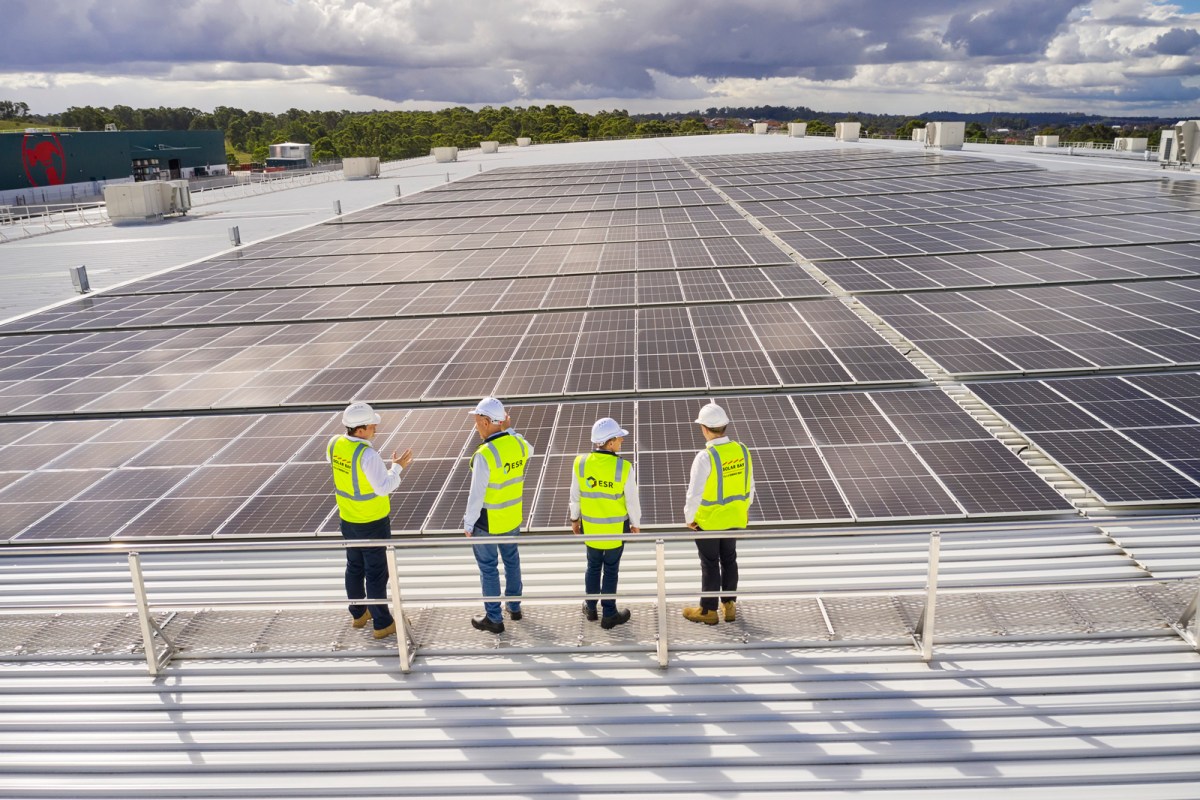
Industrial tenants have particular needs as they increasingly head towards decarbonisation in industrial properties. How do they, and their landlords, rise to the challenge?
Simon Carter, head of ESG for industrial landlord ESR Australia and NZ, and Summer Steward, project manager – ESG for Team Global Express, took to the stage at Buildings as Batteries to unpack some of the issues they each faced from opposite sides of the fence.
Moderator Alison Scotland of the Australian Sustainable Built Environment Council (ASBEC) started the session with a probe into the issue of split incentives in industrial property – where the owner may pay for infrastructure but the major benefit accrues to the tenant.
So far, said Steward, the discussion has largely been limited to who pays for power and who gets the benefits of solar. But going forward, there are more ambitious goals to be considered.
Carter said his company was a relatively new brand to the market. It recently integrated with LOGOS, through which it gained Team Global Express as a “significant customer”. The company now manages $30 million assets under management and a further $18 billion in the development pipeline, “so we’re aggressive in the market and certainly surfing the big INL boom at
the moment.”
In terms of chasing net zero goals, around 99 per cent of ESR’s emissions are either upfront embodied carbon, of which about 97 per cent are concrete or steel, or tenant energy, both of which are scope 3. “Scope 1 and 2 really don’t feature for us … 100 per cent of our landlord-controlled electricity is green power, but it’s not a large amount.”
“For us, net zero is a game of scope 3. So w e need to collaborate with our customers in ways that probably don’t happen in other sectors. There’s a lot of talk about green leases. I’m a little bit cynical about green leases. A lot of people seem to think they’re magic wands. You’ve got to be willing to enforce them to work. But what does work is a really attractive proposition for customers, which we, like our peers, have been actively working on.
“We need to collaborate with our customers in ways that don’t happen in other sectors … There’s a lot of talk about green leases, but they need to be enforced to work”
Despite a solar partnership with Energy Bay, Carter said ESR was currently challenged by not fully knowing what its customers’ charging demands would be at its sites or elsewhere.
“[We] have been actively honing our proposition for customers to try and deploy as much solar as possible. And one of the really interesting challenges there is the uptake of EVs, because many of our customers don’t know what they will be charging at our sites in the future.
“There’s an awful lot of assumptions circulating around the space. Will they necessarily be charging at our sites, or will they be charging at their own purpose built hubs?”
These are important questions because charging requirements transform the energy needs of what are essentially sheds “with racking and some forklifts and lights”.
It’s a “big, interesting challenge” said Carter.
“This uncertainty affects how we size our solar systems. The energy requirements are changing, and we need clarity on charging needs.”
Steward added that sites might not be able to fit trucks or could be expensive to retrofit, so it’s always cheaper to charge “back at base.”
Balancing solar structures on roofs
It was important to note that the new National Construction Code standard now required industrial roofs to be able to support solar panels. In the past they’ve been flimsier and not able to support the weight.
“The challenge is the size of your electrical infrastructure,” said Carter. “Our rooftops, even with one megawatt system … has a lot more roof space.”
What was the prospect of major EV truck rollout given the prices of these vehicles?
Steward said that without the Australian Renewable Energy Agency (ARENA) funding they received, her company would not have embarked on the trial. The costs for EV trucks are roughly double those for diesel trucks.
Future projects needed to make business sense and be “affordable, practical and feasible.”
While EV trucks lose payload, they were generally faster and featured regenerative braking, she added.
Performance often also depended on the driver and how much weight the vehicle carried.
Were landlords starting to be choosy about tenants who did not meet the ESG or net zero aspirations?
Carter said that that while he has yet to reject a tenant who wanted gas, his company was thinking more about the net zero transition. The challenge tended to be not so much whether the tenant wanted solar, but whether the landlord owned enough solar.
Landlords also needed to consider embodied carbon, and now with heavy vehicles and bigger, thicker concrete stands, that was another emerging problem.