


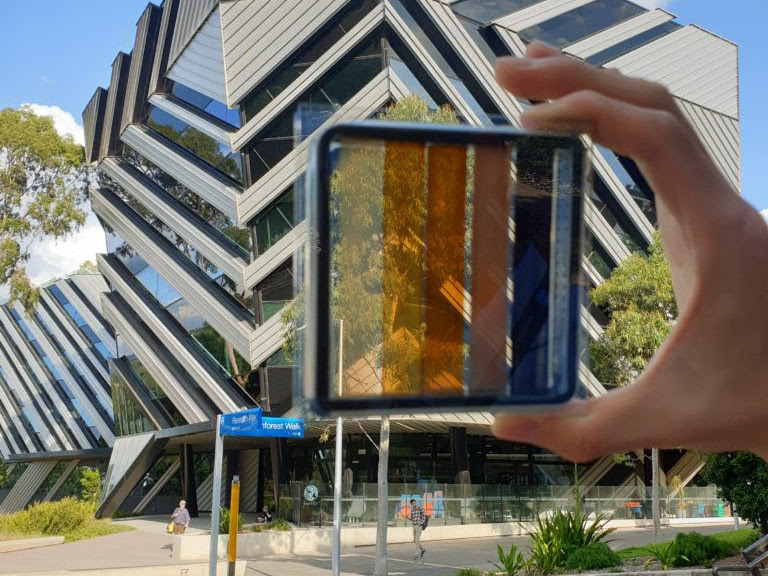
Solar power-generating windows are not new but a recent breakthrough could make this technology cheap, stable and efficient enough for widespread take up.
Research supported by ARENA and led by Professor Jacek Jasieniak from the ARC Centre of Excellence in Exciton Science and Monash University has managed to produce perovskite solar cells that have a decent energy conversion efficiency – similar to solar panels – and that are also see-through.
The researchers said two square metres of the semi-transparent solar glass will generate about as much electricity as a standard rooftop solar panel.
“Rooftop solar has a conversion efficiency of between 15 and 20 per cent,” said Professor Jasieniak.
“The semi-transparent cells have a conversion efficiency of 17 per cent, while still transmitting more than 10 per cent of the incoming light, so they are right in the zone.”
He said that when tinted to the same degree as glazed commercial windows the solar glass would generate about 140 watts of electricity per square metre.
Investigations are underway to see if the new technology can be built into commercial products made by Viridian Glass, an Australian glass manufacturer. The goal is to have the product available to purchase in under 10 years.
Professor Jasieniak expects the economics to work well in multistorey buildings because large windows are already expensive and the added cost of using the semi-transparent solar cells will be marginal.
“But even with the extra spend, the building then gets its electricity free,” he said.
The researchers expect the glass to be a “game changer” for planners and designers, and might alter the way buildings are designed. Buildings might have to be reorientated, for example, so that glass walls face the sun.
The only downside is that the darker the glass, the more energy it’s capable of producing. This means architects will need to make decisions about how much light comes into a building versus how much energy the glass produces.
What’s different about this glass?
There are already semi-transparent solar products on the market but the researchers said they tend to be “very expensive, unstable or inefficient”.
The new glass design replaces a commonly used solar cell component, Spiro-OMeTAD, with an organic semiconductor that can be made into a polymer. The problem with Spiro-OMeTAD is that it “shows very low stability because it develops an unhelpful watery coating”.
Researchers said the organic replacement produced “astonishing results”.
I’d be interested to know the heat transfer of the glass compared to similarly tinted glass. If radiant energy is being converted to electricity, it perhaps performs better, leading to a double whammy of reducing A/C costs.