


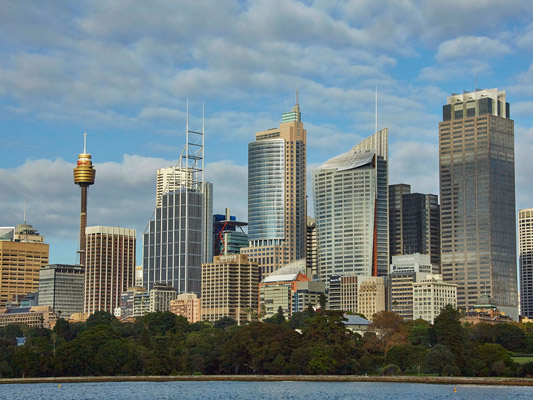
The City of Sydney has opened the door to supertall buildings with a plan that could see CBD buildings reach in excess of 300 metres, part of the largest review of CBD planning controls since 1971.
The Central Sydney Planning Strategy identifies areas for concentrated “tower clusters”, where buildings could grow in excess of current height limitations while still preserving the city’s solar access planes.
Height limits of buildings on the western edge of the CBD are also recommended to grow from the current 80 metres to 110m, which the plan says responds to the changing character of the area and the NSW government’s investment in rail infrastructure.
The council says the new strategy could unlock 2.9 million square metres of additional floor space and provide for 100,000 jobs.
Residential and serviced apartment floor space in large developments would be capped at 50 per cent to ensure a “genuine mixed-use outcome”. Controls for tower separations would also lead to slimmer towers to improve sun access, air flow and outlook.
Lord Mayor Clover Moore said the plan struck a balance between residential and commercial growth.
“Past planning strategies have successfully increased the number of residential buildings in the city centre, but now we need to protect and increase the amount of productive floor space to maintain Sydney’s economic vitality and resilience,” she said.
Commercial development, she said, needed to be “protected” from high-priced residential on larger scale sites.
She said development would be “balanced with the provision of social infrastructure and amenity”.
“Ensuring infrastructure keeps pace with growth, in terms of transport, cultural and social institutions and affordable housing, will help keep our community strong and maintain our standards of living,” Ms Moore said.
On affordable housing, the council wants to deliver a modest 300-520 affordable housing units through requiring developer contributions, which has only occurred at Green Square and Pyrmont previously. The council says this could figure could increase “significantly” if its Central Sydney Affordable Housing Program were extended to state significant development in the area.
Sustainability agenda
Sustainability is a key plank of the plan, with floor space bonuses to be given for sustainability initiatives and minimum NABERS levels set for new office buildings, with a view to a trajectory of net zero buildings.
Actions sought under the plan include:
- having large residential projects comply with higher BASIX targets
- new office development to have a minimum five-star NABERS rating
- the requirement for major new development sites to push for net-zero energy precinct outcomes
- ensure major developments include capacity to generate 10 per cent of total energy onsite
- the investigation of initiatives that would reward the retention, refurbishment and upgrade of older office assets
- Ensuring precincts are designed for the collection, treatment and reuse of locally generated wastewater, stormwater and rainwater for non-potable use
The City’s director of planning, development and transport Graham Jahn said the proposal had already had warm responses from government and industry, including Premier Mike Baird, planning minister Rob Stokes, the Department of Planning and the Sydney Business Chamber.
State government support will be crucial to the strategy, including on raising sustainability outcomes.
The move was also welcomed by the Property Council. NSW executive director Jane Fitzgerald said it was a long-awaited step that would allow Sydney to “realise its full potential on the world stage”.
“The strategy includes some excellent proposals such as removing long-term height controls which have constrained the CBD’s growth,” she said.
“Sydney needs a sensible and sustainable supply of commercial office space, and the proposed incentives for commercial development reflect the future demand that our geographically constrained CBD faces.”
She did, however, argue against “more property taxes” to provide for affordable housing.
The plan is set to go to the council’s environment committee on Tuesday 19 July, and is expected to be passed by the full council of 25 July.
The plans 10 key actions:
- The expansion of Central Sydney to reabsorb The Rocks, Darling Harbour, Ultimo (The Goods Line, Central Park and UTS) and Central Railway to Cleveland Street
- The prioritisation of business floor space employment by expanding the city’s commercial core west to Barangaroo and south to Belmore Park
- The management of small sites to consider wind, sunlight, public views and setbacks
- Progressing plans for three new squares along George Street – at Circular Quay, Town Hall and Railway Square – to provide precincts that improve the liveability of the city centre
- The strengthening of public open space, accessibility and connections to make moving around the city easier and more enjoyable for workers, residents and visitors
- The promotion of design excellence by requiring all towers and major developments to go through a design competition process
- Ensuring transport and social infrastructure keeps pace with growth, and that Sydney is inclusive of all members of society by the introduction of an affordable housing levy
- A move toward zero net energy for all buildings through sustainability incentives for floor space ratio bonuses and minimum NABERs standards for new office buildings