


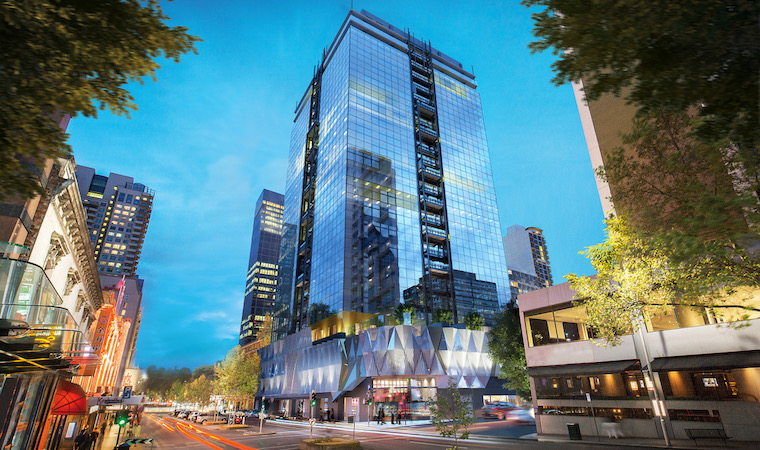
LaSalle Investment Management is turning an outdated 1980s commercial building into a sustainable success story, showing that millions of dollars in capital expenditure (capex) is not needed to create premium outcomes. Here’s how they’re doing it.
Breathing new life into Melbourne’s 222 Exhibition Street building through a targeted sustainability upgrade was seen as key to commercial success when LaSalle Investment Management bought the property from AMP Capital in 2015.
According to LaSalle Investment Management associate director Gareth Sneade, sustainability improvements are part of a wider mandate to “drive innovation in sustainable property investment”.
And it’s not just to make them feel good. Sustainable properties attract a wider range of potential tenants and are judged more favourably against buildings with poorer operational performance.
“Tenants are continually raising minimum requirements for their premises’ environmental performance, often driven by pressure to improve the holistic environmental performance of their own business,” Sneade says.
“The building upgrade works allow the asset to be considered by a broader group of potential tenants, which in turn minimises leasing downtime.
“Improved building efficiency also leads to lower building running costs, which in turn reduces the tenants’ cost of occupancy. This puts the asset at a financial advantage when assessed against other leasing opportunities in the market.”
Rare: A long-term, asset lifecycle approach to sustainability
LaSalle appointed Knight Frank to manage the property in September 2015. One of its first steps was to undertake extensive analysis of the building’s systems and performance.
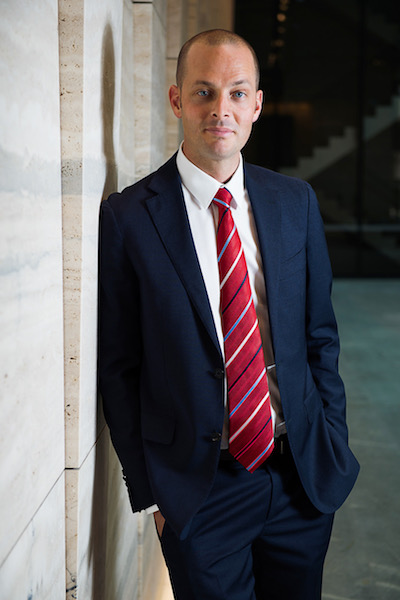
It engaged environmental consultancy Ausnviro to take a lifecycle review of the building’s plant and systems, and develop a NABERS Upgrade Pathway Report for improving the building’s sustainability performance.
Priority was given to optimising existing services and upgrading end-of-life plant with new technology, with a focus on improving energy use.
By commissioning a detailed engineering investigation before developing a proposal for works, the owner was “going against standard market practice”, Ausnviro managing director Jay Gualtieri says.
This ensured LaSalle got the biggest building performance improvements for its investment.
“LaSalle is taking a long-term approach, rather than simply considering immediate budget impact. It is so rare in this game. In most cases, buildings are flipped within two or three years. There is not a lot of long-term capex thinking,” Gualtieri says.
Getting high NABERS ratings in existing commercial buildings
High NABERS ratings are necessary for any quality building that wants to attract high calibre tenants. But while it is standard practice for new offices to target high NABERS performance, there can be many challenges for existing commercial buildings.
“A lot of existing buildings are not set up for NABERS ratings,” Gualtieri says. “There is a lot of baggage in existing buildings, which can include redundant metering and ‘the way things were done back in the day’ habits.
“For another, existing buildings are generally occupied. This makes completing project upgrades a logistical nightmare. Tenants come first and comfort conditions are a paramount priority.
“Standard market practice is to tackle these challenges with a typical ad-hoc approach to upgrades. This does not yield NABERS improvement in the short to medium term.”
222 Exhibition Street had a 3.5 Star NABERS rating when LaSalle took it over. It’s currently at 4 stars, thanks to already completed works and maintenance, and while the target rating can’t be released at this stage the building is aiming to go higher.
Stack effect “made a difference”
The comprehensive roadmap for the energy upgrade was completed by Ausnviro at the end of 2016, and the consultancy subsequently won the tender for project management and engineering design of the project, as well as a subsequent year-long measuring, monitoring, verification and optimisation period.
Some of the works detailed in the roadmap include chiller upgrades and boiler upgrades, with new heating hot water coils on the air handling units.
There is also a controls strategy around optimising the mechanical systems, and a strategy for optimising the cooling towers. Air flow strategies are also another element.
“There was a big stack effect in the building,” Ausnviro project manager Trent Taylor says.
“The building’s relief air fans were actually dropping all of the conditioned air outside. So, a relief-air to returnair pathway has been designed, meaning the HVAC plant is not constantly conditioning new outside air.
“Some things just needed optimising and changing, and they can have a big impact on energy without having a big impact on the budgets.”
These operational aspects have already “made a difference” in energy use, Taylor says. Having everything in the building metered allowed for a “good in-depth study”.
A maintenance offensive
A new “offensive” approach to maintenance was also developed and implemented, Knight Frank Asset Management Services senior facilities manager Matthew Graham says.
This “predictive maintenance” regime uses the Bueno Analytic Platform technology, a key tool for the optimisation phase

following capital works and for identifying maintenance issues before they become problems, he says.
Bueno’s cloud-hosted software remotely monitors a building’s BMS and building systems, and is supported by engineers that “triage” anything revealed by the data before alerting the building manager.
Graham says it will be used as part of setting up reporting, both for verification of the energy conservation measures and performance, as well as ongoing reporting. The software has also provided the team with nine months of data on the building, which helps to identify any anomalies.
The predictive maintenance program developed for 222 Exhibition Street covers HVAC, the BMS and other mechanical plant.
It’s something that has not been tried before in a commercial building in the city, Graham says. The regime has been in place since September 2016, and is already generating “massive benefits” including time and cost savings and plant reliability.
Getting those premium aesthetics and wellness outcomes
Another element of the major refurbishment includes a full lift modernisation, as the current ones are at end-of-life. This is expected to yield significant energy savings.
The main entry foyer will also undergo major redevelopment with the new design reflective of a modern premium office environment. A new tessellated façade detail will wrap the building and create a sense of visual interest with its form and scale.
In tackling a growing wellness demand, a brand new end-of-trip facility will provide greater amenity and upgrades of the common area’s bathrooms and lift lobbies will also be undertaken. On level seven, there is a podium space that comprises around 2000 square metres of outdoor space.
Graham says concept plans have been developed for this unique CBD opportunity for outdoor space. These include potentially an elevated urban park or childcare centre, however, it is essentially a “blank canvas” for any tenant who may take this space.
Graham says the sustainability improvements will be ongoing due to the analytics platform.
“All of these little improvements will be happening in the background; they are all built into the maintenance contract,” he says.
There are other aspects of the building’s performance he also has his sights set on, such as waste.
Drawing on some of the best practices outlined in The Fifth Estate’s Waste ebook, Graham has worked with the building’s cleaning contractor to put in place a regime of daily bin weighing and weekly contamination inspections.
That data can then be used to work on educating tenants about better waste management.
He is also scoping the addition of recycling facilities for mobile phones, batteries and e-waste, and working with the consultants on a series of information resources for tenants and the FM team. A supplier has also been sourced that can take used paper towels for recycling.
Million of dollars of capex not necessary
Graham says the example being set by the building has more relevance to the wider market than a brand-new high performance building going up. It shows that millions of dollars of capex is not necessary to improve performance. What’s required is “the right strategy”.
From the owner’s perspective, building performance is something investors are increasingly savvy to.
“It is no longer just the early adopters looking at energy efficiency in potential investments,” Sneade says.
“Buildings performing at the high end of the sustainability spectrum have become increasingly attractive to almost all types of investors. The market has come to expect a minimum level of environmental performance and this level continues to be raised.”
Upgrades are expected to be complete by December 2017 or January 2018.