


When Andy Bowen joined his family company in 2015 after a career in investment banking, including as vice president with JP Morgan in New York, it was on the proviso that he could lead growth and innovation.
After a 128 years history of supplying timber and building products, an existing chain of stores throughout Melbourne, and brother, father and uncle all ensconced in the business, you could imagine it was a reasonable proviso for an ambitious young man to ask for.
Today, Bowens is among the biggest 150 privately owned companies in Australia. It has 16 stores throughout Melbourne, it has a lightweight timber prefabrication business that Bowen claims is the most technologically advanced in Australia, and it’s got a major digitalisation strategy under way. And to cap it off there’s been more growth in housing demand than anyone could have hoped for.
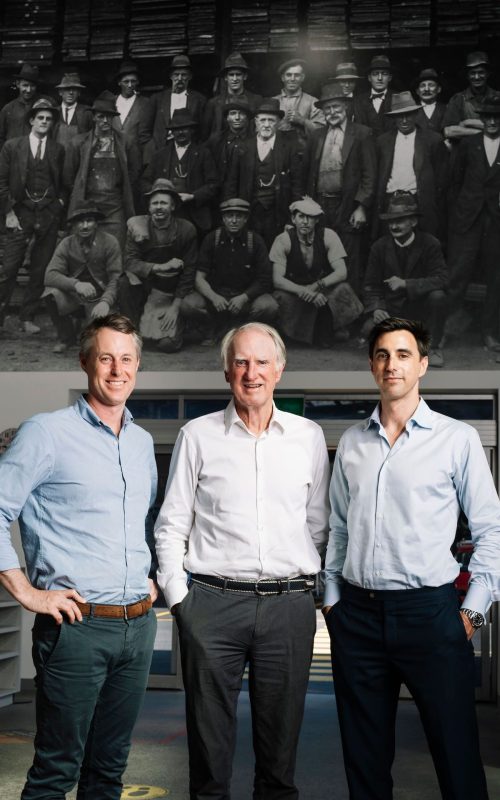
In a phone conversation on Tuesday Andy Bowen ranged through a bird’s-eye view of life from the inside of the building materials supply business and some of the strategies for the future.
Timbertruss, the company’s manufacturing facility at Corio an industrial suburb of Geelong, 66 kilometres south-west of Melbourne, is clearly a jewel in the crown.
It just had 1386 solar modules installed, while the 16 stores throughout Melbourne have also had their renewable energy profile boosted with power factor correction units. All up, a $1.2 million investment that should slash about a third of the business’ energy consumption if all goes to plan.
It’s a nod to reducing what Andy Bowen acknowledges is the construction sector’s 18.1 per cent contribution to national greenhouse gas emissions and part of his pivoting the business to appeal to more young trades people coming through the industry.
Part of that strategy also includes digitising the business with online product sales and distribution. This is not as easy as it sounds.
Bowen says this is partly because of the complexity of building materials. The digital team, which is very talented, he says, has already logged around 42,000 products, including more than 7000 doors, but the job is still not quite half way done.
Part of the challenges of digitalisation include the extreme variability of products.
“It’s very complicated. If a product doesn’t fit into a box for distribution, it’s very challenging,” Bowen says.
“We’re distributing products nationally but only those that fit in a box and that can go through a third party, such as Australia Post.”
This makes the company a logistics company as much as a supplier of materials.
Business is doing very well
There’s been a surge in the business in the past two years, which probably reflects the Covid stimulus boost to home building. Forward orders from builders are up 250 per cent, though it’s possible they’re just getting better organised and hoping to beat supply chain constraints, Bowen says.
Turnover last year was around $417 million, after double digit growth compared with the previous year. The same range of growth is expected again this year. Bowen won’t be more specific, but still, he’s surprised at the strength of the market.
Usually when one state is down, another is up, he says, but this time all the markets are moving in unison thanks to the stimulus packages.
“I’ve never seen all these markets moving at once but because of the stimulus it’s kicked off everything around the country and created a wave of issues both good and bad.”
Among the negatives is the lack of tradies to deal with the surge, but then again, one way to speed things up is to go to off-site construction.
Bowen is riding the wave. There are two new stores planned and some refurbishment or redevelopment of others. Staff is at about 1200 but “like everybody else” would be bigger if the business could find the people.
The prefab business is probably the most advanced in Australia
In the pre-fab business it gets “really busy” when the market is hot, so much so that there’s a 24 hour operation required to deal with the demand, especially for wall panels, Bowen says.
“Timbertruss does incredibly well. A lot of technology there is now automated.” And contrary to what you’d expect, when more automation is introduced and productivity increases, companies can take on more people instead of needing to lay off staff. That’s because the efficiencies have driven more capacity to satisfy demand and there’s more people power needed to ensure quality.
“You can see the signs by the amount of stock in the yard. Volumes have grown, we’ve added shifts and grown.”
Timbertruss was purchased by the Bowens company in 2007, but in around 2017 it bought some land from the local council and embarked on a new facility purpose built for sophisticated automation.
Exactly what that looks like is not widely shared. He doesn’t let anyone take cameras into the facility and he doesn’t like anyone to see the configuration either.
“What we do is a little different. We turn around really quickly.
“It is the most advanced manufacturing facility in pre-fab building in Australia.
“And we don’t think there is another factory that has the integrated system we have.”
Sourcing (and no doubt guarding) the tech are general manager Penny O’Leary and business manager Steve Collier. O’Leary is a lawyer by background and both have been there long term (O’Leary for 27 years).
The technology comes “from all over the place – Scandinavia, Germany, the UK.”
Among the products are wall panels and timber floor cassettes that Bowen says, “slot straight in; it speeds up construction time.”
The company’s customers include some of the biggest in Australia but generally there are single home developers such as Simonds Homes and those involved in medium density multi residential units. The company is definitely not in the cross laminated pre-fab timber business that has taken its share of victims in Australia and mid last year, the giant US-based Katerra, Bowen is keen to point out. That is a tricky business with very long lead times that can be a problem.
The future is with more women in building and definitely pre-fab
Part of Bowen’s strategic planning for the business is to appeal to women.
The business notices many of its customers online are female and it holds events to attract women in trades. He says there should be more. So far about 20 per cent of staff are female and Bowen says he’s the first to admit “it’s not enough”.
He agrees the future is inevitably more prefabrication. There are so many benefits – from less waste to less pilfering on site (a big problem it seems).
“Many people would agree that it’s the way forward. Certainly, when it comes to large volume multi residential buildings.”
But when it comes to bespoke buildings, not so much. “The efficiencies are not there because so much of it is automated; it’s more to do with the design.”
Digitalising the business, he says, is key to growth. “I think our customers appreciate it and our customers and staff appreciate the direction we’re heading in. We want to grow and we want to grow responsibly.”
However, whether that will include stronger environmental credentials of the timber provided to customers, is not something Bowen is keen to discuss without some time to consider.
It’s no surprise – it’s a tetchy topic. Under supply constraints, it’s understandable that builders and tradespeople will take whatever they can get, but in five years’ time there might be a quite different story to tell.
But as pressure grows on the development industry to take responsibility for the 70+ per cent of emissions it’s responsible for overall, you can bet it will remain a tetchy topic.