


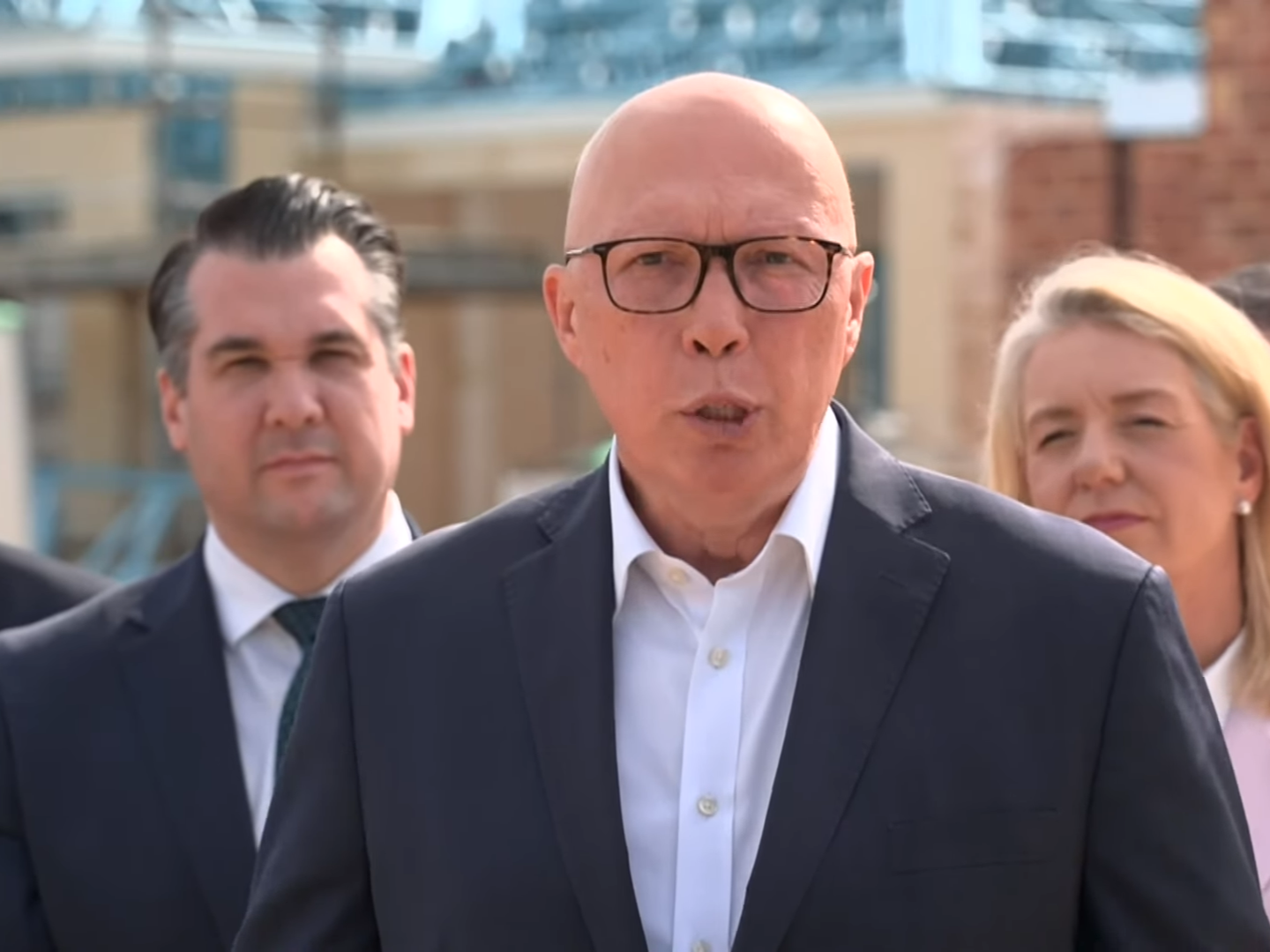
Federal opposition leader Peter Dutton is on a roll – with misinformation and furphies masquerading as silver bullets. First came the nuclear energy nonsense – promising that there was an easy fix for the energy crisis and that we could all relax and go back as we were. Now he’s spreading the fantasy that halting building standards will magically make housing more affordable.
On Saturday he told the nation that if elected he would fund more urban sprawl. And that he would also freeze the National Construction Code for 10 years, offering both as solutions to the housing crisis.
First problem is that we urgently need apartments for housing near city areas where people in low paid jobs need to work. Not in far flung urban sprawl sites that condemn people on lower income to the false narrative of cheaper upfront housing, only to face massive toll fees to drive to work, before we mention the cost on environment and infrastructure.
With the second part of the announcement, to freeze improvements in the NCC, these buyers and occupants will soon also find they also have massive energy bills because these houses can’t protect them from extreme heat in the heat sinks of Sydney and Melbourne where most new development will be.
Nor will these houses in the future have regard to the dangers of flooding or fire, which was the big ambition for the NCC’s future over the coming decades.
The call to freeze the NCC as most alarmed the industry’s sustainability and quality advocates (seen an interchangeable terms for most people these days).
But it was the constant singular call from housing and construction lobbies like the Master Builders Association, the Housing Industry Australia and the Urban Development Institute of Australia that was pulling Dutton’s strings.
Their claim is that the better standards are too expensive. Experts say that’s just not true and that these groups consistently refuse to share their costings.
But Dutton ploughed on regardless of the lack of evidence.
“The Coalition’s freeze will provide certainty to the industry and let builders get on with the job of building homes for Australians,” he said.
Master Builders chief executive officer Denita Wawn who flanked the Opposition Leader said, “A pause on unnecessary code changes that increase cost and complexity without meaningful improvements in standards is a positive step.”
She might have added that it was lobbying by her members and their peers in the Housing Industry Australia that dumbed down the last NCC in 2022 so it was at just 7 stars NatHERS instead of the 10 stars that many hoped for, given the climate crisis.
Regardless, the costs attributed to the better standards are continually blown out of proportion by these two bodies while insiders say they can be achieved at very little cost compared to the savings they generate in energy.
The Opposition, channelling the lobby groups, said the 2022 code added $60,000 to the cost of a house to bring it to 7 star NatHERS, but the Australian Glass and Window Association told the ABC the average was closer to $5000.
Not everyone alongside Dutton may have known what was coming
Also standing alongside Dutton at the weekend announcement was the Property Council of Australia, which is understood to have supported the public funding of infrastructure for greenfield development but was blindsided by the proposed freeze on the NCC, sources told The Fifth Estate.
Serious people in the sustainable property world were also gobsmacked.
A spokesman for industry minister Ed Husic said the minister was expected to signal his response to the proposal on ABC’s 7.30 on Tuesday night.
Other well placed sources said they now feared other states would follow the dumbing down of standards, first flagged by South Australia and reported in our story in early August.
South Australia announced it would freeze the NCC for lower income buyers in the Mt Barker region to 2019 standards of energy efficiency. Was this a way to externalise the cost of heating and cooling to buyers? Yes, we were told. Buyers could retrofit their homes later.
But how do you retrofit under slab insulation? asked another source on Tuesday.
Now all eyes are on Queensland to see if the Liberal National Party, which is odds on to win the state election on Saturday, will go the same way as Dutton wants. Its leader David Crisafulli has certainly not fallen into line with Dutton on nuclear. But this is the state where the MBA has been loudly protesting the “unwarranted requirements” of the 2022 NCC.
Another state that’s gone wobbly is Tasmania. It’s chosen to slow down code improvements and joins NSW in the pushback. The latter chose to adopt the energy provision in the 2022 code but not the liveability standard, which is essentially access for people with disability, or prams or temporary incapacity – that’s to say most of us at some time.
The standard called for relatively simple things such as a reinforced wall in a bathroom that could one day be fitted with a safety rail, step-free entry and absence of a shower hob.
By contrast Victoria is holding firm on a progressive agenda, and Western Australia likewise but from necessity – it’s commitment to the NCC is baked into legislation and even if the government wanted to rewrite the rules it would struggle to do so in time before the next state election in March next year.
Resilience at risk
A fallout from the rogue states a massive failure of the big harmonising agenda earnestly wished for over decades by leading advocacy groups such as the Property Council.
It was only a few months ago that we published the news that all of Australia’s building ministers had agreed that the NCC would progressively improve resilience in housing and other buildings. After years of struggle.
So what happened?
The Voice happened. And Trump. And the rolling, roiling aftermath of the decade of abject negativity promoted by former prime minster Tony Abbott. One source said on Tuesday that it was Abbott who took a proposed breakthrough policy for national consistency on construction and quality of buildings “out the back and shot it”.
And for better minimum standards of energy efficiency it could already be too late.
Former NSW Building Commissioner David Chandler said the Australian Building Codes Board that administers the NCC is being progressively defunded, especially in relation to energy efficiency. The suggestion is that if the energy departments of various jurisdictions want better efficiency in buildings they should fund it themselves.
The ABCB was now forced into a “begging bowl” situation and was in a “very dire state”, he said.
And this at a time when investment in national construction capability was lifting and there was a growing focus on best practice and Modern Methods of Construction (prefab).
The general “dumbing down regulatory requirements” would see a “whole bunch of products and assemblies” that may be below par, pushed onto consumers by vendors.
When Chandler headed up Project Remediate to remove flammable cladding from NSW buildings Chandler told some providers that their cladding would not be included in acceptable alternatives. Their response was to “visit every politician they could”.
“I stared those people down,” he said.
There’s some optimism, but it’s not ideal
An optimistic note come from the insurers and fire and safety people who still have a strong voice over the industry and will insist on standards before they insure property.
Some observers say insurers will become a regulator of last resort. Failing this, it will be taxpayers in the crosshairs.
Quality is rising overall
Richard Choy chief executive of NatSpec which is a government and industry body dedicated to improving construction quality, said there was a general move among the industry leaders to ever better awareness and quality.
Choy who sits on the ABCB said the momentum in the industry was towards greater sustainability and higher quality, though this needed to flow down below the top 20 per cent of the industry.
“There’s lots going on in terms of sustainability and quality and enforcement” he said.
Australia hopefully had “enough checks and balances that related to key aspects of structure and fire safety, which are the foundations of the NCC, and are robust and will continue to be robust.”
An example was Queensland’s Chain of Responsibility Act and Victoria’s tightening of its Victorian Building Authority that was lifting standards, both largely in response to the work of Chandler in NSW spreading further afield.
That might be the case but what’s in danger of being lost is the certainty that future homes will be protected as best as possible from rising heat, floods and fire. At least for people on the lowest income with the lowest capacity to pay and the fewest choices.
Others will be fine. They’ll pay for great houses that are sustainable and resilient. And they will probably all soon pay for bunkers.
The NCC is already a failure in providing consistency across jurisdictions. Not only has WA and NSW not signed up the Livable Housing Design Standard, QLD LNP is threatening to rescind it even though it’s been running a year.
Something has to be done with lobbyists who represent their own power, not those of regular members (who they also misinform) and certainly not the public. Oh wait… I thought politicians were supposed to represent the public. Only hope the ABCB can stay afloat if and when there are budget cuts.