


On Green Cities 2014 – stars, messages and families
21 March 2014 – So who were the stars of Green Cities? What were the snippets that lingered, the take home messages that simmer away and will make sense of the year just gone and shape the year ahead?
As one of the delegates said – or was it Green Building Council chief executive Romilly Madew? – Green Cities is the yearly peer review, a kind of pulse taking of the industry.
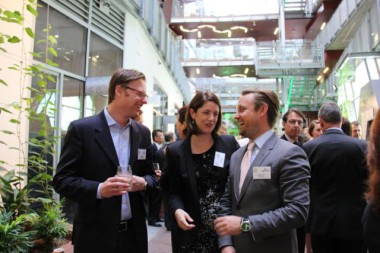
It started with the opening cocktails on Monday night, a bit hesitantly. We knew the numbers would be down, there was to be no exhibition; the venue would be a hotel instead of a convention centre. In the end these were changes that benefitted the event.
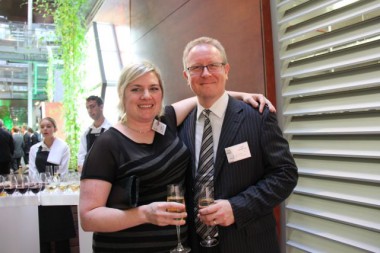
The Grand Hyatt in Collins Street was delightful. With its abundance of faux crystal, faux gold and glitter, it was almost a fond museum piece of ’80s grandeur gone by. The staff and food, though, showed that a hotel beats a dedicated convention centre every time for quality and atmosphere.
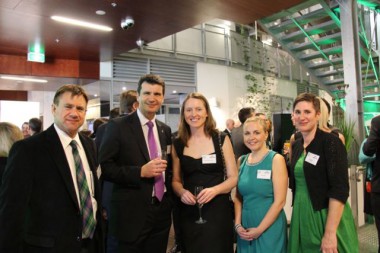
The numbers 600 or so people who turned up could sit comfortably sharing tables instead of being jammed into impersonal lecture theatres. The mood soon relaxed into something akin to a big family get-together, and sure, just

like any big family, with a mix of good will, some undercurrents of squabbles and splinter groups – but, in the end, family.
As a movement that’s just completed its first decade, you can tell maturity is setting in.
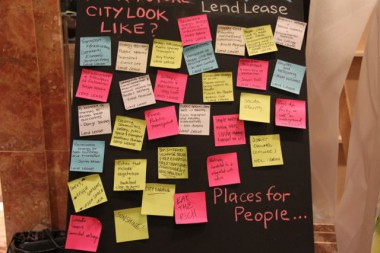
When revolutions are new and fresh there is unbounded excitement and a united front. As they settle into the job of integrating visions into reality, they morph into factions – each determined they know the best way to do things, and plenty of disagreement.

If we can stop short of the Trotsky solution, this is healthy and how it should be.
This year the big theme that’s riffing through the industry is diversity. And not just of gender, but all ethnic minority groups, ways of thinking, disciplines and so on.
At the Tuesday night drinks, we spoke to a conservative pollie, who urged that if the green movement is to make headway with the current federal government – which seems hell bent on dismantling every environmental and ethical position it can see then you have two choices, he said.
One is you dig yourself into a ditch and try not to look for three years, or you stick your head out, see if there is someone on the other side doing the same and tentatively cross to the middle and have a chat.
We mention that perhaps the government is driven by the fossil fuellers because
they know they’ve only got a few years left before coal and gas go the
way of stones in the Stone Age – abundant, but irrelevant.
“So what are you worried about? They’re screaming; that means you’re winning,” said our conservative pollie.
The reaction of the feds right now is emotional – it’s payback time; that’s something that won’t last, he said.
During one of the pleasantly long networking breaks, Tom Roper, the indefatigable president of the Australian Sustainable Built Environment Council pointed out grounds for praise in the feds with federal environment minister Greg Hunt. Not just because he’s genuinely trying so hard to get Direct Action to work for the property industry, but for his allocation of $3 million a year to adaptation work.
He also mentioned good works by the current Victorian government, on adaptation. But we’re not so sure that goodwill on environmental grounds continues with the mooted wind back of the Victorian Energy Efficiency Target and other mooted cuts. (You know what we’re looking at Vicgov…)
But enough of politics, stars are more fun
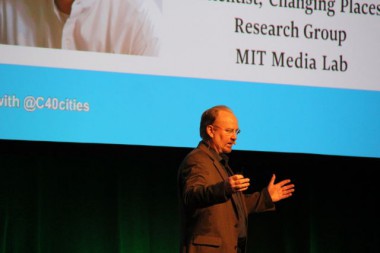
One star at (Twitter handle )#GC_2014 was Kent Larson the impressive guru of technology and cities from MIT. His official title is director and principal research scientist, Massachusetts Institute of Technology, Media Lab’s Changing Place Group.
In a dazzling, highly professional presentation Larson showed one of the most advanced laboratories in the world for solving our cities’ looming problems.
Much of it seemed like game playing; a kind of brainiac’s rampant playground. But in effect it was a bird’s eye view of the creative process, which takes ideas, plays with them and sees if they can be shaped into useful tools.

Cities bring good things, he said but often in parallel with bad. Think pollution, crime, congestion.
“Can you have the good stuff without the bad stuff?”
Micro cities are good, he said.
“In Cambridge where I work… everything is a 20 minute walk away.”
In Paris, too, everything is 20 minutes walk away. (maybe 10) and this is a “highly functional pattern, an even distribution of what people need in their daily life.”
But the technology split the audience.
For instance there were fold away cars that you could program to take your kids to say, basketball, and that would then neatly bundle themselves into tiny car parking spaces, when done.
But, asked one delegate, why the focus on individualised transport?
There was the über-tiny apartment – 17 square metres – where the bed could be lifted up to the ceiling while the floor was reconfigured for a living room or a dining table. Or maybe all the furniture can glide away to create room for a party.
“I wouldn’t want to live in such a tiny apartment, no matter how clever,” said another delegate. On the defence were others who said good design in small apartments could make the sceptics change their minds.
Larson and his team are also working on food solutions for crowded cities, using combinations of 27 different elements to find ways to grow plants that could be grafted onto facades of entire skyscrapers, or in hydroponic systems. Scepticism again: sure we might need to one day, but isn’t that what good land use planning should protect against? And how can 27 elements replicate the thousands if not millions of elements and microbes that make up our precious soil?
Adaptation, a growth industry
Larson said that in the US sustainability has been subsumed by resilience as a concept. “There’s good and bad news in that,” he said.
“Research shows that if you have a blackout in a glass building you have two days before its fundamentally uninhabitable and in older masonry building probably a week or 10 days because they weren’t designed to reply on mechanical systems”.
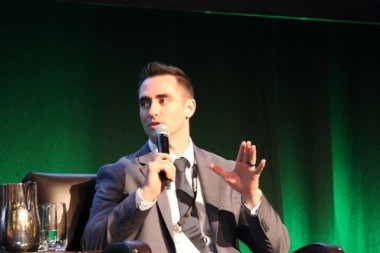
The investment angle
Matthew Bell, partner Climate Change and Sustainability Services Ernst & Young, was another star.
They care about sustainability and climate risk inside EY, that much was clear. And why not? The 10,000 or so staff have an average age of 26. Who was it that said sustainability and climate action was a “generational change issue”.
But just a sample of Bell’s comments, which impressed a big contingent in the audience, was his comment that in investment terms green is global. And it’s only going to grow in importance.
In the last 12 months alone, he said, the change in sentiment towards green from investment has grown hugely.
Daryl Browning, chief executive of ISPT said sustainability was a Nike thing – “just do it, rather than talk about it,” he said. “It’s a continuous journey.”

Mirvac chief Susan Lloyd-Hurwitz talked on the challenges of changing the culture inside her large property company. One way is to announce very publicly and loudly what your intentions are and then to call the strategy, “This Changes Everything”. As Mirvac did. How was this received by the investors? Well, the $5 million annual savings on energy and water that comes with the strategy goes a long way to help, Lloyd-Hurwitz said.
Collaboration
Author of that strategy, Paul Edwards, in a later session, demonstrated the collaborative nature of green when he talked about the work of the Better Buildings Partnership – a group of the nation’s leading property companies based in Sydney, managed by the City of Sydney. He also praised the work of a Mirvac competitor, Investa, for its tenant engagement program. Of course, as BPP chair, that’s his job, but still, it’s good to see publicly.
Likewise Edwards noted our “happiness” book, the Tenants and Landlords Guide to Happiness, a collaboration between the BBP and The Fifth Estate.
A modular road to manufacturing bliss?
On a different tack, that of the contractor, Michael Argyrou of Hickory Group said that his modular prefab construction company is taking advantage of the skills that the car industry is leaving behind. The savings of materials is huge, likewise time. (Not so much, yet, money – we know from our previous articles on this subject)
Argyrou said Asia could do with a good pre-fab industry.
“I travel to Malaysia and Thailand. You see the rivers choked up and streets congested, dozens – hundreds – of bins continually filled with concrete re-enforcement and building materials. And it’s all because of the lack of skills: they need to do things two and three times to deliver their buildings.”
Anyone listening out there in pollie-export-land?

On embedding the concepts
Rohit Aggarwala, of C40 said what you do need to be self referential; “it has to be about generic development; it has to be about your company”.
Look at some of the dutch cities.
“In Holland, resilience is not just about building the dyke, they think about their relationship with water in a very more systematic way.
“If you grow up in Holland you automatically think about water.
“In San Francisco, technology is something you do before breakfast. The green tech industry has taken a couple of tries before it’s really started to work and resonate with people.
“It’s that rootedness in place and culture.”
A motif for the conference
Ann-Kristin Karlsson, director sustainable cities, Sweden Green Building Council and WSP, pretty well gave the conference its motif when she called for the delegates to network liberally (and brag a bit), research (code for “steal ideas”) and to have fun (no subtext required).
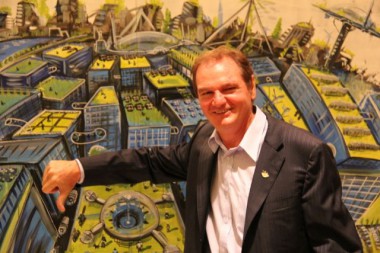
And from Queensland comes another dynamo
Another star or should we call him “agitator with a purpose” was Ipswich mayor, Paul Pisasale, whose reputation precedes him.
Pisasale has been mayor for 20 years, with a consistent 90 per cent of the vote, he claims.
You can see why. Partly it’s his energetic and controversial style that attracts people’s imaginations and builds a fire, and partly because he can enunciate a vision for his area and work to make it happen.
This thinking started when he asked his young daughter what she wanted to do when she finished her studies.
“Get out of this hole,” she answered.
It was a galvanising moment, he said.
The area was based on coal. And we know what that means. But Pisasale planned ahead and when the coal industry finally moved out hardly anyone noticed because there were alternative strategies in place – growing industries, growing jobs and an area that young people wanted to be part of.
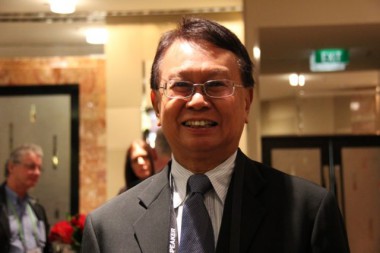
A weather report/climate alert from Singapore
There was a heartfelt moment when Ng Eng Kiong, president of the Singapore Green Building Council, spoke about how lovely the weather was in Melbourne (yes it was).
“I love the weather here. It’s just bright and sunny and you don’t get the smog and smoke,” he said. In Singapore, there’s no rain, the golf courses are dry. “We’re just waiting for the rains to come.”
But when it last rained, it flooded, “and in places where you don’t expect”.
So if you want to know why the government wants to fast track green buildings, there’s a clue.
Here’s another: 85 per cent of the population lives in high rise, and the country is running out of land.
But it’s hard to learn new tricks. So Singapore is now working on the kids, “getting children thinking about sustainability when they are in school, so that when they grow up they create good living habits that will save our country.”
Green growth or bust?
Paul King of the UKGBC is a good speaker. Not only for his style but because he’s got such good things to say.
OK the UK government just on Thursday said it would cap its carbon price, but in general it’s a steady and ambitious pace from the government on sustainability and retrofitting the building stock.
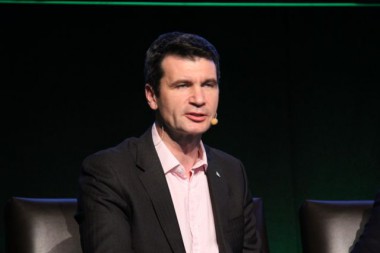
The UKGBC spends “a lot of time working with government,” King said.
“But the government doesn’t need to spend a lot of money. It has the power to set confidence for industry.”
Right now there’s a struggle and division is emerging.
“The tension falls down to something very simple – is this green stuff a break on growth or do the two go hand in hand?
“I’m a proponent that not only can it but it must, otherwise we’re heading to the next recession.”
Yes you can change the language and think about changing GBC to mean Good Building Council, King said, “but the reality is we are facing environmental limits so now we cannot afford to reduce our attention to green.”
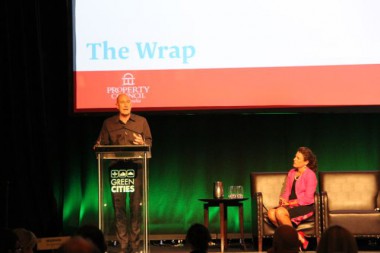
The wrap, by the inimitable Property Council chief Peter Verwer, was his last, ahead of his move to head the Asia Pacific Real Estate Association, based in Singapore.
It turned into a mutual admiration session as CGBCA chief Romilly Madew praised Verwer’s integral role in the green buildings movement in Australia and Verwer said Australia was the only place in the world where there is such strong collaboration between these two property siblings. Ah family, again…ain’t it grand?
There are many more stars. We’ll try to bring you more highlights soon.