


The first day of Green Cities saw presentations on artificial intelligence, self-healing homes, smart cities, density done well and Sustainable Development Goals, so it was surprising that perhaps the most interesting session of the day was on legislation.
Or perhaps it’s not surprising. Legislation is the blunt instrument that compels the laggards of industry to meet minimum standards, so it’s not surprising that enacting it can be a political minefield of vested interests, misinformation and obfuscation.
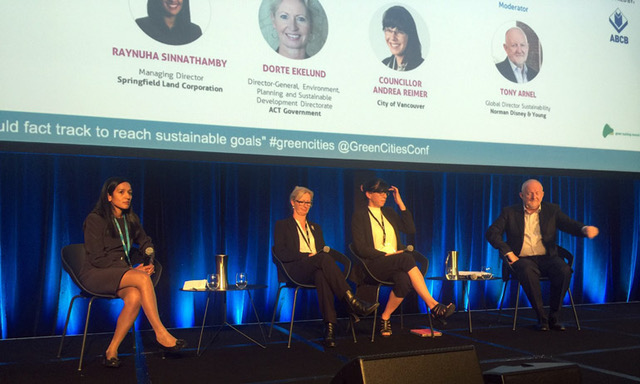
The “Legislation: Stepping out of the grey areas” session heard from an all-female panel – Andrea Reimer, a councillor all the way from the City of Vancouver in Canada; Dorte Ekelund, the outgoing director general of Environment, Planning and Sustainable Development for the ACT; and Raynuha Sinnathamby, the managing director of the Springfield Land Corporation.
Global director of sustainability at NDY Tony Arnel moderated the panel and in his opening address said in Australia, government legislative frameworks had been stop-start and spasmodic in relation to the built environment.
In the building energy efficiency world, minimum standards introduced in Victoria back in 2004, and nationally 10 years ago, had only been changed a couple of times, he said.
“In 2019, which is the next opportunity to set new minimum standards nationally, it looks as though, the way things are going at the moment, that only commercial buildings will be improved and that residential will not be touched until 2022.
“Are we missing some really big opportunities in relation to the legislative frameworks? Do we as a nation need to be much braver and stronger? How can legislation drive a leadership position? And how can we be better advocates for it?”
Andrea Reimer said the best way to take the grey out of legislation was to “shine a light on it” and set firm targets and metrics.
Start with energy efficiency
She said the most important step for Vancouver was to reduce energy use. Without efficiency, she said the city’s 100 per cent renewables target would not be possible.
“The first and best made fuel of a 100 per cent renewable economy will be energy efficiency. It will be impossible to replace kilojoule for kilojoule all of the current energy demand that we have and also accommodate growth of the same level. So you must first reduce and then replace.”
Act first, don’t ask
Reimer stunned the audience when she said her city’s green strategy hadn’t even gone out for public consultation, as the need to act was so great.
“We set up our plan with the help of 16 experts. We did not do a public consultation. This was extremely controversial at the time. However, the climate has an absolute limit. It doesn’t care what the public opinion is about that limit. Nor do toxins or other factors that are essential parts of our greener city plan.”
In the ACT they’re listening (to the climate)
Dorte Ekelund said a changing climate was with us already, and the ACT government wanted to ramp up action on the built environment to help mitigate some of the effects.
“Heat is a thing that kills more Australians than all the other natural hazards combined,” she said. “What we’re really doing is looking at the built environment and how the urban environment can actually protect us in future.”
Get those houses off the gas
Zero emissions housing was on the cards for the ACT, which means gas could be out.
“Once we get 100 per cent renewable electricity, gas is going to contribute a significant part of our carbon emissions. We’re currently having conversations about new subdivision not actually being connected to gas, and looking at how we can promote further decarbonisation of gas.”
Why aren’t we tackling resi now? As a matter of urgency
So with heat being our number one natural killer, energy efficiency being a key to meeting climate targets, and energy demand during heatwaves a key issue in Australian politics at the moment, why is improving residential performance off the cards for the update of the National Construction Code in 2019?
Jeff Robinson, a technical director, built environment with Aurecon, asked the panel what the barriers were for increasing standards, and also making sure they are enforced.
Ekelund said she was a board member of the Australian Building Codes Board (which sponsored the session), and was frustrated that things couldn’t change as fast as she would like, a frustration also held by the ABCB chair.
“I’d love to be able to put in place changes much more quickly, but we have a very big machine that we’re trying to change here, and the building sector is very, very powerful and politically influential, and there’s no point having regulation if it’s not going to actually stick.
“Changing the regulations when there’s so many ‘anti’ forces in the building sector is a real problem. While I can’t speak for my government, I would be surprised if they did not change any of the requirements for the residential sector before 2022 because we’re reviewing a number of our policy frameworks now.”
Arnel added that the building industry was made up of influential advocates – “people who don’t agree with the idea that minimum standards need to be raised”.
“We all recognise that minimum standards will only ever eliminate worst practice, and you shouldn’t really be threatened by that. But the reality in my experience over 15 years is that there’s some really influential forces that choose not to understand cost-benefit,” he said.
“For every change that has ever occurred in the National Construction Code, the benefit has far outweighed any disadvantages.
“Going into 2019 where we are apparently going to lose the opportunity of upgrading residential … to have only done this three times in 15 years is a real lost opportunity for Australia.
Speak up… urgently
“So all of you, as advocates, in my opinion, should be perhaps saying a lot more about what is not going to happen in 2019.”
The Australian Building Codes Board group manager Mark Davis, who is overseeing the development of the energy efficiency provisions for the 2019 NCC, told the session that the objective for the residential sector was to establish a foundation for a stringency increase.
Hamstrung work plan
One industry insider said the ABCB was hamstrung because its official position was based on a work plan that refers only to “improving processes” in residential for the 2019 update, but it refers to improving stringency for commercial property.
So governments, through the Building Ministers’ Forum, have not put it on the ABCB’s agenda.
A couple of things could change this, however.
The National Energy Productivity Plan has identified residential as an area to explore in meeting its 40 per cent per cent energy productivity improvement by 2030. Work is being done by the federal Department of Environment and Energy, with results expected very soon.
“That may influence the thinking of the states, and then the Building Ministers’ Forum, and that could inform what the ABCB do,” our source said.
“Until they have alternative instructions they will persevere with what they’ve been told to do.”
Outside of government the Australian Sustainable Built Environment Council has teamed up with ClimateWorks for the Building Code Energy Efficiency Trajectory Project, which is looking to provide an evidence base to make sure upgrades in the NCC for residential happen from 2019, as well as pushing for the introduction of long-term targets and forward trajectories for progressive increases in stringency for the energy efficiency provisions from 2022 onwards.
An interim report is expected mid-year.
“Australia has committed to the Paris agreement. Various states are committed to ambitious emissions targets. In order to work towards that, we should be setting all regulatory frameworks in that direction,” ASBEC executive director Suzanne Toumbourou said.
“Now the NCC is up for three yearly review, we should be thinking about how we can set a trajectory to meet these targets.”