


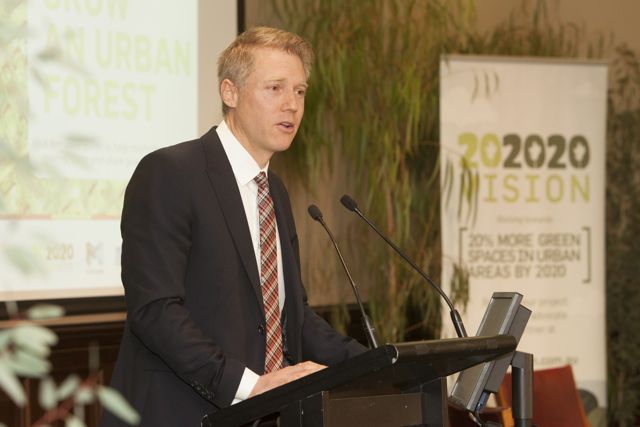
Developers in Melbourne are now being asked to compensate for loss of trees as part of a council plan to create greater tree cover, which has inspired a new 10-step guide from 202020 Vision – How to Grow an Urban Forest.
The guide is based on City of Melbourne’s Urban Forest Strategy that saw the city reverse the decline in tree numbers through drought-proofing, community engagement and steps to engage developers in contributing to open green space. It was launched late last month in Melbourne along with a masterclass on how to grow an urban forest for more than 50 representatives from local council and government agencies in Australia and New Zealand.
Chair of the City of Melbourne’s environment portfolio Arron Wood said the 202020 Vision guide would provide a vital resource for urban councils across Australia. It would help them strategically plan for and develop healthy urban forests to create liveable and climate resilient cities and towns, he said.
The city aimed to increase tree canopy cover from 22 per cent to 40 per cent by 2040, he said.
“We’re planting 3000 trees in Melbourne every year to increase the resilience of the urban forest and cool our city by four degrees Celsius,” Mr Wood said. “We’re proud to share our knowledge and help increase shade and greenery in towns and cities across Australia.”
In a phone interview on the morning of the launch of the 202020 Vision report, Mr Wood said that the major challenge the city had was in balancing green space with development pressures.
Under the city’s plan developers would now pay compensation for loss of trees to the city’s tree fund, or be asked to offset the loss by planting more trees, he said.
New developments would also be required to either set aside open green space or donate between 5-8 per cent of the development value to the city’s open space fund.
There was tension in the city between the value of parks as open space, and the value those areas have as sites for development, he said.
“The onus is on us to show the value of open space.”
Mr Wood said there were more than 20,000 “significant” trees on private property within the council boundary, and 77,000 trees on public land that the council was responsible for.
A combination of development, vandalism and trees reaching the end of their lives was seeing the city lose hundreds of trees every year across both private and public land.
Council often had to step in to defend public green open space, especially where a new development or infrastructure project was located next to an area like a park, and the construction team saw the park as “a great space for a worksite”.
“The tension [between development and green space] will probably only increase,” Mr Wood said.
“Community ownership” of the city’s trees was one of the elements of the urban forestry strategy that helped with replacing those lost trees and adding to the city’s tree cover, he said.
“It is all about generating public buy-in.”
Another element of the city’s strategy is to “think laterally” about where the city puts green space – for example, adding plants to city roof areas and walls.
Community gardens are also part of the strategy, and Mr Wood said those operated by council currently had a 5-10 year waiting list to participate.
“Urban food production will grow in the future.”
He said the services trees provided for Melbourne, including the cleansing stormwater and cooling the city, were things many other cities around the world were “really understanding”.
In urban areas where tree cover had been substantially or entirely diminished, it was a case of “you don’t know what you’ve got until it’s gone”, he said.
Executive director, water and catchments at the Victorian Department of Environment, Land, Water and Planning Scott Hamilton said it was increasingly important to support measures that combat climate change and improve liveability.
“Melbourne’s population is predicted to increase rapidly in the coming decades. As the population grows, so too will the importance of urban greening in supporting liveable, sustainable and inclusive communities,” Mr Hamilton said.
The guide, How to Grow an Urban Forest, is the first major outcome from the long range 202020 Vision Plan funded by nurseries and gardens industry, launched in May this year. The plan aims to achieve a 20 per cent increase and improvement in urban green space by 2020.
The Victorian government provided $16,500 to hold the Urban Forest Master Class.
- Download How to Grow an Urban Forest
How committed are the Urban Forest teams to avoiding planting tree species which will become the weeds of the future?
Are species chosen in consultation with the Invasive Species Council and other experts on sources of weed problems?