


I have spent the past two decades navigating the shifting currents of the corporate world, working with countless organisations and clients to tackle the complexities of doing business in a climate crisis. Executives that learned business school approved playbooks that worked 50 years ago have been thrust into the unknown.
Spinifex is an opinion column. If you would like to contribute, contact us to ask for a detailed brief.
While the private sector can be a powerful tool for good, it’s also true that its ability to make a difference has its limits. I’ve seen companies across all sectors adhering to incremental, often superficial, changes that failed to address systemic issues, exposing a frustrating sustainability gap between corporate rhetoric and reality.
These organisations have good intentions but too often play it safe instead of wielding their economic influence to make lasting environmental and social changes. Instead of turning challenge into opportunity, they remain risk-averse and unimaginative – and we’re running out of time.
Business as usual isn’t working. In recent years, corporate leaders have signed up to ever more ambitious targets, but the climate catastrophe is still very much upon us. In many parts of the world, inequality and social injustice is growing. We’re now past the halfway mark for achieving the Sustainable Development Goals – a UN-sponsored blueprint “for people and the planet,” a set of targets to achieve by 2030 – and only 17 per cent of the goals are on track.
One of the greatest barriers to meaningful climate action may be a lack of imagination. The status quo feels so entrenched that it is difficult to envision a different future. When we think about solving the most pressing issues of our time, we tend to focus on the obvious actors — governments, corporations, scientists, and activists. We propose new regulations, green technologies and corporate sustainability initiatives to reduce emissions and transition to a low-carbon, more equitable future. But there is another, often overlooked, force that has the potential to be truly transformative: arts and culture.
We often see narratives about climate change that focus on technical challenges – understandably so, considering the scale of the problem – while downplaying the human dimensions of a problem that affects us all. Perhaps when we’ve been looking for leaders, we’ve been looking in the wrong places. Perhaps, instead of looking only at boardrooms and government buildings, we should also be looking at our stages. Perhaps, instead of waiting for CEOs politicians and economists to save the world, we should be paying attention to our artists as well.
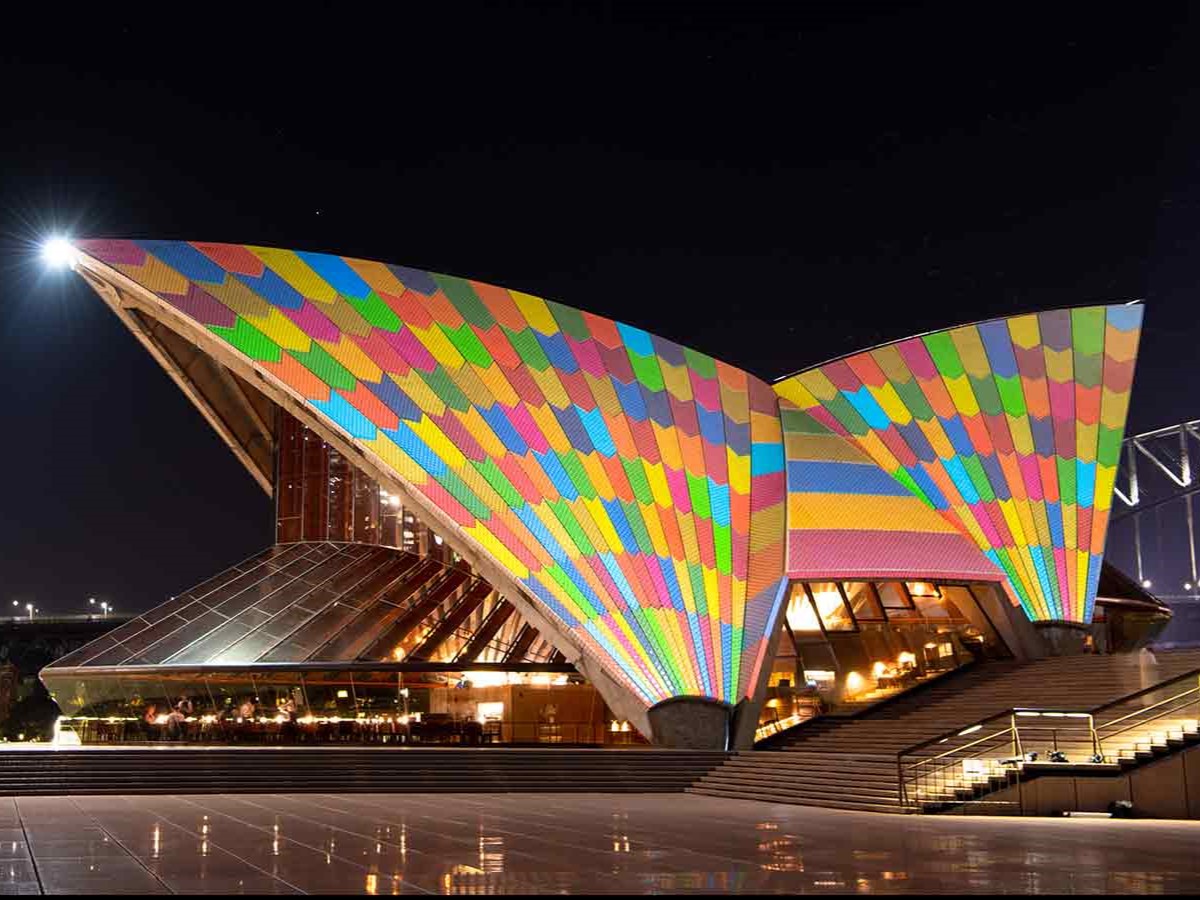
That’s the idea that led the Sydney Opera House to the UN Global Compact, a sustainability movement made up mostly of private businesses, large and small, from 167 countries. The Opera House is the first major arts organisation in the world to join this initiative – and in doing so, reinforcing the importance of creativity as a central part of the global conversation, a chance to share knowledge and collaborate between sectors and different areas of expertise.
The opportunity was inspired by the promise of the building itself. Fifty years after it opened its doors, changing the face of the city around it and challenging tired conventions, the Opera House still connects with the community every day through the power of storytelling. This is the message that comes through in Tim Minchin’s short film, Play it Safe, which celebrated the Opera House’s 50th anniversary. As I watched the film, carried along by its catchy melodies and joy, I wondered, as I reflected on the deeper meanings behind the lightness, why these people didn’t have a bigger voice in a global conversation that affects us all.
From Guernica to Mad Max, artists articulate abstract issues into stories that connect with our lives, moving people from passive awareness to active engagement. Arts and culture can be challenging. It can bring us face-to-face with uncomfortable truths and then create space for conversation to help us imagine new possibilities and inspire us to believe that transformative change is not only necessary but can also be joyful and achievable. This is particularly important in a time of climate fatigue and despair when so many people feel powerless in the face of this challenge.
In recent years, there’s been a rise in art projects and cultural movements that highlight the voices of those most affected by climate change. Indigenous artists, for example, are using traditional art forms and modern media to express connections to land and their fight against environmental degradation. These cultural expressions are not just about raising awareness — they’re about reclaiming power, mobilising action and demanding justice in the face of a global crisis.
The climate crisis is a human challenge, one that asks us to change the way we relate to the world around us, the values we prioritise and the stories we tell about our place in the natural environment. Artists can play a pivotal role in shaping this necessary cultural transformation, helping to mobilise collective action and catalyse deeper, more meaningful engagement with the environmental and social issues of our time.
As the world approaches the 2030 deadline for the SDGs, there’s never been a more urgent need for the kind of imaginative thinking and bold action that brought the Opera House to life more than five decades ago. Who better to bring us together and bring into sharp focus the challenges that confront us and the opportunities that await us for a more sustainable future than the risk-takers, visionaries and storytellers – the arts and the artists themselves?
Even with imaginative solutions Bevin it seems Government bodies can find ways to restrict their implementation and move the goal posts because status quo is more important. The Fifth Estate for example has run numerous articles about cool roofs including an article about the City of Adelaide (CoA) Cool Roof trail in May 2022.
This report has been completed by the CoA in June 2023 and the results are outstanding yet the Council refuses to release the report. The results from the University of Adelaide highlight there is a coating that solves urban heat issues, reduces energy costs, protects community during heatwaves and reduces carbon. This is crucial information for Australia’s need to tackle urban heat and carbon emissions yet it is being suppressed. In full declaration we worked with the CoA to apply the coating Super Therm to the pilot buildings nominated by the Council. The CoA say in their Integrated Climate Strategy 2030 plan they want to:
• A climate resilient city
• A net zero ready city
• A city where nature thrives
• Transition to a decarbonised city
• A climate leading capital city
They also include the mention of the Cool Roof Trial in the plan and are sitting on a report that proves cool surface solutions, as cool as the trees due to the technology in the coating. It seems it’s easier to talk about the problems rather than solve it. Perhaps The Fifth Estate could look into this issue. There are greater corporate powers that like the status quo and don’t want to change so will work hard to ensure anything that is innovative is squashed. Doing business in a climate crisis is vital; doing the right business with integrity is the missing factor.
Bevin you mention “Executives that learned business school approved playbooks that worked 50 years ago have been thrust into the unknown.” Heat is being tacked with a 47 year old regulation and R-value established in 1977, there is new technology yet there’s too much money being made by the traditional insulation industry so the innovation of a coating that has existed since 1989 isn’t given the chance to assist in the climate crisis where it is giving genuine solutions that the traditional insulation industry is failing at because the science and method is very much old school.
“While the private sector can be a powerful tool for good, it’s also true that its ability to make a difference has its limits. I’ve seen companies across all sectors adhering to incremental, often superficial, changes that failed to address systemic issues, exposing a frustrating sustainability gap between corporate rhetoric and reality.” Well in this instance it is Government rhetoric. As the Fifth Estate has covered the story on insulation and cool coatings this is one cover up to consider as a good solution for the climate being kept down by a government’s self interest.