


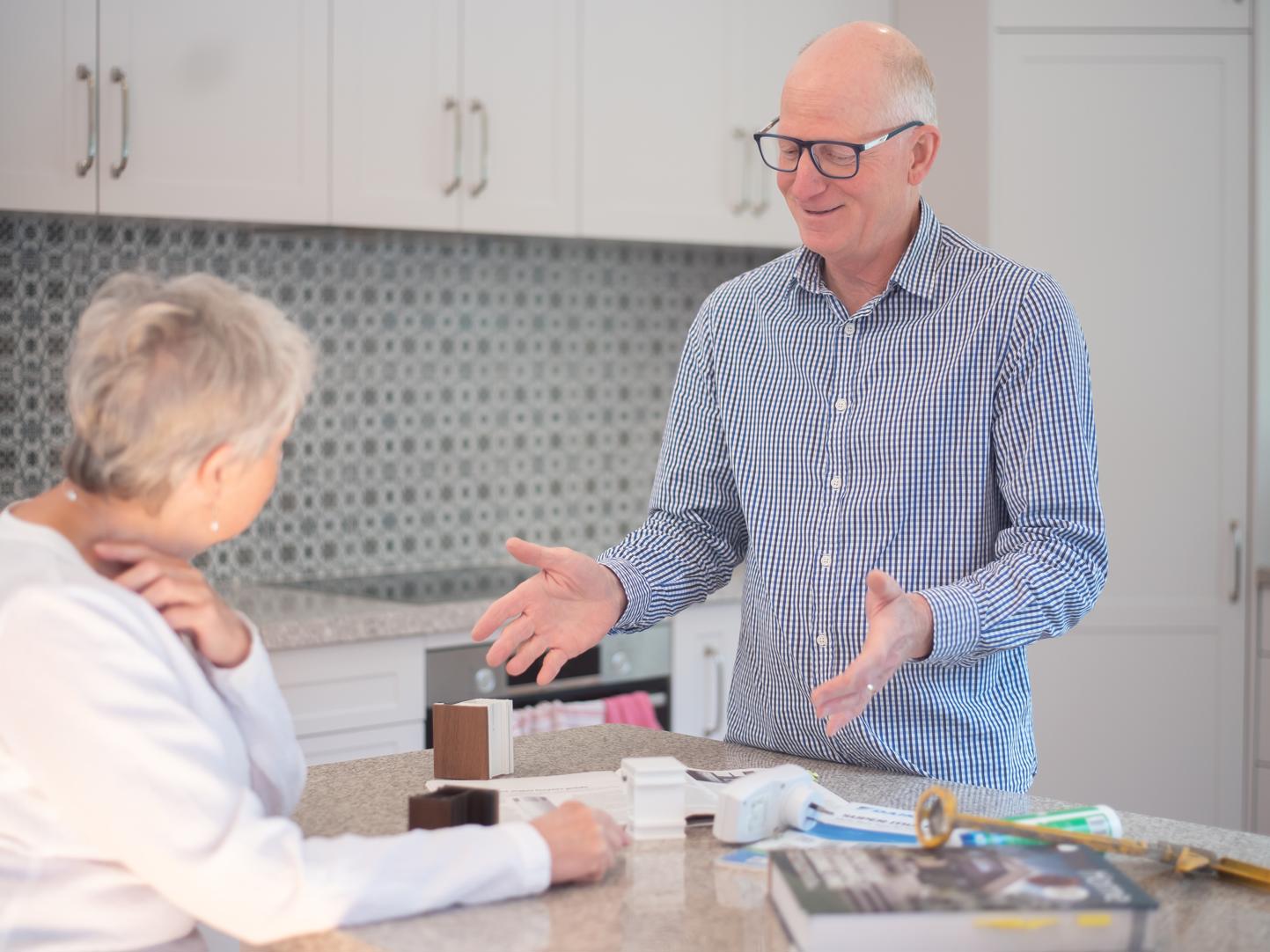
Tim Forcey’s book My efficient electric home handbook has led to a raft of book launches in communities from Beaumaris in Melbourne to Wagga Wagga and Lithgow in regional New South Wales. The common denominator? Readers’ growing interest in electrifying for their homes.
Across Australia, individuals, community groups and local councils are switching on to the efficient electric home.
It’s been seven years since I asked, here at The Fifth Estate, “has the time for the all-electric home finally arrived”? I can now report, finally, it has!
Since 2015, we’ve known that it’s far cheaper to heat a home with a reverse cycle air conditioner than with gas.
Spinifex is an opinion column. If you would like to contribute, contact us to ask for a detailed brief.
The same heat pump technology can be used to heat your home’s water far more cheaply than by using either a gas-burning hot water service or a simple electric-resistive water heater.
Even more critical for some households, we’ve become aware of the significant health impacts of burning gas in the home for cooking – in particular, the way it could give your kids asthma.
And all of these electric technologies work so well with the solar photovoltaic (PV) panels that many Australian homes already have on their roof.
Further, folks investing in electric vehicles, which we’ll soon be able to use to power our homes overnight, and/or in home batteries, extend the impact of electrifying.
And then there is the “efficient” part of your efficient electric home. Focusing on your home’s thermal envelope, insulation, draught-proofing (while maintaining indoor air quality), window treatments, and the windows themselves can ensure you are comfortable at home, have better health, and have very low energy bills and environmental impacts.
So how do I know that efficient home electrification “is now a thing”?
One indication is that we recently passed 135,000 members at the collaborative Facebook group “My Efficient Electric Home”.
But wait, there’s more! Allow me to tell you about my recent adventures across eastern Australia.
Not my idea
With a late stage career change to become a home comfort and energy advisor, I’ve now been in over 1000 homes, sitting at Australian dining tables or kitchen benches, suggesting ways folks can take the steps to achieve an efficient electric home. I’ve had many articles published here on The Fifth Estate, was surprisingly announced as a 2023 Emerald Award winner, and then, in June 2024, published a book entitled My Efficient Electric Home Handbook.
Though I had worked on and published many research reports in my career, this was my first (and I expect only!) book.
It wasn’t my idea. My publisher heard me on a Design Files podcast saying the same things I have said in over 1000 homes. She then rang me up and said, “Write that all down, and we’ll make a book out of it”. So we did.
The popularity of the book in its first five months is more evidence that efficient home electrification is taking off. Here’s a story about several dozen Australian communities.
Book launch, anyone?
As I said, I had never written a book before. As the publication date loomed, my wife asked, “Will you organise a book launch”?
As novices, we learned that these days, authors (unless perhaps you are Kevin Rudd or Malcolm Turnbull) have to organise their own book “launches” or similar events. Because publishers, wisely I suppose, mostly promote new books via the many online and social-media methods we have today.
So, in response to my wife’s idea that the book deserved a launch with a bit of wine and nibbles, I said, “Why not?”
With help from the property developer Hip v Hype and the not-for-profit organisation Renew, we scheduled a launch at Brunswick in Melbourne, with a keynote by Victoria’s Energy Minister Lily D’Ambrosio. And so, tick, that was one book launch, organised! Whew! Time to relax?
But then the phone began to ring. I was contacted by dozens of climate action, community energy, or electrification community groups, as well as by local council sustainability officers and associated libraries.
First, it was local. “Would you come speak at Beaumaris (Victoria) Library and do you think our local federal MP Zoe Daniel would come along too, because after all she wrote the foreword for your book?” Sure, we could do that event; it was close by.
But then there were more phone calls and more local events in Albert Park, Sandringham, Hampton, Brighton, and Glen Eira.
Next, calls from around metro Melbourne. Would I come to Altona, Maribyrnong, Moonee Valley, Merri-bek, Melton, Caroline Springs, Fitzroy North, City of Yarra, Balwyn, Hawthorn, Eltham, Greensboro, City of Hume, Ferntree Gully, Mount Waverley, Frankston, Rosebud, or Flinders? Even a business in the Melbourne CBD invited me to do a lunchtime talk.
And then interest came from farther away. Across Geelong and regional Victoria: Warrnambool, Wodonga, Wangaratta. Ballarat, Beechworth, Shepparton, Woodend and Romsey, Healesville, Inverloch, and Seymour.
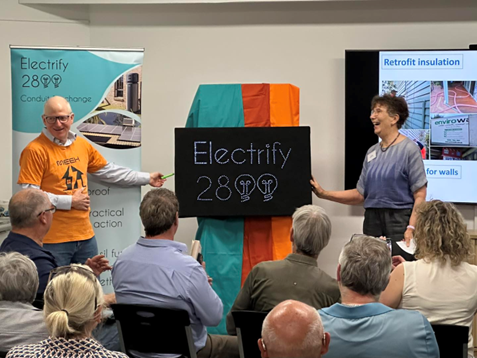
Canberra and New South Wales joined the list of “book launch” after book launch locations: Lake Macquarie, Narara, Sydney, Camden, Lithgow, Orange, Wagga Wagga, and Albury.
And finally, I’ll mention an excellent event in Port Adelaide, and to top it off, a massive crowd at an “Electrify Adelaide” event in Unley.
Sadly, I might not get to every location where there is interest. Places such as Mildura or the NSW Northern Rivers are missing out… for now!
In the lists above, I provide hyperlinks to some of the many community volunteer-led home-electrification groups, should readers here want to get involved in their local area. Also, readers can contact Rewiring Australia, led by Dr Saul Griffith, who is stimulating electrification postcode by postcode.
So all up, what my wife and I thought might be a single book launch is going to end up as nearly 60 book launches held across eastern Australia in the second half of 2024.
No surprise
Should I or anyone else be surprised about this level of interest in efficient home electrification? I guess not. Not anymore. Whether it is being driven by the cost-of-living crisis, the climate emergency, or people simply wishing to be more comfortable and healthier in their homes during the heat of summer or the cold depths of winter, the efficient electric home is now a thing.