

In Western Australia, the rampant gas industry is going next level with its impacts on Western Australian cost of living, climate and cultural heritage.
Spinifex is an opinion column. If you would like to contribute, contact us to ask for a detailed brief.
While every day we watch climate catastrophes roll across our screens, the WA Labor state government is on the cusp of approving a 46 year operational extension for the massive Woodside operated North West Shelf gas export plant on the heritage listed Burrup Peninsula.
Forty six years! Doing the maths, that takes us to 2070. What could be wrong with that?
What’s wrong with this approval is that it’s being made in arrogant disregard for human life on our Earth – past, present and emerging. Plus:
- disregard for past humanity, given that pollution on the Burrup Peninsula is destroying ancient rock art that has been there for 40,000 years
- disregard for future (and present) humanity, in paving the way for the release of billions of tonnes of greenhouse gases, with the liquefied natural gas (LNG) industry found out yet again to be even dirtier than coal
- disregard for present Western Australian households and businesses (the main subject of this article) who, in the midst of a cost of living crisis, are watching their electricity and gas bills rise as onshore “domestic” WA gas is sucked into the gas export plants and then shipped off to distant markets
I’m writing this from Perth. Overlooking the city from King’s Park, it’s undeniably beautiful, with the hills, Swan River, and modern high rise buildings. Sadly, it’s from those offices and inside WA’s Parliament House that the powerful gas industry locks in these damaging multi billion dollar plans.
Meanwhile, millions of Western Australian energy consumers, be they manufacturers or households, sit meekly on the sidelines. They consume the messages on the billboards at the airport and above the freeways that – no worries mate – what’s good for the largely foreign-owned gas exporters is good for the people of WA.
Western Australian energy users (households and businesses) have fallen into the same gas industry trap set a decade ago on Australia’s east coast. So first let me describe that debacle.
East coast gas-led mayhem
Eastern Australia used to have the cheapest gas in the developed world, contracted at around $3 a gigajoule. For decades, gas was a cheaply available byproduct of the oil coming out of the conventional Bass Strait and Moomba fields.
This all changed in 2015 when the gas industry worked out how to extract vast quantities of coal seam gas from Queensland – volumes many times more than what could be absorbed by the domestic east coast market.
And then what happened to the price of east coast gas? The wholesale price doubled, doubled again, and then went up some more
So what to do with all of this gas? Though it turned out not to be a profitable thing to do in the case of coal seam gas, the industry nevertheless built liquefaction plants in Gladstone so they could – for the first time – ship east coast gas overseas.
Queensland used to pipe cheap gas to the southern states. But this suddenly changed as the Gladstone export plants searched around and sucked up gas from far and wide.
Instead of gas flowing south, the gas in the pipelines actually turned around and went the other direction. Gas now flowed north, from Victoria to New South Wales and on up to Queensland to satisfy the LNG plants, and then into a ship and off to overseas markets. I was the first industry commentator to mark the very day the pipeline flow reversed.
And then what happened to the price of east coast gas? The wholesale price doubled, doubled again, and then went up some more, reaching heights beyond $20 per gigajoule. Nearly overnight, what had been a buyer’s market with cheap gas suddenly became a seller’s market. Stricken gas consumers were faced with having to take gas priced even beyond international benchmarks.
Those that benefitted most were the conventional gas suppliers (such as ExxonMobil/BHP) realising gas volumes and sale prices far higher than their expectations. They were thrilled to empty out the Victorian gas reservoirs as quickly as possible, accelerating their depletion plans and profits.
Governments, business lobby groups and consumer advocates were all asleep at the wheel. If they were thinking at all, they thought because gas had long been cheap, it always would be.
How could a region replete with gas, suddenly have a high-cost gas crisis? They failed to understand or didn’t want to understand the power and cartel-like behaviour of a small group of largely foreign-owned gas companies.
So today, east coast households are saddled with ridiculously-high gas bills. Gas-consuming businesses, be they manufacturers of bricks, chemicals, cups or paper, have already closed or are on the way to closing.
Further, anytime gas is used to make electricity, east-coast wholesale electricity prices reach stratospheric heights.
Today on the east coast, gas is too expensive to burn. And now the same thing has happened in Western Australia.
Policy shift – gas from onshore Western Australia can now be exported
In past decades, when a gas company was thinking of building a gas export plant and entering into long term gas supply contracts with overseas buyers, it was essential that the gas company had identified more than enough gas reserves to fill the plant for a 20 year life and beyond.
Indeed, it was the massive gas discoveries in Commonwealth controlled waters off the northwest shelf that underpinned Woodside’s and others’ export of gas from Western Australia from 1989 up until today.
One exception to this prudent practice, again back on the east coast, was when the gas company SANTOS failed to line up enough gas for its Gladstone LNG business. This was a big factor leading to the mad scramble for gas that has gone on in the east since 2015. (SANTOS’s share price is now half of what it was back in 2014, before this error became apparent to investors.)
Back over to WA, when compared with the volumes of gas that their massive LNG facilities will require for the next 46 years, so far Woodside has firm access to not much gas at all. Even if the environmentally damaging Browse offshore project gains approval, Woodside would still be looking for more gas.
The obvious place where Woodside will be looking to get gas will be from onshore, often fracked,Western Australian gas fields.
In fact, Woodside has already grabbed some onshore gas. In December 2020, for the first time, the WA government allowed Woodside to enter into contracts to export gas sourced from onshore WA (the “Waitsia” gas project). (This transforming Western Australian gas-supply situation is detailed in the May 2024 report “From Provider to Parasite”, by P. Verstegen et.al.)
The days of cheap WA gas are over
In the nearly four years since the Waitsia deal, what has happened to the wholesale price of gas in WA? The chart below (from www.gastrading.com.au) reveals that the impact of this policy change has been quick and dramatic.
In May 2020, the wholesale price was in the range of $2 per gigajoule. It was around this time that some energy commentators were mirthfully expressing opinions like “see unlike in the east, Western Australia knows how to keep gas prices under control”. But as soon as those words were out of their mouths, the gas price took off.
By April 2023, WA’s wholesale gas price had reached $10. Similar to what happened on the east coast, from a low of around $2, the price of gas doubled, doubled again, and then went up some more.
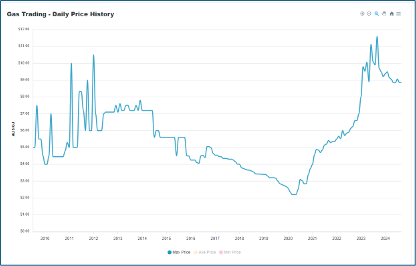
The risk is that as Woodside sweeps up more and more onshore gas for export, the price that Western Australians will pay for gas will continue to rise. But even if the price doesn’t keep going up, it’s already unaffordable for many households and business.
High cost gas means high cost electricity
In Western Australia as on the east coast, gas is used as one way to make electricity, along with coal and renewables. High cost gas means high cost electricity.
Last month, the WA based Chamber of Minerals and Energy of Western Australia (CME) reported:
“… wholesale electricity prices have doubled in the space of three years – from $46/MWh in 2021 to $96/MWh in 2024…”
The timing of this electricity price increase aligns perfectly with the rapid WA gas price rise set in train by Woodside’s novel and nascent exporting of onshore gas.
Be warned and alarmed
Western Australians, here’s a warning. The massive sucking sound you hear up on the Burrup Peninsula is from Woodside’s LNG plants hoovering up all the gas they can find from around your state.
The Western Australian government should be warned not to repeat the mistakes made on the east coast. The WA government should not allow Woodside to ride roughshod over the present cost of living needs of WA households, nor over the existential economic needs of WA businesses.

How about $2/GJ green hydrogen promise, only Angus Taylor. Did he actually graduate in add ups?
Great article, but government serving the the people, I’m still waiting ?