


A question that often arises when the possibility of home ownership becomes a reality is whether to build or buy? Building a home is an exciting dream for many, offering the thrilling opportunity to craft a personal and customised living space that perfectly reflects your unique lifestyle and your family’s needs.
Spinifex is an opinion column. If you would like to contribute, contact us to ask for a detailed brief.
While the prospect of building a brand new home is enticing, there are a few drawbacks to consider. Having recently embarked on the “new build adventure”, we discovered seven compelling reasons why choosing a newly constructed home might not be as thrilling as it seems!
1. Cost
In 2024, building your dream home could appear more budget-friendly than buying an existing property – depending on location, design and materials. However, inclusions and upgrades to a new build substantially increase the cost.
Costs can vary significantly by state, city, suburb, and even street, as well as localised fluctuating housing markets and the buyer/seller’s situation.
Even modest upgrades to a standard new build can increase costs by 20-30 per cent. Adding solar is also one of those discretionary dissonance decisions. While low interest green loans are an option, we chose to purchase a premium solar system outright. Our house is fully electrified, and our average electricity cost is around $20 a month.
To achieve this, apart from the solar power system coupled with a heat pump hot water system, we upgraded our insulation (ceiling and walls) to the max and installed premium ceiling fans. Thus far, even at 30 degrees Celsius outside, inside has remained a comfortable 24-25 °C, and we haven’t had to use airconditioning at all.
It’s advisable to install a high quality solar system by a reputable installer. If not, upgrade your insulation significantly and invest in good ceiling fans. Be cautious of low cost, low quality solar
We upgraded the house’s wind rating to N3 (non cyclone), exceeding our region’s N2 building code rating, which is obsolete in a climate crisis. We also added extra drainage and installed rain resistant aluminium windows and external doors.
We have a 3,000L water tank, which we would have installed anyway, but it was required by the covenant. Once again, all these upgrades are a matter of cost and affordability.
Simply advertising a Nationwide House Energy Rating Scheme 7 star energy rating on a builder’s website doesn’t guarantee their homes meet that standard. The new (NatHERS) 7 star rating for new builds, effective May 2024 lacks regulation, leading to potential greenwashing where homes may only be 3 star at most. And despite government subsidies, achieving a true 7 star energy rating is costly but something to aspire to.
Spoiler alert: On 31 October, the Bureau of Meteorology and the CSIRO released the latest State of the Climate 2024 report noting that Australia’s climate has warmed by an average of 1.51 ± 0.23 °C since 1910, surpassing the 1.5 °C threshold. This contrasts with a global average increase of 1.2 °C since 1850. Future years are expected to be warmer than any prior years — post the onset of anthropogenic climate change — putting us on track to breach the next tipping point of 2.00 °C.
2. Average cost
ASIC reported a 54 per cent rise in mortgage hardship notices filed with banks in Q4 2023 compared to Q4 2022. As quick resales increase and capital gains decrease in a cooling market, home turnover declines and prices for older homes tend to fall.
However, housing in Australia is somewhat unique, and short term market predictions are often unreliable. While experts provide numerous reasons to buy or sell, luck with timing and purchasing capacity are the key factors.
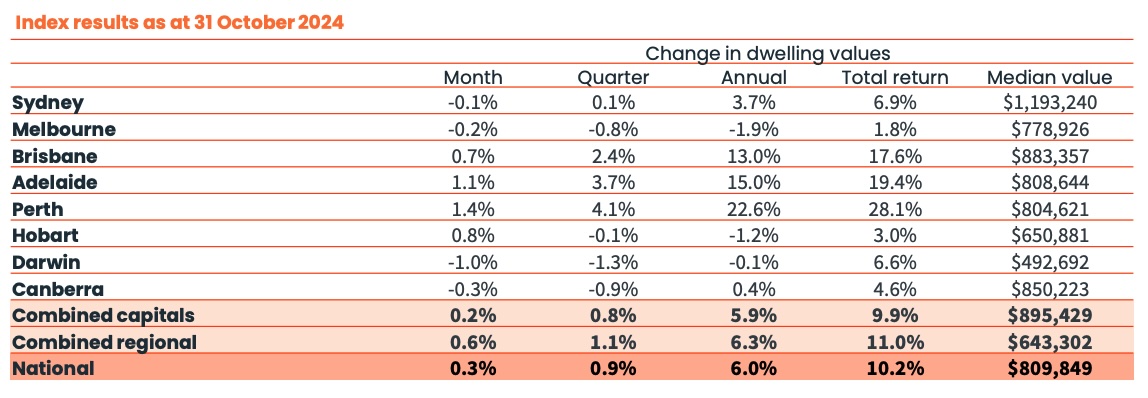
Apart from the statistical median value above, there’s no definitive average house cost in Australia for building or buying; it’s determined by location, build quality and size, and what buyers are prepared to pay at any given time. Houses in desirable areas, however, consistently achieve record prices.
Unlike established homes that offer the flexibility to negotiate the price, builders’ fixed profit margins limit negotiations for new builds. That said, the “heart over head” dilemma often arises when choosing between building a dream home and the charm of an established property. And, oh, couples will not always agree.
A point to note: Recent discussions around modular homes highlight their potential to improve construction efficiencies and reduce costs. However, we need to streamline processes, adjust regulations to suit, and address cultural preferences as most Australians favour traditional builds. Moreover, while modular homes reduce construction time, waste and greenhouse gas emissions, they don’t “significantly” lower costs. Nonetheless, I fully support their development.
3. Environmental impacts
The environmental impact of new home construction is significant due to the embodied energy in materials, urban sprawl, additional infrastructure, increased travel distances and the associated greenhouse gas emissions. Not to mention habitat fragmentation.
In contrast, many existing homes can be retrofitted for better energy efficiency, allowing for reduced environmental impact without the need for new construction.
Building a NatHERS certified home may address some concerns but incur higher costs. Constructing smaller, eco-friendly homes using reclaimed materials can provide a more sustainable alternative and foster a “feel-good” outcome that you’re doing something environmentally responsible rather than contributing to the climate crisis.
Perhaps most importantly, why are we still building the biggest houses in the world when, according to the ABS, the average household size in June 2024 was 2.5 people, down from 2.6 people in June 2014?
A spare bedroom is great, but having a spare bedroom, a study, a media room, two living areas, and a double garage when you only have two children (or less) and one car just because you can, is impractical and environmentally negligent.
A point to note: Building large homes increases material use, energy, waste, and greenhouse gas emissions, which contradicts sustainability. While governments are mindful not to dictate homeowner choices, expecting homeowners to prioritise sustainable building over size is unrealistic, even in a climate/housing crisis.
4. Stress and the time-cost factor
Building a new home requires considerable time and effort, often causing stress. Homeowners regularly report frustration related to delays, which can be debilitating. From labour shortages to coordinating trades to the availability of materials and structural defects, there is no shortage of things to worry about.
And perhaps the most redundant time-wasting enterprise is correcting defects that should never have occurred. Also, be mindful that you may have to rent during the build, and rents have skyrocketed, representing as much as 25 per cent of the build cost.
A point to note: In most instances, buying an older home is more straightforward, saves time, and is less expensive and emotionally taxing.
5. Whatever happened to pride in construction?
This is a biggie! In short, the quality of a new build is always questionable, and it is recommended to engage your own independent building inspector.
The use of low quality imported products is why most people invest heavily in upgrades. And the quality difference between a house built for investment and a “forever home” is significant but often overlooked.
Expectations and attention to detail greatly influence your satisfaction when building your dream home. Needless to say, there are widespread concerns about the quality of materials and craftsmanship in new homes.
Modern homebuilding prioritises speed and cost efficiency over quality and sustainability, often leading to poor workmanship and structural deficiencies compared to older homes that commonly emphasise quality materials and pride in construction.
A point to note: All levels of government have failed badly in their housing policy. Moreover, Australia’s privatisation program, which commenced in the 1990s under the Hawke government, included privatising building certification, leading to corrupt and incompetent regulatory bodies and a significant decline in construction quality. Not coincidently, correlating with the 1990’s privatisation program, house prices began to detach from wages, culminating in today’s housing unaffordability crisis.
6. Working with builders and subcontractors
Although intuitive, we were reminded early on that maintaining good relations with your building supervisor and the tradespeople involved would make for a better and more efficient build.
Suffice it to say that this takes some doing when things go awry. Although builders generally encourage homeowners to ask questions, they can become sensitive when you ask too many questions or too many difficult ones.
You might find yourself questioning whether you are still the customer, as it often feels like roles have been reversed. In short, maintaining civility in the quest for high standards can be challenging, especially with subcontractors (subbies) who answer to their own supervisors.
Subbies from different companies working on the same house often don’t communicate, relying on a loosely organised messaging system via the building supervisor that can break down. As a result, updates and maintenance schedules tend to diminish over time and the build time is drawn out.
A point to note: The post handover maintenance period for a new build is potentially the most stressful as the final payment has been made, and you no longer have any leverage. Consequently, completing the maintenance (minor and major defects) can take longer than the actual build.
7. Personal fulfilment
While not increasing the depleted housing stock, many individuals find greater personal satisfaction in renovating and improving existing homes rather than building new ones from the ground up. Upgrading and enhancing a property can be a deeply rewarding experience.
Homeowners often take pride in transforming a preloved space; even small projects can bring a sense of fulfilment that may not be experienced when building a brand new home. For ourselves, after doing both, renovating an existing home is just as rewarding, if not more, than building a new one.
Ultimately, while the desire to build a new home is understandable, it is essential to consider the advantages of purchasing an existing property. After all, the great Australian dream does not bias new builds over old; it simply values ownership. The feeling that it is truly yours.