


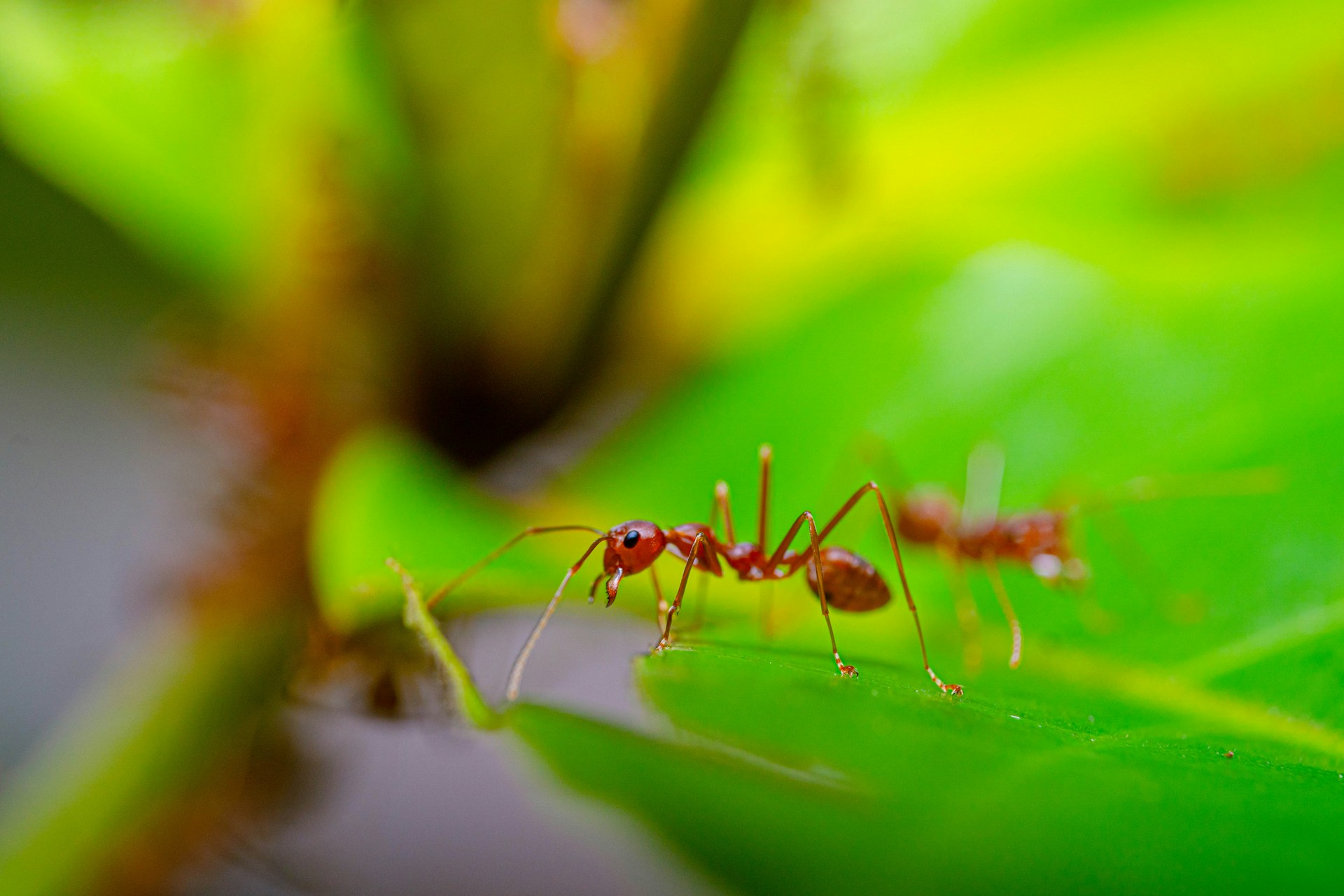
The sheer scale and rapid expansion of fire ant colonies is a stark reminder that humans should never conflate modifying the natural environment with the delusion of domination over it.
Darwin writes in his seminal work On the Origin of Species (1859): “In the long history of humankind (and animal kind, too), those who learned to collaborate and improvise most effectively have prevailed.”
Spinifex is an opinion column. If you would like to contribute, contact us to ask for a detailed brief.
Succinctly, the complexities of evolution are summed up in the non-random and random biological processes of natural selection and genetic drift. Picture an expanse of wooded grassland where a small group of animals begins to thrive, their growing presence signalling the dawn of a new era on Earth.
In the process, some species go extinct while others proliferate, creating a delicate and ever-changing balance. The ones that proliferate eventually form large communities with complex social structures.
At the fringes of these emerging civilisations, intense conflicts erupt over resources and dominance, leading to unprecedented fatalities. This struggle for survival reshapes territorial boundaries, fundamentally altering ecosystem dynamics.
A narrative that parallels our own
The path to planet dominance is accentuated by the knowledge that only 0.1 per cent of the myriad plants and animals that have inhabited the Earth exist today. Of all these life forms, we are morphological misfits, capable of reinventing ourselves and innovating through the trickiest situations.
Now envision a narrative that closely parallels ours yet unfolds in the vibrant ecosystems of Central and South America, where a remarkable group of ant species flourish. Solenopsis invicta, commonly known as the red imported fire ant (RIFA) or simply, the “fire ant”, belongs to the genus Solenopsis within the subfamily Myrmicinae.
These formidable creatures, characterised by their complex social structures and determination, embarked on an extraordinary journey, not unlike theHomo sapiens’ diaspora out of Africa.
As they made their way through the now lush environments filled with towering trees and vibrant flowers, they became part of the rich tapestry created by European explorers in search of new lands, engaging in trade, colonisation, and conflict.
With each evolutionary step, these resilient ants, with their hard, waterproof exoskeleton, not only adapted to their changing world but also left an indelible mark on the intricate balance of their ecosystems, showcasing their role in the grand scheme of discovery and conquest that shaped our planet’s history.
Ants, like humans, are intrepid explorers
Over the past 450 years, fire ants haven’t merely survived but have globalised their communities, establishing a presence that mirrors the expansion of human societies.
Some of these tenacious little travellers managed to stowaway in soil used for ballast on the majestic Spanish galleons of the 16th century.
These ships carried precious silver from the bustling port of Acapulco across the vast Pacific to Manila as part of the Manila Galleon trade, which operated from 1565 to 1815.
Their story is a vivid testament to nature’s remarkable resilience and adaptability. As they journeyed through an ever-changing world, their experiences echo the transformative path of humanity. Yet, in subtle ways, their tale diverges from our own, illustrating the serendipitous nature of creation through evolution.
Fire ants are no ordinary ants
Fire ants form colonies of about 25,000 members, including one or more queens and various workers. They communicate through chemical secretions and stridulation. Adult workers become aggressive when threatened, while young fire ants, whose stingers and exoskeletons are not yet fully developed, play dead.
Fire ants were first discovered in Australia on February 22, 2001, in Brisbane, Queensland. However, the exact date of their arrival remains a mystery. Some experts believe they may have arrived on Australian shores as much as 20 years earlier. It is speculated that they entered the country in shipping containers originating in America.
Native to the warm climates of South America, fire ants are one of the most destructive invasive species on the planet. An analysis by the Australian Institute estimated that fire ants could cost the Australian economy more than $22 billion by the 2040s if left unchecked.
Fire ants can cause serious harm or even be fatal to humans, livestock, and ecosystems. They damage crops, raid beehives, and threaten newborn domesticated animals. Closer to home, they can make parks, playgrounds, and backyards unusable.
The climate and landscape of Australia, along with a lack of natural predators, provide ideal conditions for these ants to flourish. They have managed to spread from Gladstone in Queensland all the way to Fremantle in Perth through natural means and human activities.
In late 2022, fire ants were discovered for the first time in Europe, near the Sicilian city of Syracuse. Although the presence of 88 colonies surprised many, it wasn’t unexpected after another South American ant species had already established itself.
The Argentine ant (Linepithema humile), a native of northern Argentina, Uruguay, Paraguay, Bolivia, and southern Brazil, was detected on Madeira Island in 1882 before establishing a supercolony across Europe in the 1920s and 1960s.
What’s really happening beneath our feet?
What is surprising is the depth of our misunderstanding of global ant societies. Beneath our feet, an extraordinary narrative is unfolding — an epic reminiscent of a science fiction movie, teeming with life and intrigue.
The Earth is home to a mindboggling number of ants, each engaged in complex interactions that hint at a form of “alien geopolitics”. The characters within this tale are bizarre, and the scale of their activities borders on the sublime.
How can we begin to narrate the saga of global ant societies without merely echoing our own human existence? It poses a profound challenge, inviting us to explore an entirely different fabric of life devoted to an extraordinary level of eusociality. And, ultimately, whether we can continue to cling to the delusion of dominion over nature.
That said, humans remain the dominant social animal on Earth, and our intensely social nature has led to unparalleled success as a species.
Similarly, as Edward O Wilson notes in his 1975 book Sociobiology, “Ants are in every sense of the word the dominant social insects,” which has led to their unparalleled success as a species.
Can fire ants take over the world?
The answer is likely yes, albeit taking place in an elaborate underground labyrinth of cities and supercolonies.
Fire ants are fascinating and formidable insects, renowned for their incredible adaptability and survival skills in a variety of climates and environments. Their remarkable resilience enables them to establish thriving colonies in diverse habitats, from arid landscapes to lush ecosystems.
As they proliferate, they often outcompete native species, leading to significant ecological shifts and altering local biodiversity. Their relentless march raises questions about their potential to dominate ecosystems globally through supercolonies, causing irreversible damage.
Both indoor and outdoor spaces are vulnerable to their relentless incursions, as fire ants are notorious for their aggressive behaviour.
They defend their territories with ferocity, making encounters with them not only uncomfortable but potentially fatal for both humans and pets.
Homo urbanis: an alien in an insect world
Could we humans be the real aliens on this planet? Exploring the notion that our very existence might be considered alien to the natural world, we might ponder our role and impact on this vast ecosystem we call Earth.
Humans likely originated in Africa around 2.5 million years ago, with modern humans appearing about 300,000 years ago. In comparison, ants have existed for 140 to 168 million years, predating the Tyrannosaurus rex by about 100 million years, making them some of the oldest multicellular organisms on Earth.
Estimates today suggest around 20 quadrillion ants live in various ecosystems, translating to an extraordinary ratio of 2.5 million ants for every human.
As our planet transforms into an unfamiliar landscape, embracing the mindset of an alien is a more fruitful approach to cultivating the imagination and humility necessary to navigate these significant changes.
This perspective shift encourages us to focus on understanding the intricacies of other species rather than merely identifying their similarities with humanity, categorising them, and continuing on irrespectively.
That said, adopting the thought patterns of an ant does not imply an acceptance of our potential future under the reign of insect overlords. Humans are unlikely to relinquish the compulsion to dominate and go quietly into the night.
Sleepwalking into the Homogecene
Scientists have warned for decades that the world is heading toward a geological epoch called the Homogecene, with severe biological homogenisation observed in river basins across Europe, northern Africa, Asia, and North America.
The Homogecene is a troublesome term that envisions a future where biodiversity is diminished and ecological balance is compromised, leading to a bleak outlook for the environment we depend on.
The Homogecene is linked to biotic homogenisation, where local species are replaced by non-native organisms that can coexist with humans, reducing spatial diversity. This leads to an ecological landscape favouring invasive and harmful species like red fire ants and us, Homo sapiens.
Have we alienated ourselves?
The sheer scale and rapid expansion of fire ant colonies is a stark reminder that humans should never conflate modifying the natural environment with the delusion of domination over it.
While we can significantly alter our surroundings, we often lack control over the outcomes. Each intervention can ripple through reality in unforeseen ways, resulting in initial benefits that may lead to devastating long-term costs.
The interconnected global society of fire ants starkly illustrates that we cannot predict how other species will react to our attempts to reshape the planet. We can only be sure that they will respond in some manner, often in ways beyond our comprehension.
Dr Stephen Dark has a PhD in Climate Change Policy and Science, and has lectured at Bond University in the Faculty of Society & Design teaching Sustainable Development and Sustainability Economics. He is a member of the Urban Development Institute of Australia and the author of the book Contemplating Climate Change: Mental Models and Human Reasoning.