




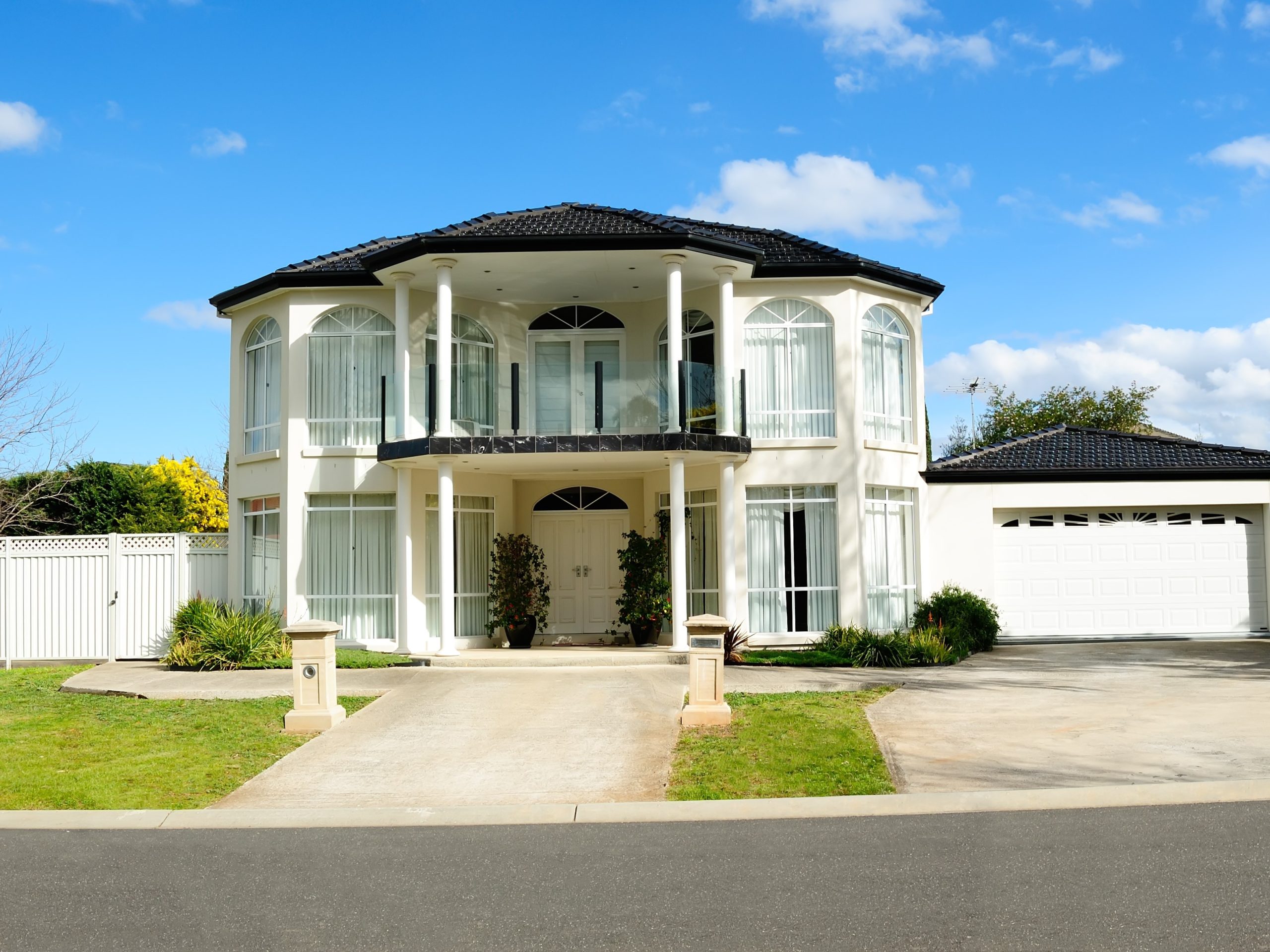
The size of our homes has been a contentious topic among experts for decades. However, we are now seeing this debate shift to the public sphere through the Home Truth Commission by Breathe Architects at the National Gallery of Victoria.
The installation raises awareness about the unavoidable environmental impact of our large homes. But is this true for all homes? How do we know how big a home should be? And how should we measure it?
Spinifex is an opinion column. If you would like to contribute, contact us to ask for a detailed brief.
RMIT University’s recent research draws attention to the uneven distribution of new home sizes in Victoria, as well as the need to develop appropriate ways of measuring and evaluating housing size to reduce carbon emissions and improve social equity.
Australia holds the record for the largest new homes in the world. While “McMansions” may be aspirational, they pose ecological challenges. Current housing energy regulations, which focus on operational energy efficiency, put meeting our decarbonisation targets at risk. Normalised metrics that aim for zero energy demand per square metre (NatHERS) or energy use per house of a similar size (whole of home) may even invite building bigger: zero times anything is zero – right?
There has been a slight trend to smaller houses since 2008 in New South Wales and Queensland, which promise to be more affordable and allow for increased density and more garden space for health and biodiversity. However, new house floor areas have increased in South Australia and Victoria and the number of people per house has also declined to the lowest levels in recorded history. Housing size has, thus, remained a significant environmental problem and continues to lead to uneven distributions of housing related health and wellbeing outcomes.
In 2022, the Intergovernmental Panel on Climate Change (IPCC) suggested that we should focus on the concept of sufficiency as the main way to fight climate change, even before thinking about using energy more efficiently or switching to renewable energy. For housing, sufficiency means using less energy in our homes for heating, cooling and other services, as well as building houses with less embodied energy in their materials and processes while still making sure people have a decent place to live. Right now, we’re not following these ideas of using only what we need.
In our recent study, we explore the concept of sufficiency for new homes in Victoria. Since 2016, we have built six times as many new detached houses and townhouses as apartments by a factor of six. This trend contradicts the sufficiency principle of prioritising multi-family over single-family homes, thereby increasing per capita environmental impacts for many years.

Distribution of number of new dwellings by IRSAD decile and Class (FirstRate5 data) in Victoria since 2016. These rankings assess and compare the socio-economic conditions of different areas across Australia. Decile 1 represents the most disadvantaged areas, Decile 10 the most advantaged ones.
We also looked at how the size of new homes in Victoria is linked to the social status of the suburbs. A common way of measuring sufficiency in housing is by calculating the space allowances by dividing the habitable floor area by the number of people living, or likely to be living, in the home. We examined the relationship between floor area per person and social status and the Australian Bureau of Statistics’ Index of Economic Resources and Social (Dis)advantage’s (IRSAD) decile rankings at the postcode level. For this comparison, we used data from FirstRate5 new home energy certificates for over 334,000 houses and townhouses and 65,000 apartments.
How much space is enough?
Our study found that disparities in space underscored enduring social inequalities, particularly in less advantaged areas where overcrowding may occur. Average space per person was larger in houses (52.49sq m per person) than in apartments (41.63sq m per person), but still considerably more generous than in homes in London (average 32.6sq m/person) and other European countries (14 to 20sq m/person). Houses in the most advantaged areas were significantly more spacious. Houses featured larger kitchens and offered walk-in wardrobes and ensuite bathrooms, amenities that are seldom considered in apartment and social housing standards. However, with regard to sufficiency, underutilised spaces in houses, such as home theatres and rumpus rooms, may be seen as wasteful extravagances.
Apartment construction in Victoria occurred predominantly in more advantaged suburbs. On average, apartments were the most spacious in postcode areas with the highest socio-economic advantage. Low income households looking for a home in these areas may be faced with relatively high purchase, rental and operational costs, potentially trapping these households in cycles of economic hardship.


Box plots of postcode-average area per capita by IRSAD deciles for Class 1 (left) and Class 2 (right) dwellings. Outliers are shown as dots.
During the 2021 Census, many Victorian homes had at least one unoccupied bedroom, suggesting that space could be even more ample than estimated above.
Sufficiency is given little attention in housing policy
Sufficiency integrates environmental and social considerations yet remains underrepresented in current debates on housing supply and sustainability. The National Construction Code considers the energy efficiency of housing, however dwelling size is largely overlooked. Some apartment design guidelines and social housing policies imply a minimum level of sufficiency through minimum room or dwelling sizes, yet the size of new private homes appears limitless.
The diagram below shows that people living in new houses in the wealthiest suburbs of Victoria have almost three times more space than those in a 3 bedroom social housing unit. The uneven distribution of housing space could be perceived as unfair; households with high space allowances are likely to account for high operational and embodied carbon emissions, but the environmental burden of their energy and material use is carried by everyone.
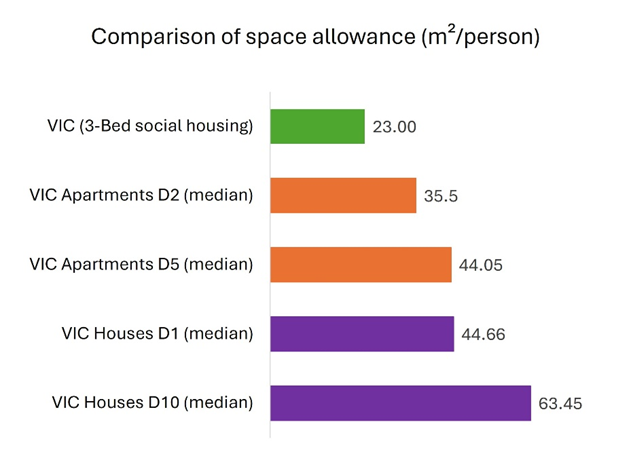
The disparities in space allowances also raise the question of how much space is necessary for functionality, such as inadequate storage space, health (for example, a second bathroom may help with effective infection control) and housing-related well-being outcomes (such as privacy, status and control). A further concern is that excessive space, which is more than householders may consider enough, may prolong the construction of new homes and make new housing unaffordable in terms of upfront costs as well as heating and cooling expenses. More research is needed to explore the interactions between dwelling type, size and life cycle environmental performance.
Balancing housing needs with design quality through new sufficiency metrics
Australia faces the challenge of balancing the need to build more homes and the desire for spacious living spaces with the imperative of environmental sustainability and social equity. Considering and measuring sufficiency in housing policies may help promote more equitable and environmentally sensitive dwelling design and construction.