



Cost of living is increasing by the day. This includes the cost of electricity which has a flow on effect on how we look after our comfort needs considering that we spend more than 90 per cent of our lives indoors.
With extreme temperature conditions experienced due to climate change, the need for keeping us comfortable is no doubt getting expensive with our use of heating and cooling systems. Most of us are getting sustainability conscious and switching off energy consuming lights and devices when not required. However, there is a simple energy conservation measure that can lower our energy bills. That is with the use of curtains.
Let us look at this from the curtain’s perspective.
“I am a set of curtains crafted by a consortium of Tajik women, renowned for designing custom curtains for a wide range of settings. Their distinctive creations grace everything from newly renovated palaces and upscale homes to suburban residences.
“I am honoured to be hung in the prayer hall, where I cover windows facing west in this splendid place of worship. While I may seem like a mere element of the décor to many, I am actually multifunctional.
“Beyond enhancing the room’s acoustics by absorbing sound, my primary role is to provide comfort and conserve energy. The secret is in the operations. My colleagues (other curtains covering the east and south facing windows) and I have a good routine that we follow religiously (pun intended).
“We are closed whenever there is direct sun on us, except during winter when we are kept open to allow the winter sun to warm up the interior.
“The most important aspect of our operation is that we remain closed all night, especially during those cold harsh winter nights, when outdoor temperatures plumet well below freezing points.
“We call this the blanketing effect, keeping the heat in and the cold out. Cumulatively we help achieve an energy saving of around 6 to 8 per cent.”
Let us examine whether this claim by the curtains has any veracity and starts with going back to basics.
Heating and cooling systems provide the required coolth or the heat to maintain a comfortable indoor temperature. The extent of heating or cooling depends largely on the type and state of the building envelope, which covers the roof, external walls and windows plus any unconditioned air that enters the space from outside through infiltration.
Glass – an excellent energy conductor
Windows and the type of glazing have significant impact on energy consumption of heating and cooling systems.
There are two components – direct energy gain when sunlight enters the interior and other through conduction, whereby when there is temperature difference between inside and outside there is instantaneous heat gain or loss considering that glass is an excellent energy conductor.
For example, if the outside temperature is 35 degrees Celsius and inside is 20 degrees Celsius, the simple calculation is temperature difference multiplied by the area of the glass multiplied by the thermal conductivity of the glass or commonly known as U-value.
For a 2 square metre of single glazed window (U-value of 5.9) the heat gain calculation would be 15 X 2 X 5.9 = 177 watts.
If this was double glazed, the heat gain would be 102 watts – a 42 per cent reduction. During say cold weather if the outside temperature goes down to minus 35 degrees Celsius, heat loss would be 177 watts reduced to 102 watts for double glazing and 36 watts for triple glazing (U-value 1.2) – a 64 per cent reduction compared to double glazing.
The lower the U-value, the lower the heat gain or loss.
Glass treatments versus curtains
A wide number of studies have looked at ways to improve energy efficiency by analysing the impact of window coverings and glass treatments on reducing heat loss and heat gain, measures that are not commonly considered as energy efficiency interventions.
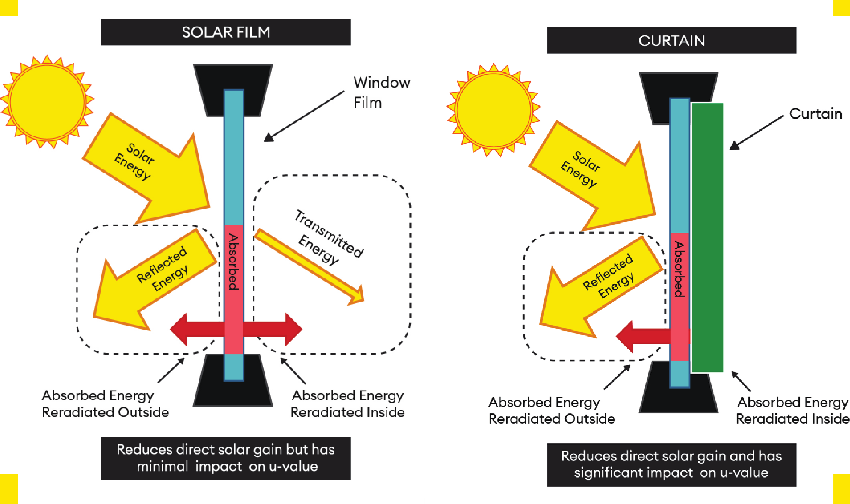
The use of curtains, and the application of solar films, reduces the direct solar heat gain when subjected to direct sunlight.
However, curtains have an increased impact on reduction of related heat gain or loss due to conduction because curtains have an insulating effect and hence lower the combined U-value. The combined U-value is also dependent on whether the curtains have loose or sealed edges, as shown below:

Thermal modelling
To carry out an evaluation of these options, like application of solar films and use of light or dark curtains, the most appropriate tool is thermal modelling – a software -based technique that accurately simulates and predicts the thermal behaviour of the indoor space and provides energy consumptions for each energy minimisation option.
Following are the key parameters that need to be incorporated into the modelling exercise:
Building geometry
- room sizes, wall thicknesses, ceiling heights, and floor areas
- the orientation of affects solar gains and losses
- floor layout and connectivity between spaces
Windows and glazing
- Window orientation and size which affects solar heat gain and daylighting.
- Single, double, or triple glazing, and associated thermal performances.
Materials and construction
- type and thickness of insulation materials in walls, roofs and floors
- materials with high thermal mass that can store and release heat
Building envelope
- properties of walls, windows, doors, roofs, and floors, including their thermal resistance (R-value) and thermal conductivity (U-values)
Internal heat gains
- number of people, their activities and the heat they generate
heat generated by appliances, computers, and other electrical devices
types of lighting (incandescent or LED) and their heat output
Air Conditioning Systems
- type, capacity, and efficiency of heating and cooling systems – essentially COPs ((Coefficient of Performance)
Thermal comfort parameters
- desired or target indoor temperature and humidity ranges
Building use patterns
- occupancy schedules outlining times when respective spaces are occupied
- variability in heat generation based on different activities and equipment usage
Climate data
- local weather conditions and seasonal variations
- solar intensity and duration of sunlight exposure
- outdoor relative humidity levels affecting indoor comfort
Energy conservation measures
- Application of solar films or use of double glazing or use of curtains
Energy minimisation study
This place of worship features a well designed and well-constructed structure.
It operates uniquely with most religious services occurring after sunset and before sunrise and social activities typically taking place on weekends.
The facility utilises LED lighting and minimal heat generating equipment.
An energy efficient ducted central airconditioning system ensures indoor thermal comfort.
The occupancy and usage patterns of this facility, like most places of worship, vary considerably. Realistic activity and occupancy schedules, along with all relevant parameters, were incorporated into the modelling program.
The weather data was selected for 2023 so that the predicted monthly energy consumptions derived from the modelling could be compared with the actual energy bills.
Specific internal shading and glass treatment options evaluated
| Type | Details | Solar Heat Gain Coefficient – SHGC* | U-value |
| Base case | Clear -– Single Glazing | 0.81 | 5.7 |
| Retrofit | Clear – Double Glazing | 0.81 | 3.4 |
| Solar Film-1 | 3-M – light | 0.53 | 5.1 |
| Solar Film-2 | 3-M – dark | 0.44 | 5.2 |
| Curtain | Dark coloured with lining | 2.9** | |
| Curtain | Light coloured with lining | 2.8** |
** CIBSE Guide A
Modelling outcomes
Findings show that light coloured curtains hung loosely are responsible for:
- reduction of heat loss through windows in winter by 53per cent
- heat gain through solar with curtains kept open in winter around 21 per cent
- reduction of heat gain through windows in summer by 63 per cent
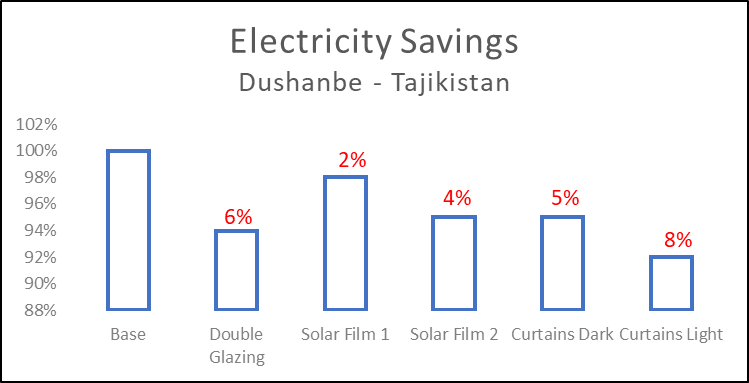
Double glazing offers a six per cent reduction mainly due to its lower U-value.
Application of darker solar film with SHGC of 0.44 has a two per cent advantage over the lighter solar film, which makes sense. However, since the usage of the facility is primarily after sunset and before sunrise, the reduction of heat gain with solar films is primarily limited to heat buildup prior to use of power consuming cooling or heating systems.
Darker curtains absorb the direct sunlight and release it inside during the day. They offer around five per cent saving as compared to the eight per cent reduction using loosely hung light curtains. Both are due to their lower combined U-value and the blanketing effect.
Commentary
How do these results apply to other types of buildings and other locations?
Thanks to the versatility of the modelling software and the expertise of Jiyan Patharwalla chief executive officer and founder of Building Zero Consultants, there were more “what-if” exercises able to be carried out.
The results show that buildings subject to an extreme cold climate benefit the most – with energy savings of around eight to nine per cent with the strategic use of curtains while buildings in temperate climates like in most Australian cities, the energy reductions would be around five to six per cent with usage of good quality light coloured curtains.
Curtains are not utilised as much in high rise office buildings. Perhaps there are opportunities to consider them. By installing them in conference and meeting rooms energy conservation would be made.
At the domestic level, use of curtains will certainly make a visible contribution towards the minimisation of cost-of-living expenses.