


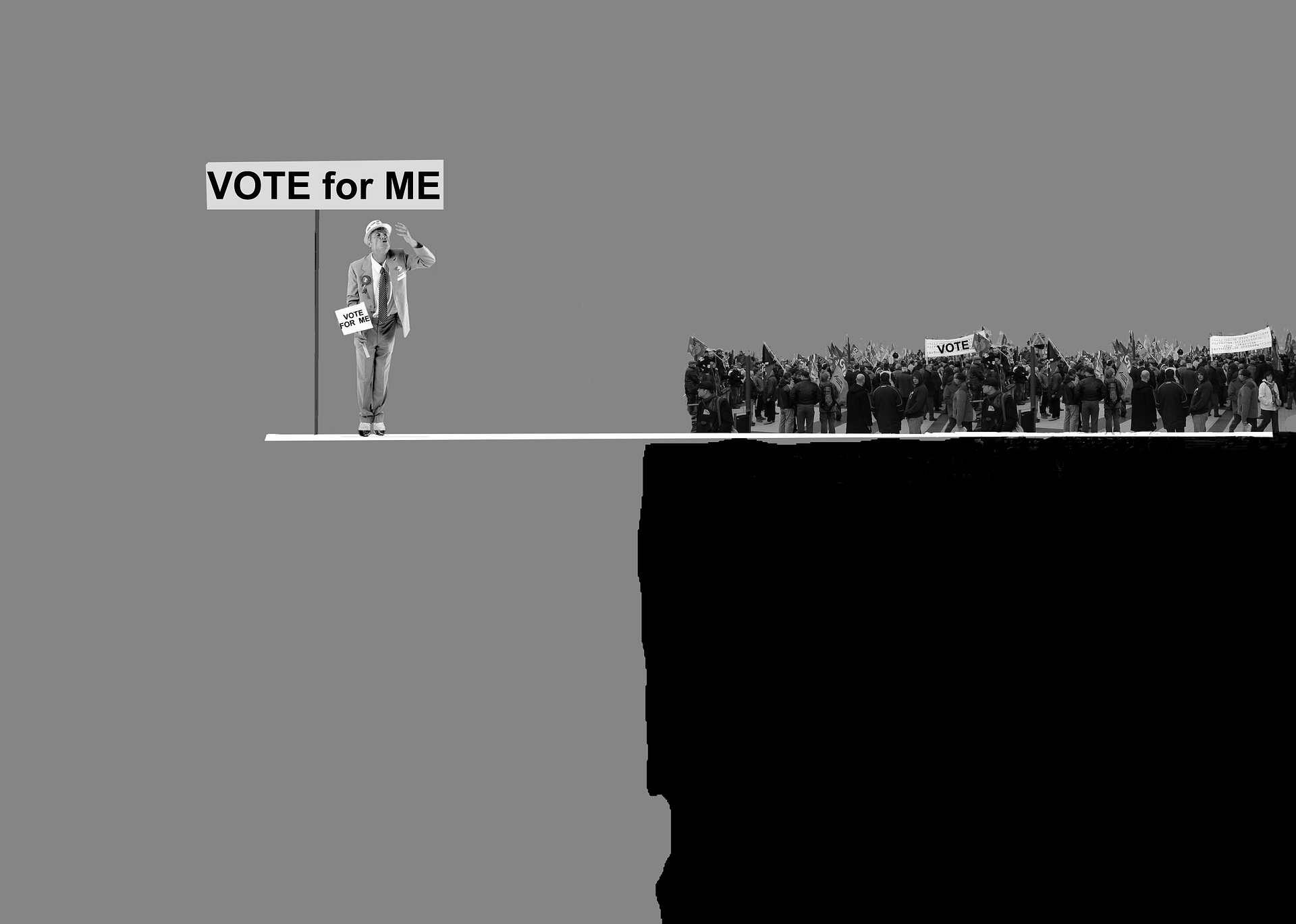
In 2024, did America show the world it wasn’t smart enough for democracy, begging the question: is any advanced democracy, including Australia, with a federal election on the horizon, smart enough for democracy?
Growing up in the 1980s and 90s, democracy was synonymous with the US of A. It achieved celebrity status with Superman’s credo of “truth, justice, and the American Way”. But after Trump’s failed January 2021 self-coup d’état, it became much harder to reconcile the American way with truth and justice.
In October 2021, DC Comics chief creative officer and publisher Jim Lee adjusted the iconic credo to a more appropriate “truth, justice, and a better tomorrow”.
Spinifex is an opinion column. If you would like to contribute, contact us to ask for a detailed brief.
“A better tomorrow” is the much-needed modifier of “truth and justice” that has been sorely tested in recent years, highlighting the need for a more hopeful outlook.
“Life imitates art!”
What few could have imagined — even the likes of Superman — were the idiosyncrasies of the American psyche that propelled Trump, now “officially” a convicted felon, to victory in the 2024 US presidential election.
As the supervillain Lex Luthor said to Superman in the 1996 animated TV series, “I control everything in this town, Superman. Your cooperation isn’t really necessary.” One can easily imagine Trump, or his equally erratic sidekick Elon Musk, delivering a similar message to Congress: “I control everything in this town, suckers. Your cooperation isn’t really necessary.”
While Trump plays the supervillain of American politics, he conversely claims to uphold “truth, justice, and the American way”. He also claims to be a champion of democracy but treats it as a throwaway. In hindsight, it was only a matter of time before “life imitates art” and American politics leapt from the hallowed halls of Washington DC into the animated pages of DC Comics.
Comic book news
We find that mainstream media has turned in sympathy from post-truth news to comic book news, replete with larger-than-life characters and increasingly rambunctious adjectives and verbs to pique one’s interest.
Adjectives like shocking, massive, and catastrophic, coupled with percussive verbs such as slammed, crashed, and shattered, are used to make the ordinary appear extraordinary. Parroting the onomatopoeic words (or bang words) in comics — like “kapow!”, “boom!”, and “splat!” — to amplify actions and incidents so they are fervently felt.
Audiences love action and drama, which is apt in comics but amounts to puffery in political journalism. George Orwell called it “Newspeak” for its ability to “diminish the range of thought”. When ethical guardrails are flouted in favour of the “kapow!” factor, it’s not journalism, it’s comic book news.
A caveat for incompetence
Henceforth, in a functional democracy, voters must be skilled at reading between the lines, capable of critical thinking and, importantly, be politically engaged. French Philosopher Jean-Paul Sartre defined “political engagement” as an intellectual commitment and a shift from personal moral consciousness to recognising the individual as a social actor and citizen in society. A transformation that carries significant responsibility and demands a level of competency that could not be considered universal.
The view that voters are incompetent, however, is not absolute. Associate Professor Paul Goren, in On Voter Competence, argues that evidence of American voter incompetence is largely anecdotal. Voters may lack detailed political knowledge, but they aren’t necessarily incompetent. One could argue, however, that “the proof is in the pudding” and voter gullibility combined with disinformation can turn an election.
A caveat is necessary here: a distinction exists between an isolated error of judgment and those who make a career out of it. Regarding the latter, as German philosopher Immanuel Kant points out: “Deficiency in judgment is properly that which is called stupidity; and for such a failing we know no remedy.”
Moreover, stupidity knows no bias. As Professor of Economic History Carlo M Cipolla’s Second Basic Law of Human Stupidity states,stupidity is independent of any other attribute, including intelligence, which says much about the grossly incompetent political candidates that manage to get elected.
Politically disengaged or advocates of the Epicurean ideal?
On this, the burning question on everyone’s lips is this: if Peter Dutton wins the upcoming Australian federal election, would he follow Trump’s imperialistic petulance and endeavour to annex New Zealand as Australia’s seventh state? Would the “Make Australia Great Again” lobby — aka “Get Australia Back on Track”, also expropriated from NZ — and the bureau of disinformation at Sky News vote for this? But I digress.
Unlike Australia, voting in the US is not compulsory, and about 90 million Americans, or 36 per cent of the voting population, did not vote in the 2024 presidential election, obfuscating the ideal of majoritarianism. There were more non-voters than voters for either Harris or Trump.
It is unclear if non-voters were disengaged; found both candidates unappealing; viewed voting as an avoidable disruption to their daily lives; or were subscribers to the Epicurean ideal and have withdrawn from the public sphere in pursuit of pleasure.
One might also argue that an accurate analysis of the root causes underpinning much of the political decision-making in democratised nations will inevitably lead to disgust, disenchantment, and, ultimately, political disengagement.
That said, lead investigator for the January 6th Committee, Timothy J. Heaphy, writes in Harbingers, “A disengaged citizenry is a more insidious threat to democracy, and ultimately more destructive than a large crowd of angry rioters.”
Should you need a licence to vote?
In Democracy a Guided Tour (2023), philosopher and Georgetown University Professor of Business, Jason Brennan, has a decidedly cynical view of political competency.
“Government decisions concern high-stakes matters of war and peace, prosperity and poverty, freedom and oppression. Yet we let incompetent people steer the ship of state,” he wrote.
“Most voters are ignorant and process what little information they have in biased and irrational ways. They fall prey to propaganda and demagogues. They are conformists and don’t try to vote in their interests. Democracy is the political equivalent of drunk driving.”
Suffice it to say, ideally, don’t drink and drive as you wouldn’t drink and vote, but there’s no law against the latter. And just like you shouldn’t drive under the influence, a designated driver to steer the economy is just as crucial. And considering the consequences, as you need a license to drive, should you also need a license to vote?
Plato and the Founding Fathers
The ancient Greek philosopher Plato doubted the efficacy of democracy, a sentiment echoed by the Founding Fathers of the United States, who were wary of its association with direct democracy. Direct democracy” is where the people decide laws directly through majority rule.
Plato believed that society should be governed by those knowledgeable in society’s social conventions rather than the masses. He argued that true governance should be guided by philosophy, as ordinary citizens’ political opinions often stem from ignorance, leading to wrong actions.
Likewise, the Founding Fathers doubted ordinary citizens’ ability to legislate, hence their reservations about direct democracy. John Adams, a Founding Father and second president of the United States, expressed his scepticism in a letter to John Taylor on December 17, 1814, stating, “Democracy never lasts long. It soon wastes, exhausts, and murders itself.”
The systematic splintering of democratic societies
In a 2022 article, social psychologist Jonathan Haidt reflected onthe fracturing ofAmerican society. “It’s been clear for quite a while now that red America and blue America are becoming like two different countries claiming the same territory, with two different versions of the Constitution, economics, and American history.”
Personal slurs, unsubstantiated claims, and purposely divisive rhetoric are somehow seen as signs of a healthy democracy engaged in robust debate and, thus, an excuse for politicians to pardon themselves from appalling behaviour and accountability thereof. Yet the opposite is true. A healthy democracy is where opposing sides compete against and respectfully negotiate with one another to achieve efficacious outcomes for the common good.
This dichotomous degeneration increasingly imposes itself on advanced democracies, reflecting John Adams’s dim view. Major parties exploit real and manufactured grievances that foster adversarial politics, often resorting to lies and illegalities to divide communities and the nation. Digital disinformation further exacerbates suspicion and enmity, eventually causing a shift toward democracy’s dark side and, lamentably, January 6-type insurgencies.
Should voters take a quiz before voting?
Knowing this, why are we so easily duped? If we hesitate to quash disinformation because it discriminates against politico-media elites propagating lies, should voters take a quick quiz at polling booths to prove their ability to identify fallacious information before voting? Think of the bevy of politicians who continue to promulgate climate change apathy and denialism that will likely cost millions of lives.
This raises an important question: considering what’s at stake, why do we allow stupid people to vote? From the perspective that only stupid people would vote without knowing what they are voting for. We might argue, because we are a majoritarian democracy that values equal rights for all, as such, we hesitate to strip away individual rights, believing that democratic principles precede ignorance.
From a voter’s perspective, however, today’s politicians are simply inept. A 2023 Pew Research Center survey of over 30,000 people in 24 countries found that “better politicians” was the overwhelming response for improving democracy, highlighting the need for greater competence, better representation, increased responsiveness, less corruption, and for politicians to be less influenced by lobby groups.
This raises more questions: if we can’t tolerate some incompetence and corruption, will there be enough competent and honest politicians to choose from? And does the fault lie with the electors, the elected, or the political system itself?
Has democracy lost its sex appeal?
You might not have noticed, but in recent years, there’s been a worldwide retreat from democracy, stifling the fight for equality against oppression. While alternatives like aristocracy, autocracy, and America’s pseudo-democracy that has succumbed to Robert Michels’ “iron law of oligarchy” are undesirable, democracy remains a less undesirable form of governance despite its flaws and seeming resistance to positive change. But does democracy need a rethink to reinvigorate its sex appeal?
In Using Political Ideas, University of East Anglia Emeritus Professor of Political Philosophy, Barbara Goodwin, sums up the democracy problem.
“Democracy creates limited, artificial equality for everyone in the political sphere, viewed as voters, while the liberal value of ‘equality of opportunity’ in the socio-economic sphere sanctions the development of real [author’s emphasis]inequalities which effectively destroy the equality of the vote and of other political rights. So, while democracy threatens liberalism, liberalism undermines democracy.”
Goodwin further presents two challenges to the essence of democracy: “Can democracy safeguard minorities against ‘majority tyranny’ without undermining the democratic principle itself?” and “Can there be real democracy without real political education?”
In other words, can we realistically govern for all of the people all of the time, and do we have the collective conscience and competence to accomplish this?
Are we smart enough for democracy?
So, are we smart enough for democracy? Probably not. Democracy relies on an educated and engaged public and morally grounded political leaders — qualities sadly lacking in modern democracies like the US, UK, EU, and Australia. And are these deficiencies even fixable in a seemingly flawed political system?
Critics argue that some political decisions require a democratic process, but this can lead to indecision on crucial reforms, especially when left to the average voter, who might lack even basic knowledge in economics, history, and political public affairs.
Now imagine a different kind of political system called “epistocracy”. Epistocracy advocates “rule by the knowers” as opposed to traditional democratic rule by the people. While it retains familiar structures like elected representatives, constitutional limits, and the separation of powers, it allocates political power based on knowledge and competence.
It’s not about elitism
Epistocrats argue that many voters in democracies lack the competence necessary to make effective voting choices. They believe that poor political outcomes are primarily due to the inability of ordinary citizens to select the best means to achieve their preferences.
Epistocracy isn’t elitist in that knowledgeable individuals should hold power by virtue of their expertise; rather, its core concept is to protect ordinary citizens from the consequences of mindless decision-making. It poses the question, wouldn’t we all benefit from decision-makers who comprehensively understood the complexities in play?
In short, epistocracy aims to prevent stupid people from electing similarly stupid people, leading to diminishing returns and the slow-burn erosion of truth, justice, and the collective good — presently underway in modern democracies like the US, the UK, and Australia. Moreover, a mandate to govern does not justify ignorance, incompetence, or the right to bullshit the public. As Oscar Wilde writes in The Critic As Artist, “There is no sin except stupidity,” which applies equally to electors and the elected.
Finally, in light of what political scientist David Rothkopf termed “America’s golden age of stupidity” in a 2017 Washington Post article, I’ll leave you with Cipolla’s Fourth Basic Law of Human Stupidity, which is most relevant here: “Non-stupid people always underestimate the damaging power of stupid individuals.”
“In particular, non-stupid people constantly forget that at all times and places and under any circumstances to deal and/or associate with stupid people always turns out to be a costly mistake. Through centuries and millennia, in public as in private life, countless individuals have failed to take account of the Fourth Basic Law and the failure has caused mankind incalculable losses.”
Mr. Dark ignores that Switzerland has had more direct democracy than the rest of the world put together for centuries, now voting FOUR times a year on local, regional and NATIONAL issues, and is by all measures one of the most successful countries in the world. https://en.m.wikipedia.org/wiki/Voting_in_Switzerland#:~:text=Approximately-,four%20times%20a%20year,-%2C%20voting%20occurs%20over
Direct democracy works OK even in the half of the US States that have it, even though it’s much harder to get issues on the ballot than in Switzerland. They allow petitions to be left unattended and so paid petitioners, costing millions in most US states, are rare. Here in Boulder, CO, I spearheaded the world’s 1st ONLINE petitioning, which has more advantages: http://www.petitions.bouldercolorado.gov
Colorado’s record since 2000 is great: tinyurl.com/Coloradoinitiatives
Here’s just one reason direct democracy works: In systems theory, feedback and fixing mistakes is critical to all natural and artificial systems. The People, in direct democracy, have incentives to find and fix mistakes, but politicians have incentives to COVER UP mistakes to protect their careers, donors/owners and images. Power corrupts politicians, it gives citizens a reason to educate themselves.
Of course we need BOTH direct democracy to set the basic values and policies and representatives to carry out details and provide a check and balance
Hey, thanks, Evan, for your comments! Note that I have always admired Switzerland’s direct democracy and how efficient it seems to work. If you reread my article, you’ll see that the reference was to the concerns of the Founding Fathers and specifically John Adams about direct democracy. It wasn’t about the efficacy of direct democracy per se and where it works.