


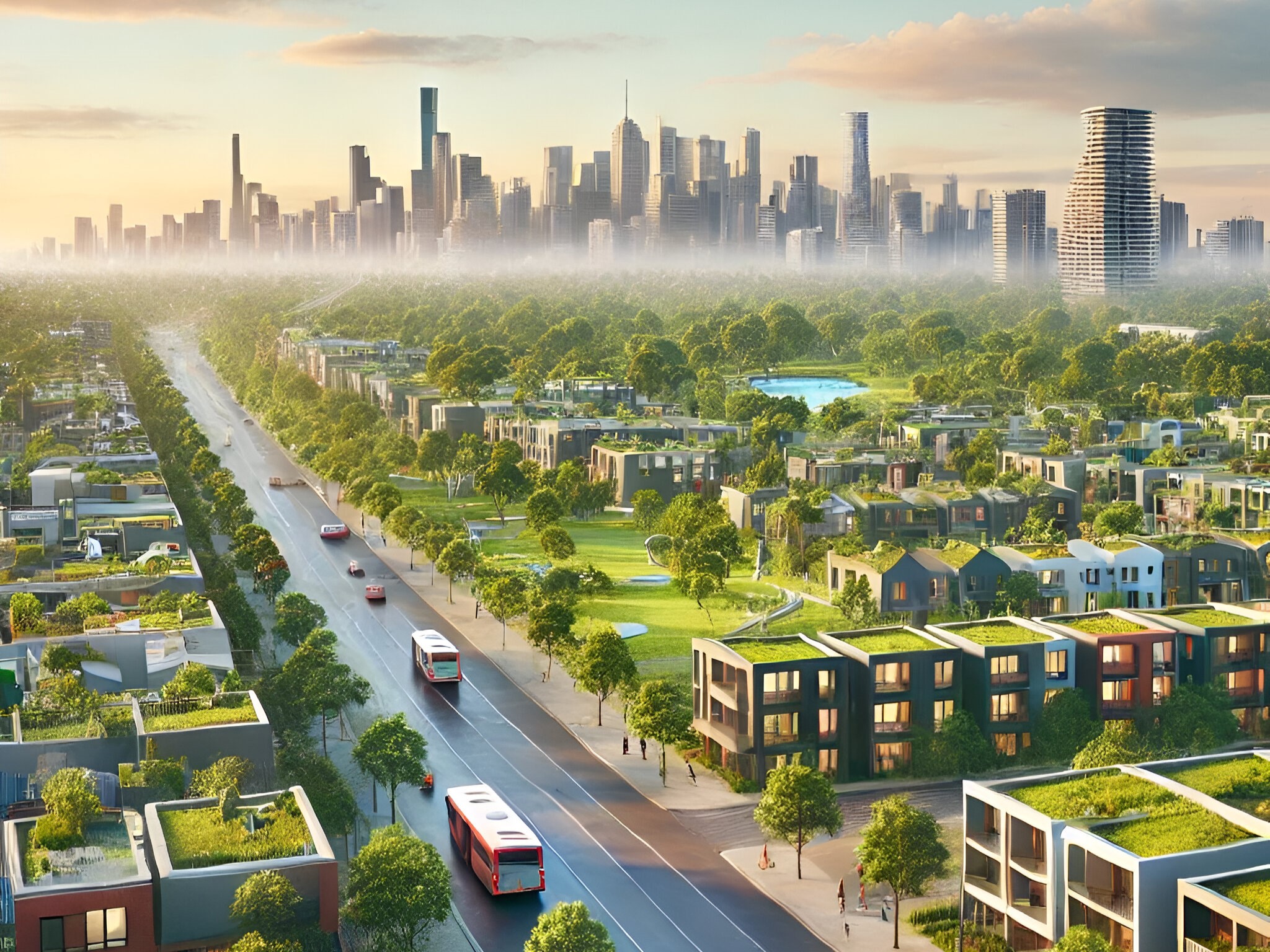
Imagine a future where we can significantly increase the supply of affordable homes, limit urban sprawl into precious greenfield land, reduce carbon emissions and provide ample parkland. I believe this future is within reach, and I’ve lodged a submission to the “Plan for Victoria” consultation process outlining a vision that challenges the traditional narrative that greenfield development is inherently unsustainable.
The size of our homes and its impact
Let’s start with an often overlooked issue: the size of new houses in Australia, which are the largest in the world.
In Melbourne, the average size of a new house is 241 square meters – about twice the size of a typical German home and three times larger than those in the United Kingdom. Have we truly considered the impact of these oversized homes on carbon emissions?
Spinifex is an opinion column. If you would like to contribute, contact us to ask for a detailed brief.
Approximately 18 per cent of Australia’s direct emissions come from construction, including the energy needed for heating and cooling. This also puts an enormous strain on an already overstretched construction industry.
Despite nearly 10 per cent of Victoria’s workforce being employed in construction, the state is still facing a serious labour shortage. In 2023, Victoria built just over 50,000 homes, falling well short of the government’s target of 80,000.
How can we expect to increase production with such a constrained workforce? Relying on market forces alone to address the labour shortage seems unwise, as it would only deepen our dependence on a single industry, making us more vulnerable to fluctuations in construction.
Instead, we could explore policy changes that promote the construction of smaller, more efficient homes.
Building smaller, smarter and more efficient
Traditional low density homes require roughly the same amount of labour per square metre of floor space as townhouses and low-rise apartments. However, because these homes are smaller, we can build more of them each year.
I propose a mandatory density target of 40 to 60 dwellings per hectare (DPH) for new developments in Melbourne’s future growth areas.
This “sweet spot” for residential construction would reduce land consumption and help manage urban sprawl. Denser subdivisions would also ease the burden on other industries essential to home building – such as planning and utilities authorities – which are also facing significant shortages, making it quicker and easier to approve more dwellings.
To house 60,000 new residents in greenfield areas at 40 DPH, we would need roughly nine square kilometres, including land for infrastructure, commercial areas, and parks.
For context, this would accommodate around 60 per cent of Melbourne’s annual population growth.
Over a decade of accommodating 60 per cent of Melbourne’s greenfield growth in denser areas, we would need around 100 square kilometres, equal to just one per cent of Greater Melbourne’s current size.
Modest urban growth boundary shifts could be sustained, ensuring a 15 year land supply that keeps greenfield land affordable and reduces speculation.
If we need evidence of market acceptance for widespread medium density, we can look to Vancouver, which has very few new low density options. Medium density development is widely accepted there and integrates well with extensive parkland.
However, the downside in Vancouver is that nearly all of this development occurs in established areas, driving prices sky high. On a recent visit, I witnessed firsthand the stark reality of this imbalance, with homelessness on a scale unfamiliar in Australia.
Melbourne has a better opportunity. Expanding medium density development in greenfield areas could be far more affordable than in established urban areas, where high land prices, NIMBYism, infrastructure constraints, and the need for land agglomeration drive up costs –especially as the best opportunities are increasingly utilised.
While mandatory density targets may affect lifestyle choices, it’s worth noting that the Victorian government is committed to maintaining a fixed urban growth boundary (UGB).
Eventually, this will mean the end of new low density development regardless. Mandatory density targets are a practical way to ensure greenfield development remains viable over time with modest UGB shifts. This approach contrasts with a fixed UGB policy that outright prohibits any new residential development beyond its boundaries – a greater imposition on lifestyle choices and housing costs.
Transport solutions for a denser Melbourne
A shift to medium density housing in greenfield areas must be supported by robust transport infrastructure. One of the most effective ways to manage growth in a denser Melbourne is through a large-scale express bus system.
Unlike costly rail networks, buses are affordable and flexible and can be deployed quickly to connect residential areas with employment hubs, particularly in the job-rich middle-ring suburbs.
With the growing availability of electric buses, the environmental benefits are even more promising.
To ensure the buses run efficiently, I propose introducing a congestion tax to reduce traffic on Melbourne’s busiest roads and complement the express bus system.
By charging drivers a fee during peak times, we can incentivise public transport use, reduce congestion, and generate revenue to reinvest in transport infrastructure.
The goal is for people to opt for buses to avoid the tax, reducing the number of cars on the road, eliminating most congestion, and cutting carbon emissions. Artificial intelligence and video technology could help manage exemptions and discounts for those carrying passengers or who must drive for essential reasons. Alternatively, extensive dedicated bus lanes could also achieve similar goals.
Addressing infrastructure costs and capturing land value uplift
One of the major expenses in greenfield development is the cost of infrastructure. Some argue that continued greenfield expansion places too much strain on government resources.
However, this financial burden can be offset by capturing the increase in land value that occurs when land is rezoned for urban development.
Research from the Reserve Bank of Australia shows that land within Melbourne’s urban growth boundary appreciates by 10 to 20 times once it is included.
Instead of allowing a few landowners to benefit from these unearned windfalls, this value uplift could be redirected to fund supporting infrastructure.
By purchasing land at, say, 2.5 times its non-urban value before rezoning, the Victorian government could curb speculation and control land prices for development.
This could be achieved by implementing a policy where only government owned land can be included in Precinct Structure Plans (PSPs) – the master plans for new estates that must be developed before any greenfield rezoning in Victoria.
Once the PSP is finalised, the government could sell the land to developers at a higher market value, using the profits to fund infrastructure.
This approach ensures that infrastructure costs would be largely covered by the increase in land value that would otherwise accrue to private landowners. This could also reduce the financial burden on developers – who currently fund infrastructure via the inefficient Infrastructure Contributions Plans system – and future homebuyers while supporting more affordable growth.
By adopting this system, which I call the Public Benefit Land Acquisition System (PBLAS), the state government would take a dominant position in the land development market, though it would not act as a developer itself.
If used benevolently, this system could significantly reduce housing costs, improve timeliness, and enhance the orderly provision of infrastructure. While conceived for Victoria, most cities would be eligible for a PBLAS.
Additionally, the PBLAS would allow the government to allocate up to 30 per cent of development areas for open space at a low cost, offering residents more public amenities.
A path toward a sustainable and affordable future
Achieving affordable housing is well within the scope of state government policy. As Victoria prepares its “Plan for Victoria” strategy, there is a unique opportunity to embrace a more sustainable and equitable approach to development.
By rethinking housing density, land use, and infrastructure funding, we can create a future where affordable homes, minimal sprawl, and environmental responsibility go hand in hand.
Read Geoff Alexander’s full word submission to the Plan for Victoria strategy below.