


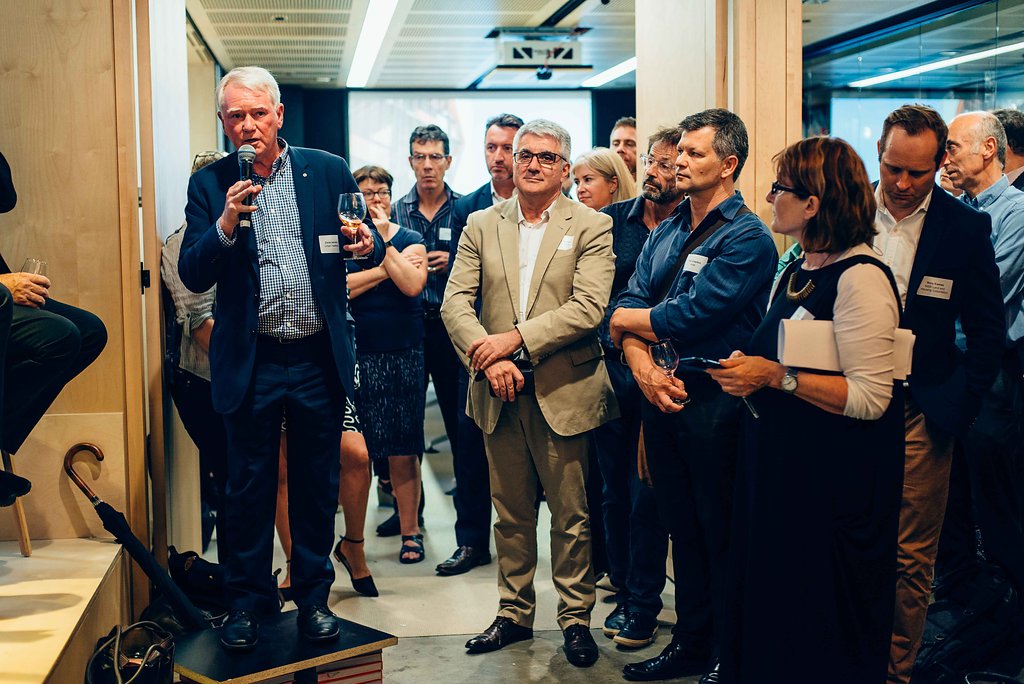
Our next big event is on housing.
Think of it as a bit like QandA gone slightly rogue.
Picture a big panel of housing experts, a crowd (80+ people), plenty of libation to loosen the thought processes, not near enough seating, so the room is bit “messy” and everyone’s fully engaged. Then set up two soap boxes, open mics, and a topic guaranteed to get the blood racing.
Discounted Member tickets available
We call it a Surround Sound because you never know where the sound will come from.
For housing this is how it needs to be.
Centre stage is the wisdom of the crowd
Up on stage will be a large panel of experts that represent various points in the housing demand and delivery chain – or system. Because it’s a complex system we’re dealing with; there are no silver bullets; no single answers and a host of outcomes needed to match the broad swathe of needs among the community.
We need the wisdom of the crowd to unpack its future.
Our sense of wellbeing
The one thing we all have in common is the acute sense that housing is critical to our sense of wellbeing. Even if we’re well housed, there’s a good chance our kids won’t be. Nor the people who serve us coffee or look after us if we end up in hospital. Not to mention the armies of people running our schools, hospitals, fire stations and other essential services.
What happens to big cities like Sydney doesn’t bear thinking about. But it’s a national problem and getting worse. In Hobart the hipster vibe probably set off by Mona has priced locals out of the market; in Perth there’s a huge deficit of housing and little regard for sustainability; in Adelaide the state government has frozen National Construction Standards to 2019 levels for a decade – condemning those at the bottom of the ladder buying in suburban sprawl-land to put up or shut up when their houses fail to protect them from heat or damp cold weather.
The building sector and MMC
Elsewhere there are furious debates about innovative delivery construction methods such as modern methods of construction (such as MMC). Mathew Aitchison’s Building 4.0 CRC roadshow in Sydney on Thursday sampled world best practice and challenges in MMC, and the state of play in Australia. It’s not good. When former NSW Building Commissioner David Chandler slammed this method in our TFE Live event a few weeks ago he had good cause. As we heard after the CRC event: the use and misuse of timber without proper design has on multiple occasions failed consumers, with poor design, poor execution and company failures.
The power within
The power of the property and development industry is immense, thanks to its size as a part of the GDP. Underneath the obvious failures of our existing system to deliver what it promised is an almighty lobbying power that rivals that of the fossil fuel industry.
Both methods of coercion and co-opting have the same outcomes. They cheat the common good. Mention the common good these days and you’re labelled a mad crazy lefty or worse. Says who? Oh, the obfuscators.
A certain Machiavellian cohort in our world has a way of identifying power structures by asking a single question of every new law or human induced event: cui bono; who benefits?
It’s time to put the “who benefits” in front of the question; not after it. We need to identify the parts of society that deserve our priority and ask others to politely make way. Just a bit. Not entirely of course – we don’t want to frighten all the horses, just the ones that belong in slammer, like the offenders in the CFMEU!
This event is about finding creative solutions
Rather than hear another endless stream of one-way advice and half-baked solutions, we’re turning the tables and giving the audience a chance to ask the experts how more creative solutions can be made to work.
Just about everyone who speaks about housing generally has good intentions. The problem is they often want to patch up a system that gave us this mess in the first place.
For instance, giving more money to first home buyers simply makes housing less affordable for those who are yet to enter the market. Thankfully that message is now permeating the general consensus.
Relying on the market to deliver sufficient adequate housing on its own is another missed opportunity.
More than a decade ago Liberal heavyweight John Brogden told a Property Council lunch that UrbanGrowth NSW was not a “rebadged” Landcom, the government’s development agency, and that it prepare land for the private sector then hand it over and get out of the way.
This was probably the pinnacle of the big ideological shift that took over governments in Australia and the UK, borrowed from the US to make governments small, sell public assets and to sit back while the markets performed their “brilliant efficient thing” to deliver goods and services at the best possible price in the most efficient possible way, because that’s what a competitive market does.
Except when it comes to housing, it doesn’t.
Housing is not a television set or a semiconductor. Allowing the market free rein to drive our housing has resulted in exactly the outcome we could have predicted: it’s delivered squillions for those who already have great assets and marginalised everyone else.
Imagine for a minute the anguish of not knowing where you home might be in a year’s time, whether the landlord will throw you out, whether you can afford the rent soon and how hard you might have to work to pay it.
Around the world countries that relied on this neo liberal model for housing are finding themselves in the same place as the schools that gave up phonics as a way to teach reading. Stuffed.
It’s why we say the problem is not that some lever was not correctly pulled; it’s a result of systemic failure.
Tinkering with demand and supply for instance.
The problem is that housing is not a commodity whose production can leave a clean neat supply and demand graph in its wake.
Housing doesn’t always get cheaper when you produce more of it. Right now, if we doubled the rate of apartments in places where people need to live or want to live in Sydney for instance, we’d just double the amount of very expensive unaffordable apartments.
Eventually prices might fall. For instance, if we produce multiple clusters of wall to wall apartment towers. But that will be because the only people who will want to live there will be poor people who can’t afford anywhere else.
They’ll put up with the brutal loss of amenity if they need a basic “bed in a box” scenario simply so they can live.
Gregg Colburn on he US view
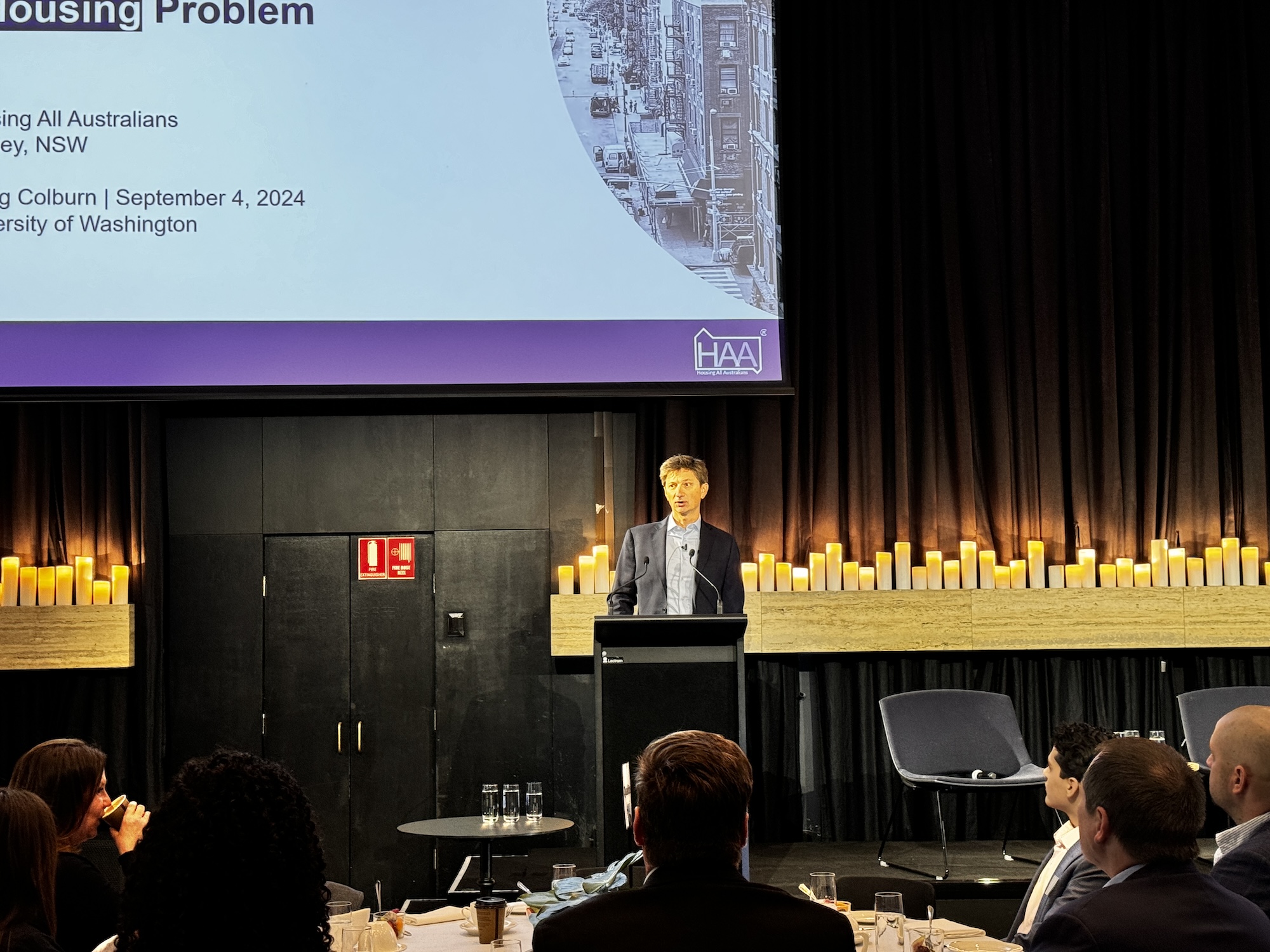
On Wednesday morning we attended a breakfast at the Ivy in Sydney to hear visiting author and academic on US housing Professor Gregg Colburn who has been brought to Australia by Housing All Australians to unpack some of his thoughts on the housing crisis.
Like many erudite Americans Colburn knows how to work a crowd. Housing is like musical chairs he said. If you take a chair away and your kid has just broken his foot chances are he will miss out on a chair. It’s not the broken foot that deprived him of a chair but the lack of enough chairs.
In the same way he says, there’s too much blame in the US on addiction and domestic violence issues for homelessness rather than a lack of sufficient housing.
Homelessness is rife in places such as San Francisco and Seattle he says but let’s not say that homeless people move there because these are liberal cities that provide slightly better social services. Homelessness he says is a result of lack of housing and slow planning approval processes.
Other parts of the country have the same rates of domestic violence and addiction but they don’t have the same homelessness issues because housing is much cheaper there. (And there’s lax planning rules).
These issues should never stand alone though. In Sydney we have plenty of housing approved but homes are not being built.
On stage at the event some of the blame was rightly pointed to a lack of skilled and affordable labour, the constrained supply chain and inflation that followed COVID – which followed the pump priming of – guess what? – the housing market because it was seen as our pathway out of those pandemic Dark Ages.
Prices can fall if places lose their amenity
Unfortunately, the market demand supply curve works very well, but can signal problems rather than solutions. Prices will of course be cheaper in places where not many people want to live, perhaps because they are remote from services, they’re isolated or have few economic opportunities.
Multiple other issues
The story of homelessness and lack of supply needs to also consider the cost of finance, shifting demographic preferences (after the pandemic many people wanted their own space) and any number of other issues; some blame immigration, but without looking at the number of empty houses kept for fun or asset gain and the number preserved for holiday rentals.
Then there is the tax regime that rewards those who already can afford an upmarket house with tax free capital gains and will logically prefer to put all their available cash into their own homes rather than an investment that’s subject to tax.
Social housing has been smashed and the politicians are a disgrace

There’s also the absolute smashing of public housing as part of the ideological shift mentioned earlier.
Introducing the Colburn session was Adrian Harrington who is chair of HAA NSW management committee and who has held various roles to try to turn the tide in this diabolic housing market.
In his introduction Harrington pointed to the halving of social housing in Australia in recent years.
He noted that in NSW 40 per cent of people seeking housing assistance were impacted by the housing crisis; 38 per cent had financial difficulties, and 35 per cent were escaping family and domestic violence.
Worse is that the state government was currently paying for crisis accommodation in hotels for 3000 people each night. Wait lists for public housing have gone to 274,000 with 106,000 considered urgent.
Unlocking a supply of social and affordable housing was clearly critical, Harrington said.
Over 25 years social housing had dropped from 6 per cent of the total housing stock to 4 per cent which is below the OECD average with the need for an additional 223,000 social housing properties.
“It’s an absolute disgrace when we’ve got a federal election coming, and yet we have our three major parties, the Coalition Labor and the Greens, who … are “diametrically opposed” when it comes to housing yet can more or less agree on any number of other issues.
“There is [housing] legislation sitting in the Senate for months because the Greens and the Coalition won’t support it. There’s measures that the Greens want to put that the Coalition don’t want…” Can’t they just get in a room and “sort this out when we have a crisis? We did it during covid. Why can’t we do it now with housing?”
Such good questions.
We need to think outside the paradigm
The trouble is there are enormous blind spots in so many of the events, panels, debates and sessions and speeches that we hear on this topic because it is genuinely hard to think outside the paradigm.
Let’s Hack Housing has grand ambitions and we’re aware it will barely touch the sides.
It’s about seeking answers from the wisdom of the crowd.
First we need to clear the slate and imagine a future we want. Just like we do in sustainability. And then figure out how we can get there.
We ran a Let’s Hack Housing event back in 2016 – Even back then housing was a major problem. Up on stage was Jessie Hochberg then of Nightingale – the amazing company founded by Jeremy McLeod and Breathe Architecture that kicked off the alternative housing revolution that influenced so many other developers – great developers who now embed of their own free will social and affordable housing or rent-to-buy housing, or veggie gardens and communal laundries that have great social dividends, and lower prices.
You can check out the video of the original Let’s Hack Housing embedded in our report on the event here https://thefifthestate.membersetup.newspackstaging.com/wp-admin/post.php?post=87872&action=edit
McLeod and the amazing cohort of supporters who flocked to his side took up radical creative thinking and to the astonishment the regular development world re-invented the housing model and showed it could in fact be different.
Time to do it again!