


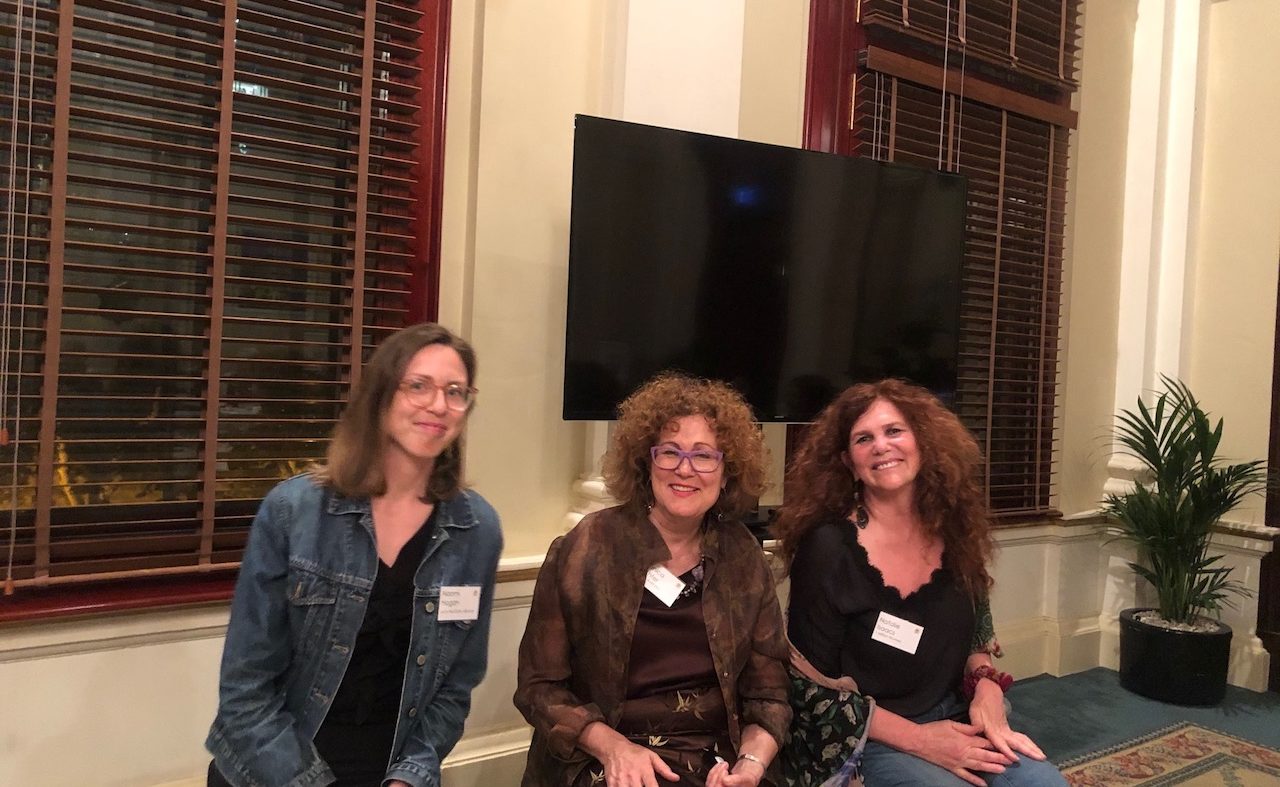
News from the front desk 459: If you want to know how to lead a strong campaign on climate and sustainability ask the three women who fronted the C40 Women4Climate panel at a Sydney Town Hall dinner the other night, in a room full of women either already making a huge impact or well on the way.
It was part of the Lord Mayor Clover Moore’s mentoring program that is shaping up as a bit of a nicely fertilised seed bomb about to be thrown out to the world.
There was Natalie Isaacs who founded 1 Million Women with its aims to shift the consumer agenda; Monica Richter from WWF who works with corporates and Naomi Hogan who heads up Lock the Gate Alliance.
A powerful, intelligent, and successful trio. One that The Fifth Estate was excited to moderate, to see what happened when three firebrands get cracking.
Isaacs spoke first. Her mission has been under way since 2009. Since then there have been some nice fillips from events such as a major United Nations global prize in 2013 and support from global leaders such as former President of Ireland Mary Robinson and Christiana Figueres, the UN climate leader.
Today the movement is just 100,000 women short of the target that Isaacs originally thought would take just six months. So, resilient AND optimistic.
Richter, well known to many people in the property and corporate space, has been one of the few representatives from a not for profit group to have made it inside the tent of the corporate sector, as Romilly Madew pointed out during the lively discussion.
Today Richter has moved from policy work in Canberra in days where the attitude to “greenies” needed a tough skin as well as clever strategy, to now helping businesses transition to a low carbon sustainable model and kick starting new agendas.
Hogan’s organisation speaks for itself. Lock the Gate has gone from a bunch of angry farmers to a coalition of skilled organisers that fossil fuellers are forced to respect. In the outback in areas such as The Kimberley and the Northern Territory Hogan’s skills as a science communicator must seem like the ultimate gift.
Together, these women have paved ways that many fear to tread, and still do.
In Isaacs’ world a dose of unknowing must have been the magic ingredient that kept her forging through a path that’s probably one of the most ambitious: convincing ordinary female consumers to change their entire life.
Isaacs’ own journey started with the simple notion of saving electricity. Her story is well known: she’d been a cosmetic manufacturer for 24 years. “I was that person… with the packaging, the micro beads.”
Was there any going back after awakening to such a path?
Richter in her earliest days at Greenpeace learned “campaigning 101,” she quipped. But in reality it seems like a blend of political and Napoleonic skills.
“What’s the critical pathway, what’s the power analysis, who are your allies, what are your intervention points to determine how best to achieve your goals and be clear about what those goals are?”
Perfect discipline for the corporate world.
From the floor, Romilly Madew, who is now chief executive of Infrastructure Australia, said Richter was “instrumental” in her influence in the property industry to achieve better outcomes.
She did not shy away from what she thought the industry should be striving for, Madew said, “you used your quiet strength to bring us all along.”
Personally we can’t see Richter shying away from much at all. Now she sits on the executive of ASBEC as senior manager, Low Carbon Futures Program, WWF-Australia and project director, Business Renewables Centre, Australia.
“You learn these things and eventually you move on,” Richter said.
“Finding ways to really engage the business sector through understanding the long term objectives and how it’s really important to speak truth to power.
“And the way to do that, that I found to be successful for me, was to be very rational; in a very rational way to get a group of people who know where they’re getting to.”
And to be utterly clear and consistent in those long term goals such as net carbon emissions by 2030, she added.
“And to be very clear at a global level of what we’re trying to do.”
Today Richter does a lot of advocacy and a lot of corporate engagement.
“The hardest part is engaging policy makers in Canberra.”
In the past the rudeness was extreme, she said.
“They didn’t want to engage at all, but you have to continue to find the allies; it comes back to the campaigning: who are the allies, what are the arguments you have to make?”
For Isaacs the hardest element of her work has been the Lifestyle revolution we have to have (not her words)
“I was gobsmacked when we only got 40,000 people [in the first six months].”
The job came with plenty of pushback. These are “profound lifestyle changes” that are needed and that’s “bloody hard” she says. “I thought I could tell my story and everyone would follow.
“You have to really understand how to build momentum and communicate this in a way that people understand.”
For Hogan, the journey is equally challenging: a science communications graduate who thought she’d landed the perfect job in a government environment department, a place from which she thought she could start to change the world.
Not so fast.
It didn’t take long for Hogan to understand in a very visceral way the power of the minerals and coal industries who directly influence policies – overriding decisions, sitting in on round table meetings, seeking changes to reports written on biodiversity.
This is something everyone knows, she challenges.
“I loved that job and the people I was working with,” she said, but eventually she could no longer stand the reality and left become a full time activist taking up camp in the Hunter Valley for five years to learn her craft, among the most polluted air in Australia where communities live down wind of coal dust.
Actions are one thing and yes they make a difference in the end such as the recent freeze by planning minister Rob Stokes on new coal mines in the catchment area for Sydney (strange that it was ever a thing; Hogan was part of the campaign to make this obvious).
But the biggest lesson from Hogan’s point of view was learning that “the real power that would make a difference” would come from the community itself; if the community itself would call for renewable energy and an end to fossil fuels.
So door knocking, talking, listening, and more doorknocking.
To hear the stories of the miners who want nothing more than for their kids to escape their own fate.
But the absurdity of the water wars must surely stimulate some fast track understanding of the issues, you’d think.
Hogan noted the loss of water resources – in this drought – to coal mines; of water trucks brought in so the mines could wash their coal, while communities go without.
In a regional part of NSW right now that’s the situation: farmers too outbid for water by mines.
Preeti Bajaj from Schneider Electric wanted to hear about the election and why the climate agenda was sidelined and so utterly lost.
The three panellists thought there was more going on than the climate and renewables agenda and Richter pointed out that along the east coast and South Australia and the ACT there are strong state and territory climate targets.
The $60 million scare campaign by Clive Palmer must have had an influence, she said. “People are motivated by fear.”
Hogan said the words climate change were still highly polarising in regional Australia and her campaign avoided related words.
“We need to spend more time in those communities, listening and reflecting back.
“There is still a lot of work to do.”
But what’s to come could be quite different.
All three women see the huge social protest movements around the world are gathering momentum.
These are not planned, Hogan said.
In campaigning, it was important to allow for creativity “that uprising in the system and let things go.
“No-one would have set out a map and said by this day have this many people… It’s really allowing people to express themselves”.
Richter was concerned at the government response to the crackdown and its threatening laws against corporate boycotts, but in particular too at the violence that’s starting to be shown by police as well.
“People are obviously angry, I am angry, but my ways of expression are different.”
What’s concerning too, she said, was that we’re entering into a time of climate breakdown and disruption and there are people who want to make a point.
It’s possible we could start to see “some pretty severe consequences”. There was “doubt that it’s going to ramp up.”
Her advice? In the corporate sector, “stick to your knitting”.
People might soon be surprised at the level of corporate support that might soon start to come out on climate.
She thinks there will be more collaboration between corporates and people working for change.
And even big important logos placed next to some strong principles.
Natalie Isaacs was in Battery Park, New York, a few weeks ago when 250,000 braved “brutal” heat to stand for four hours so they could hear young climate activist Greta Thunberg speak.
In the weeks that followed, Isaacs said it was as if people had been given “permission to speak up, they were more passionate, they had fire in their belly”.
“It gave me incredible hope. Everything’s been turned up a notch in a way that we’ve never seen before.”
In the words of climate scientist Michael Mann, Richter said: “Greta Thunberg has opened the door and we have to run through it.”
Love it! Thanks to you three legends, and all the legends in the room on the night for your inspiration.
Wonderful article and thank you all for your leadership.