


Values to value: Social licence was the dominant theme at the Clean Energy Council’s Australian Clean Energy Summit in Sydney last week. To counter this we need smart technologies, new business models and better planning to ensure regional communities share in the upside of Australia’s energy renewal.
Go back a decade or more and the big constraint on large scale renewable energy was a lack of capital to fund developments.
Around 2011, the Hepburn area near Daylesford about 117 kilometres north west of Melbourne famously raised money from about 2500 local investors to build two wind towers, named Gale and Gusto. It’s a pioneering community project that has since morphed into Hepburn Energy with solar electric vehicles and more.
These days there’s capital galore, with a global bonanza for investment in renewables and plenty of skilled commercial project originators, developers and operators.
Community energy has long taken a back seat, despite the best efforts of not for profit groups like the Community Power Agency, the Coalition for Community Energy, and small commercial players like Komo Energy and Energy Locals.
Hold the thought that we need to start prioritising and promoting community energy like never before.
It’s community acceptance, or the absence of social licence that has become the biggest constraint on significantly increasing our large scale wind and solar energy, storage and transmission.
Renewable energy proponents in industry, government and civil society know this is now their greatest vulnerability.
But so do the powerful vested interests and ideological players who still seek to promote coal and gas, delay the swing to renewables, distract with notions of nuclear power, and retain a more traditional centralised energy system.
Social licence now frames the battle for Australia’s energy future.
Will the energy system be decentralised, or re-centralised? Will it be substantially decarbonised within a decade, or will that be stretched out to 2050 or beyond? Will it be democratised, with more empowered consumers and communities, or revert to government ownership?
Politically, the path ahead will be decided at the next federal elections, which must be held by May next year.
The energy transition zeitgeist has been captured by the social licence issue. (Consumer energy resources led by rooftop solar and electric vehicles are another crucial theme, but that’s a topic for another day.)
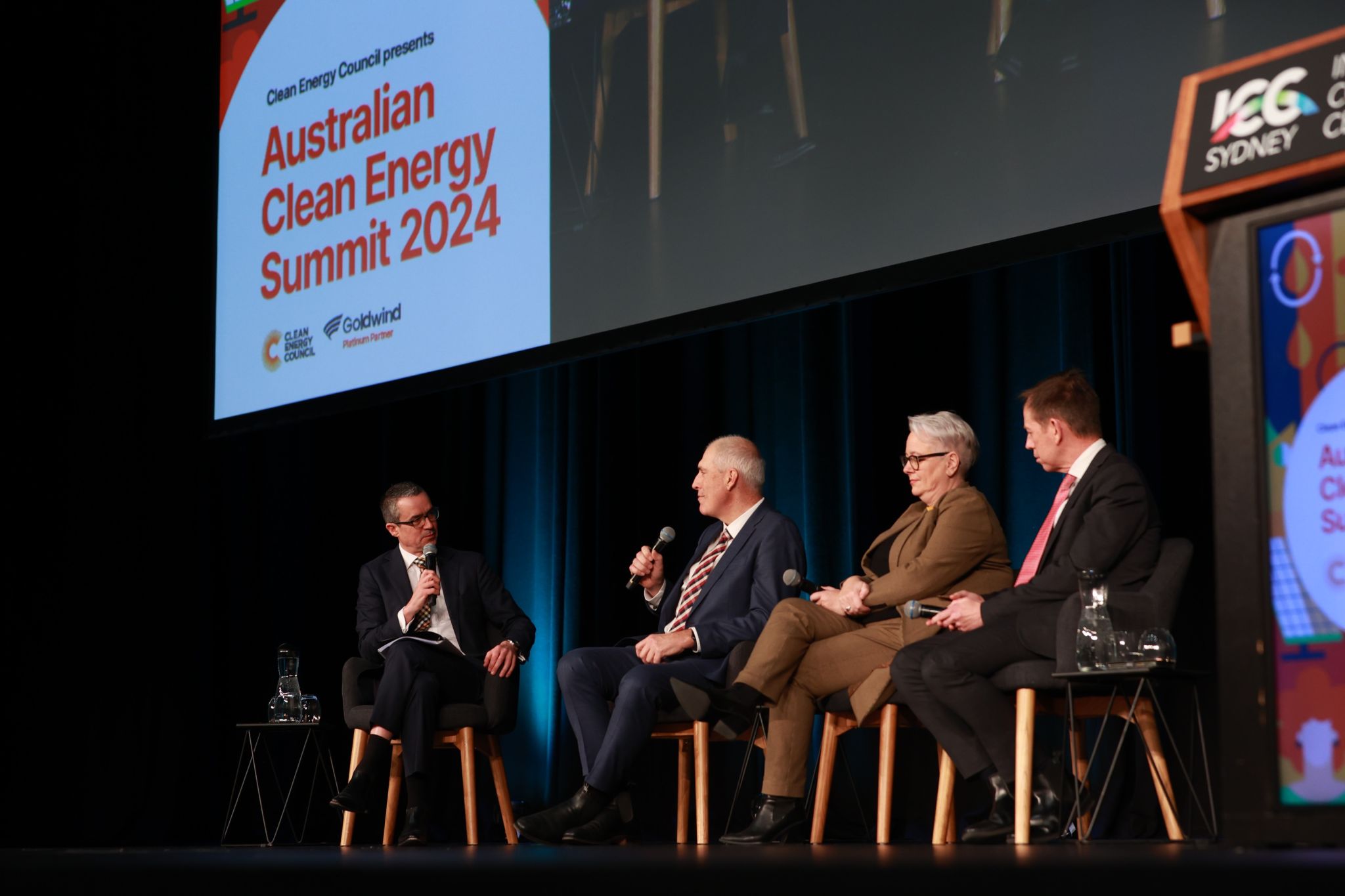
Social licence is a big theme at the Australian Clean Energy Summit
Social licence was the dominant theme for the Australian Clean Energy Summit organised by renewables advocacy the Clean Energy Council in Sydney last week.
The two day ACES attracted 1600 delegates, dozens of exhibitors, and hundreds of guest speakers and panellists, including politicians and public servants. It demonstrated that industry, investors, policy makers and governments have absolutely heard the message that consumer and community support for a renewable energy transition is under threat and requires urgent and sustained attention.
The multi billion dollar question was how to achieve that in ways that meet the needs and concerns of regional and Indigenous communities, while maintaining financial viability for energy projects and expediting their rollout.
Social licence was central again when Australia’s climate change and energy ministers met in Melbourne last Friday for their six monthly “ministerial”. It will return to the top of the agenda later this week for the Large Scale Renewable Generation and Storage Summit, also in Sydney, run by another key industry group, the Smart Energy Council (SEC).
Also last week, ahead of the ministerial, an alliance of 18 of the nation’s leading community, environmental and industry groups, including both the CEC and SEC, issued a major call to action for an equitable energy transition, saying that the greatest challenges to solve include:
- ensuring an equitable share in the benefits for and active mitigation of undesirable impacts on, the landholders, Traditional Owners and communities closest to the new energy infrastructure all Australians need
- swifter and more predictable assessment processes that are effective both in protecting nature and facilitating essential projects
- ensuring all Australians are able to benefit from consumer energy resources such as solar, thermal efficiency, electrification and batteries and prioritising people and communities experiencing disadvantage
This level of attention is crucial because community opposition, including the politically orchestrated kind, slows down the big projects that are urgently required to meet key national targets such as 82 per cent renewable electricity, and 43 per cent net zero emissions (against a 2005 baseline), by 2030.
Protecting the natural environment is core to the challenges being faced, as well as community amenity and equity. Renewable projects can’t be treated differently to other developments. The laws and the conventions, and the rules and regulations, must also be applied to them.
Planning responses include the politically fraught reform of the federal Environmental Protection and Biodiversity Conservation Act, aimed at streamlining state/territory and national planning approvals; and overtly incorporating shared community benefits, including via Indigenous land agreements into key planning instruments, such as state based renewable energy zones, and financial support mechanisms such as the national $10 billion Capacity Investment Scheme (CIS).
These are more traditional industry and government responses and are both expected and vital.
For a genuinely new and transformed energy system, however, we also need fresh approaches, which is where smart technologies and new business models come in.
Tech entrepreneur with some answers
A quick meeting I had with a on the perimeter of ACES 2024 helped me to refocus on what’s really at stake for the energy transition, and more importantly, how to get it back on track by doing new, smarter things, as well as the more traditional responses.
Grant McDowell is co-founder of homegrown Australian scale-up company Enosi, which can verify the generation source of electricity using its core PowerTracer offering.
This means it can “remotely match” generation from a specific solar or wind farm, say located in the south-west of NSW, to consumption of power from the same state based electricity grid in a tower building in the Sydney CBD, and guarantee its legitimacy in carbon pollution reduction terms.
At this week’s SEC summit Enosi will launch a new capability, “local matching”, which means that electricity from a large scale renewable project, solar or wind, onshore or offshore, could be shared with local community members to reduce their power bills, through their energy retailer.
Enosi explains it this way:
Wind and solar projects are changing our regional landscape, but the local benefits have been temporary or not directly tangible. With local matched energy every qualified community member will see a direct benefit on their bill each month, reminding them of the value these projects bring to regional communities. While grid charges are still payable, for every kWh matched to the new solar or wind farm the local community member will pay nothing for the wholesale energy component of their consumption. This unlocks fair and reasonable cost savings each month, across the life of the project. With the benefit increasing as the member shifts their demand to match the renewable output, the value is directly related to the project.
We need new tools like local matching to provide the members of communities hosting decentralised energy generation with tangible benefits that go directly to cost of living pressures today and sustained shared benefit over the long term.
Other priorities should include:
- far greater investment by governments in promoting and supporting community based energy initiatives of all kinds, including energy efficiency and power laid flexibility, as well as generation and storage. This should aim to put community projects on a level footing with commercial ones when it comes to government policies and programs
- reworking of the energy market and system rules for network businesses, the poles and wires companies, especially those covering regions areas, to deliberately encourage the optimisation of local energy solutions to minimise or avoid transmission costs, and maximise the value of locally generated renewables, including consumers’ rooftop solar. Network owned, locally deployed battery storage will be a key part of this equation, as will be coordinated vehicle to grid solutions as electric vehicles proliferate in the regions as well as the cities
The new decentralised electrified energy system needs to enable people, who are consumers and community members, to participate in new ways.
We’re going to need a fresh suite of financial and business models, engagement policies and strategies, and technologies and tools, to make a renewable energy transition work for people and communities everywhere.