


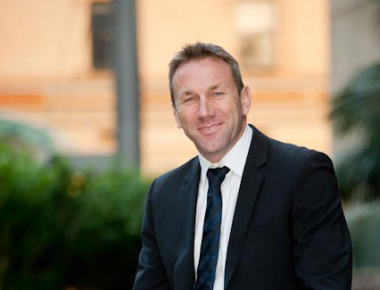
17 October 2013 — Since we last spoke to Terry Leckie in June last year, a lot has changed. His company, then known as The Water Factory, has a new 51 per cent shareholder, Brookfield Infrastructure. He’s near tripled the size of the permanent staff from six to 15. And the company’s changed its name to Flow Systems.
The name was changed because Brookfield brings with it a cogeneration outfit and its Tas Gas operation, Leckie says.
Among the new staff are Dan Hilson previously of Dalkia and Siemens, who has been hired for his expertise in the field.
The company needs the extra help. It’s in final negotiations to tie up some major trigen deals in new urban regeneration projects in Sydney and there’s new work to pitch for with City of Parramatta recently calling for tenders for a trigen system on its Parramatta Square project.
On the water side of things, the company will provide water systems to Green Square, Central Park and Australand’s Discovery Point .
That might sound like big enough jobs, but Terry Leckie has much more on his plate.
In a conversation with The Fifth Estate this week, Leckie outlined the current scope of work in residential broadacre development that is starting to move beyond NSW and into other states.
“We’ve been appointed to seven [residential] communities at the moment and we’re assisting with development on various stages of another 45 projects, predominantly in NSW,” Leckie says.
The size of communities ranges from 1000-lot estates in the new growth areas to a 14,000-lot estate in Queensland, which is still under wraps.
The biggest in NSW is a 7500-lot project at Huntley in the Lower Hunter Valley for Danny Murphy’s LWP [Live Work Play] Property Group in its first foray outside of its home state of WA.
So what is it exactly that Leckie’s team provides?
“We are exactly like a Sydney Water or a Hunter Water, but private, offering a full service system – drinking water, recycling, stormwater and sewerage,” he says.
“We provide those service locally, reusing waste water at source, reducing the size of the infrastructure so you don’t need large pipes and we are able to deliver it faster; we’re not trying to run alongside busy roads or across private land.
“We get a sustainable solution for the same if not less than the centralised solution.”
From a sustainability point of view decentralised systems offer huge advantages, because water is heavy and expensive in terms of energy and carbon emissions to move. Experts have been calling for more decentralised systems for years.
And in dollar terms the costs savings are massive.
Costs
On average the decentralised system comes at about half the conventional costs. And the time frame for delivery of a 2000 or 2500 lot system is slashed by about half as well.
Here are some comparisons. To deliver a fully serviced lot with recycled water can cost $13,000 to $14,000 a lot. So in recent times, says Leckie, Sydney Water simply said that in the in the South West Growth sector, it would no longer do so.
“Sydney Water said it was not going to be providing more recycled water solution to new developments in the South West sector. You can get a rainwater tank for about half of that so it was uneconomic.
Flow Systems, though, can do it for less.
“It’s quite a step change,” Leckie says.
Leckie agrees some of the problems of conventional solutions are difficult to shift. This includes the need to hook up new systems to the existing centralised trunk systems and legacy systems inherited from many years ago. Sometimes politics comes into the equation.
“We’re lucky we’re unconstrained. We don’t have any ageing systems of 100 years ago and we can embrace the latest technologies.
So what technologies is the company embracing?
Nothing too different at all in the end, it seems.
“We’re not trying to be bleeding edge. We’re using membrane bio reaction, which started at Sydney Olympic Park first, and we’re using reverse osmosis and pressure sewerage systems, which Sydney Water has been installing for a decade. It’s just the way we configure them and run them.”
Resilience to flooding is “absolutely” key to the design, says Leckie.
The solutions are “location by location”. And involving the community is key.
“We’re a neighbour in that community for 100 years. The community gets to make the decisions on how it uses its water.”
The provision of fresh water to the community still comes from Sydney Water, but after that the rest is controlled by Flow Systems.
So what will be the impact of the buy in from Brookfield Infrastructure?
Leckie says that from his point of view his company, with 15 people on staff and partnership relationships with another 30 companies, would gain more “weight” in a corporate sense.
From Brookfield’s perspective, the company is looking at strategic assets. “They’re able to invest in essential services such as long term assets that produce regular returns. And Brookfield is there for the long term.”
Leckie wants to add a national perspective to the long term.
For now the work is NSW-centric because the legislation that allows privatisation of water services is now five years old and has had time to be established.
“Then we’ll draw in other states,” Leckie says.
South Australia has had the same legislation but it’s new so will take a few years to have an impact on the market; WA has legislation that could support this move but so far there are “only a couple of players” that could operate in the space, Leckie says. Victoria and Queensland have yet to move off the starting blocks.
Change agent
So how is Leckie’s team operating in Queensland if there is no legislation to support private water management?
This is the subtle pioneering – and not too little political – element to Leckie’s bow.
“We’re working with the developers, assisting them to develop the concept, the feasibility and to work with the government to see how they can support the initiative and whether they need to create legislation or whether they can use new guidelines.”
New wave
If we’re going to have greenfields growth, says Leckie, at least let’s try to make it as sustainable as possible.
“The growth areas are the new wave. Let’s bring sustainability with them.”
Influencing government and helping to shape the way the legislation unfolds in the marketplace is key to meeting that goal.
And how’s that working?
Not bad, he says. “Let’s say our discussions with government are being heard.”
Victoria, through the Office of Living, seems particularly interested, Leckie says.
“Victoria is looking at new ways of delivering services in their growth areas and they have the mandate to service that growth.
“We’re talking to them.”
And his assessment for some national change?
“I’d like to say it’s easy.”
Maybe it’s not, but clearly for Leckie and his team, quite feasible.
- See our previous profile: Water Factory on a Growth Path
Hello Terry
We wish to know if your Company is in contact with Watercare Services Limited in Auckland New Zealand.
We also wish to have permission to place articles on your systems on the Manukau Harbour Restoration Society website to promote new technology (www.mhrs.org.nz)
Kind regards
Roger