


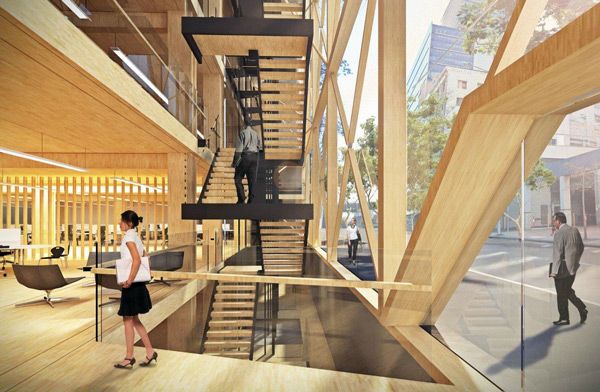
Changes to the National Construction Code mean it will now be much easier for developers to use timber to construct mid-rise buildings up to eight storeys high, a move industry says will increase both affordability and sustainability outcomes, and be a boon for the domestic building industry.
The changes, which are expected to take effect from 1 May 2016, follow a two-year consultation and research process headed by the Forest and Wood Products Australia, and involve both engineered timbers like CLT and traditional “stick” timber. Before the changes, developers who wanted to build higher than three storeys in timber needed to use a complex, time-consuming and costly “alternative solutions” model to gain approval.
As described by The Fifth Estate in our article Australand breaks through the affordable multi-resi barrier with timber, using timber for mid-rise developments could cut construction costs by 25 per cent, compared with concrete.
The managing director of FWPA, Ric Sinclair, said the move also meant the delivery of more environmentally friendly buildings that were quicker to build, while meeting or exceeding fire safety requirements.
“We expect the savings available today to increase over time as timber becomes more widely-known as a quality building material in suburban mid-rise apartments, not just houses,” Mr Sinclair said. “It is going to be an exciting time for apartment purchasers. It’s also great news for the timber industry, and a real opportunity for the domestic building industry.”
He said timber use was growing internationally, and that timber apartments were “very well received”.
“We believe the environmental advantages and liveability of these apartments will be attractive to a wide range of buyers in the suburbs, including downsizers and first homebuyers. For neighbours, the faster build- time with timber construction and the less associated noise is a plus.”
On environmental grounds, the change has the tick of approval from Planet Ark.
“Choosing apartments in timber mid-rise buildings has the potential to reduce the environmental footprint of the built environment without any increase in costs,” Planet Ark chief executive Paul Klymenko said. “It’s the perfect outcome. Creating and transporting timber building materials not only creates fewer carbon emissions than alternatives, but wood stores or sequesters carbon for the life of the building.”
In Planet Ark’s recent Housing, Health, Humanity report, the body stressed the importance of using wood that was certified, to ensure it was coming from legally harvested and well-managed plantations.
Sydney architect James Fitzpatrick, managing partner and head of design of Fitzpatrick + Partners, hailed the news as a step forward in technology for the industry.
“It’s a generational change in building technology,” he told The Fifth Estate.
“The industry has been living off the technology and systems from the ’60s and this is the first time our generation has developed new technology. We believe the use of engineered timber products is the solution of our generation.”
He said Fitzpatrick + Partners had identified the benefits of constructing medium-height residential and office buildings in timber several years ago, and strongly believed that it would become “the obvious solution” in the near future. His studio currently has three timber buildings on the go in Sydney – including in the city and the western suburbs “and another five on the drawing board.”
On environmental and safety grounds timber was superior, Mr Fitzpatrick said. Because a lot of the timber being used in mid-rise was engineered timber, it meant that much of the work would be prefabricated and built in a factory, reducing the risk on onsite injury from dangerous building practices such as concrete pours and erecting heavy steel components.
So what proportion of the buildings would be timber?
Pretty much all, he said. “We’re talking floors, lift shafts, cladding, fire stairs.”
But what about fire risk?
The new changes mean timber buildings will have to meet tough new requirements, including incorporating fire sprinkler systems. Though research on timber in fires shows that thick timber provides superior insulation and can outperform steel, which can buckle and otherwise deform.
- See our story Timber is better in fires than we think
“The simple way to think about it is that you start a fire with kindling and then put on a log,” Mr Fitzpatrick said.
“If you start with a log it doesn’t light. Timber will charr and the charring protects the timber.”
And if cost, sustainability or safety don’t appeal, there’s always aesthetics.
“The aesthetic and functional qualities of timber are at the core of the future,” Mr Fitzpatrick said. “Timber buildings are simply healthier and kinder on our environment and always express that inherent quality of warmth, nature and home.”
Mr Fitzpatrick said the code changes were a signal to the market that the industry was moving forward with timber. He also suggested it would be a huge opportunity for the local timber industry.
“This is an opportunity for the timber industry, particularly in South Australia, Latrobe Valley and North West Tasmania, to re-engineer their workforce to maximise the opportunities of their significant plantation timbers.”
Jennifer Cunich, the Victorian executive director of the Property Council of Australia, also welcomed the news, saying it would encourage domestic builders to innovate and upskill their teams to reach new markets.
“We expect a substantial impact on the viability of suburban infill developments with the increased apartment design and build options available,” Ms Cunich said.
“This new mid-rise construction methodology will add value to the property industry and the general community as the need to increase density at an affordable price increases, especially in the middle and outer suburbs. We’ll be working with the industry to ensure that training and information is available to enable domestic builders to take advantage of this code change.”
General manager of the Australia Building Codes Board Neil Savery said the changes to the code would be published on 8 February on the ABCB website but they would not become official until the states and territories adopted the new standard, expected to be 1 May.
“Until we actually publish the code it’s not official but we produce a preview on 8 February and then start a national roadshow to tell everyone what’s in it,” Mr Savery said.
“So the practitioners get a three month window to see what the changes mean.”
— with Tina Perinotto
Hi,
Good to hear that timber can be used up to 8 floors for constructing multi storey buildings. While we understand that timber is a good substitute for masonry, and from reading further articles that fifth estate published we can save 25% on costs. It is good to know that it meets relevant FRL standards, however the smoke generated by burning timber can be choking and can cause ill effects after inhalation. Also, the costs to keep the timber free from European borers, termites etc. The majority of investors in WA prefer masonry and see it more stronger compared to timber construction. Eg : We had a client who were from Asia , they would not accept timber stud construction, they insisted their construction be soild masonry. It would be more interesting to read the new code being finalised by 1st May.
Great news look forward to reading the new code