



Australia’s numerous local government councils have huge responsibilities for services and infrastructure and reach to local communities and business. They’re also first responders in emergencies and the federal and state governments’ prime chance to slash nearly a third of greenhouse gas emissions. The recent Local Government Climate Review 2024 launched early this month at the Better Futures Forum in Canberra is an eye opening text on the potential.
There are 537 local governments in Australia and they come in all shapes and sizes. From the large metropolitan inner city councils to regional centres and small rural shires, districts and towns. There is even one borough – the picturesque Queenscliffe in Victoria’s Bellarine Peninsula. Different sizes, different communities, different economic activity, different cultures and different priorities.
Spinifex is an opinion column. If you would like to contribute, contact us to ask for a detailed brief.
We have the large behemoth councils of Brisbane (1.32 million population), Gold Coast (647,000) and Moreton Bay (460,000) all the way to the Shire of Peppermint Grove in Western Australia with its 1524 residents covering 1.4 square kilometres, the smallest local government area in the land. Different and individual characteristics, local bureaucracies and local policies and of course politics.
First responders to climate disasters
There are of course a few things these 537 local governments have in common. They have elected officials – 5670 elected councillors at last count. They manage assets like roads, bridges, footpaths and community infrastructure such as leisure centres, swimming pools, libraries and childcare and aged care centres.
The other thing they are increasingly finding they have in common is being the first responders when disaster hits. And disaster is hitting more frequently.
As we witnessed with the 2019-2020 Black Summer Bushfires, the never-ending fallout of the northern rivers flooding around Lismore and surrounds, and unprecedented heatwaves across Western Sydney and swathes of the country, it is these 537 local governments who are the first responders to climate impacts on their doorsteps.
First level of government to take climate action
Ironically it has also been local governments who were the first level of government in Australia to seriously address and tackle the climate crisis and impacts that we’re now facing.
For Australian councils, tackling climate, reducing emissions and building local resilience has been a constant since the late 1990s when they started working together – and with other local government agencies around the world – to address this challenge to their communities, residents, businesses and local environments.
From the late 1990s to 2010, the Cities for Climate Protection program had 240 local governments representing 84 per cent of the population. So, over the past three decades while state and federal governments have chopped and changed, stepped up and then stepped back, pushed forward and then dithered – local governments have led the way.
When it comes to climate action at the local level this isn’t our first rodeo.
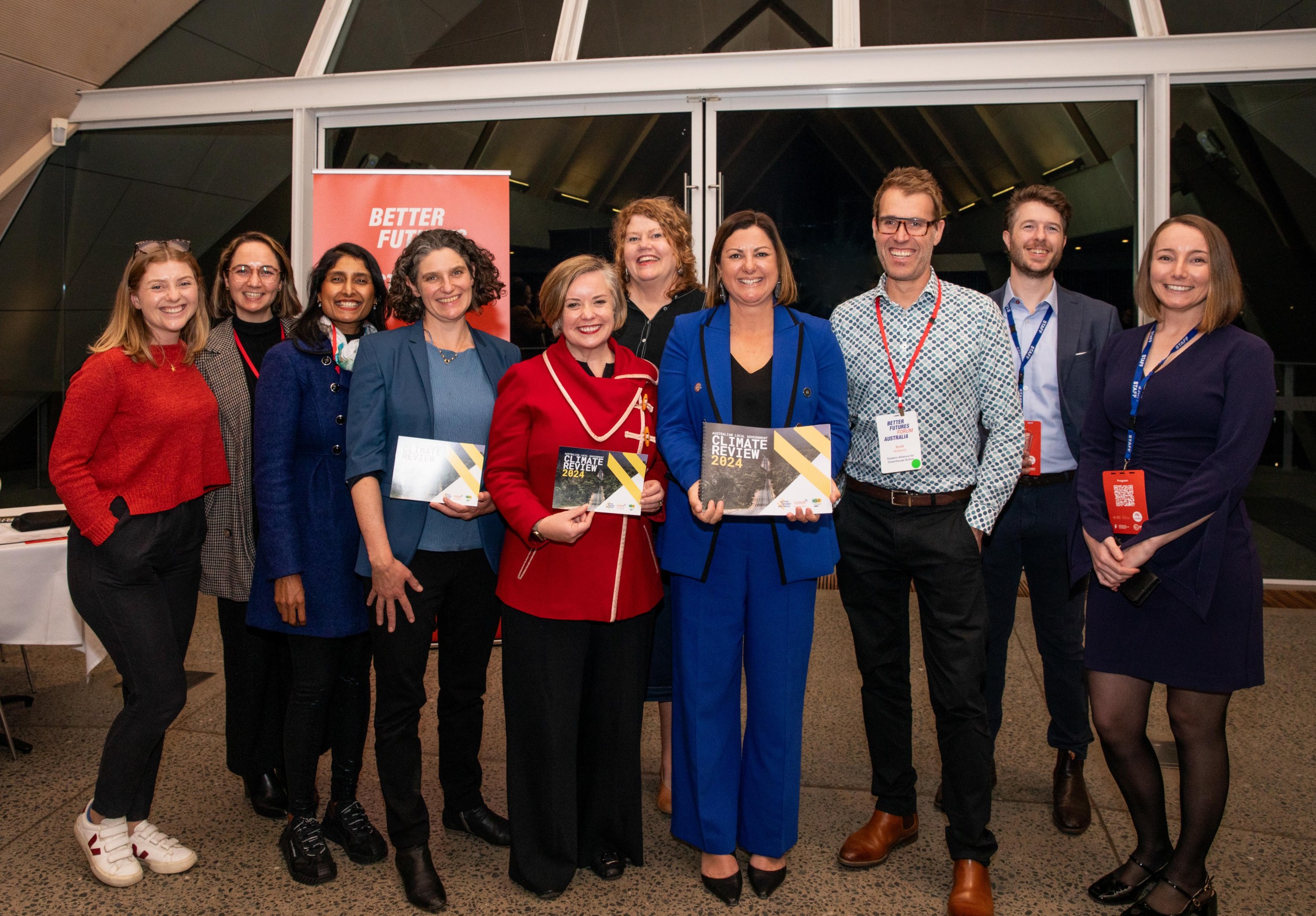
So the release of the latest Local Government Climate Review 2024 on Monday 10September at the Better Futures Forum in Canberra is a timely reminder that councils continue to lead way when it comes to their own operational emissions reduction ambition, working with their communities to cut carbon pollution and prepare for climate impacts.
Still Leading the Way
The 2024 Review, released by Better Futures Australia, developed by Ironbark Sustainability and supported by ICLEI Oceania, demonstrates the scale of local government action.
Some initial high-level findings include:
- nine out of 10 councils have set or are about to set net zero corporate emissions reduction targets for their own operations (council buildings, fleet, street lights etc)
- seven out of 10 have taken the next step to set (or about to set) net zero community-wide emissions targets (tackling residential, commercial, industrial, transport, agriculture, waste emissions)
- add it all up and these council targets alone are projected to cover almost one third of Australia’s current emissions reduction targets.
This last point is pretty extraordinary. The emissions targets of councils alone are projected to meet 29 per cent of Australia’s current targets (net zero emissions by 2050) by 2035. This highlights the crucial and largely unsung role of councils in driving national climate ambition to align with the Paris Agreement target of limiting global warming to 1.5°C.
By contrast, the federal government’s target currently commits Australia to reducing emissions to 43 per cent below 2005 levels by 2030, with calls for it to ratchet this up to 75 per cent and reach net zero emissions by 2035 ahead of the United Nations’ (February 2025) deadline for upgraded national climate plans, known as Nationally Determined Contributions or NDCs.
While council ambition on climate change is still as strong as it was decades ago, the level of sophistication in tackling the challenge at hand has improved exponentially.
State based renewable energy programs like the Victorian Energy Collaboration and Local Government Procurement Western Sydney PPA have changed the conversation as renewable energy is used to power council owned infrastructure, sports grounds, town halls, community venues, leisure centres and streetlights.
The presentations and conversations at the annual Greenhouse Alliances Conference in Melbourne in late August showed how far the sector has come, with topics around the big upcoming challenges and opportunities – electrification, adaptation and resilience, innovation, electric vehicle charging infrastructure and dealing with scope 3 and supply chain emissions.
State and federal governments. Meet gift horse.
Right now, the Australian government is developing its sectoral pathway review to steer the nation towards a net zero economy by 2050 across electricity and energy, transport, industry and waste, agriculture and land, resources, and the built environment.
The 2024 review highlights several modelled intervention programs that local government could implement right now in collaboration with other levels of governments to add significant additional abatement across the community. These include:
- solar PV adoption in lagging sectors
- facilitating community access to power purchase agreements
- increasing EV and active transport infrastructure.
Council engagement with key stakeholders/emitters to adopt and pursue ambitious targets can further reduce emissions by 6-10 per cent across the community. Together intervention programs and community engagement modelling suggests councils can support community-wide emissions reduction pathways upwards of 15 per cent by 2035 above business-as-usual projections.
Councils are again demonstrating to the federal and state governments that they stand ready to work together and ensure that national strategies are adequately supported by effective policies, resources and collaborative efforts.
Local governments stand ready with additional abatement opportunities to help meet state and federal targets.
They are slap bang in the communities struggling with the energy transition and can help with issues around social licence and misinformation campaigns around large renewables and transmission projects.
And they are the perfect implementation partner for residential and commercial renewable energy and electrification projects because they know their local communities better than anyone.
If the federal and state governments are ready to support 26.7 million Australians in reducing emissions and responding to the next flood, fire, storm or heatwave, then have a look at what Australia’s 537 councils have been up to, and how they stand ready to work with their federal and state colleagues on climate action.