


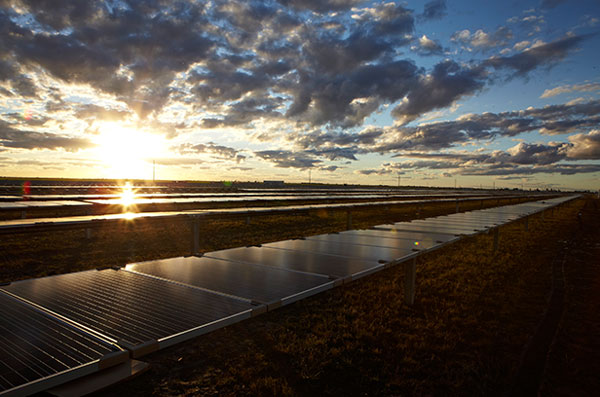
The amount of government subsidy needed to get large-scale solar projects off the ground has plummeted, according to the Australian Renewable Energy Agency, in a sign that the industry is steadily maturing. However, ARENA’s grant funding abilities, said to be key to this massive decrease, have been stymied by the federal government.
The latest ARENA competitive funding round closed last week, with 20 eligible applications seeking $211 million to go towards $1.6 billion in large-scale solar projects totalling 757 megawatts.
Whereas completed projects like Moree Solar Farm and AGL’s Nyngan and Broken Hill plants required around $1.60 of ARENA funding per watt of capacity, the latest round only required an average of 28 cents a watt – less than a fifth of what was previously required.
“ARENA is playing a vital role providing bridge funding for projects that will make large-scale solar PV more competitive by increasing confidence and building supply chains,” ARENA chief executive Ivor Frischknecht said.
“Our funding round has already reduced costs through competitive tension and encouraged a portfolio of new Australian solar plants to proceed to more advanced stages of planning and development.”
He said in the latest round funding requirements in the expression-of-interest phase were down to 43 cents a watt, and fell again to 28 cents in the full applications.
“This clearly demonstrates how quickly large-scale solar PV costs are falling supported by ARENA funding, which has resulted in rising confidence, lower finance costs and a more supportive market for power purchase agreements,” Mr Frischknecht said.
He said, however, that substantial commercial hurdles remained.
“Doing something the first few times is always harder and more expensive, and building large-scale solar PV plants is no exception.”
ARENA grant funding crucial to clean energy transition
It is in this light that the federal government’s removal of grants funding for ARENA is of concern to the renewable energy sector.
Last month Clean Energy Council chief executive Kane Thornton said clear and long-term access to grant funding was necessary to spur innovation in the sector.
“ARENA cannot build on its excellent track record of creating local employment, developing new industries and businesses in the clean energy supply chain – and bringing down the cost of these technologies through increased efficiency – without an appropriate level of funding,” he said.
“The end of capital grant funding would negatively affect the development of a range of technologies such as battery storage, large-scale solar, marine energy, sophisticated R&D and initiatives to develop a 21st century energy grid.”
The sentiment is shared by researchers at UNSW, which last month set a milestone in solar cell efficiency. They worry that the loss of ARENA funding at the R&D stage will limit the ability of Australia to innovate.
“Continuity in funding is essential in solar cell research, so if you lose your funding for even a year or so, a lot of your expertise disappears as teams are disbanded,” director of UNSW’s Australian Centre for Advanced Photovoltaics Dr Martin Green said.
“Our researchers would find employment overseas very easily, and we’d lose that expertise.”
Professor Andrew Blakers from the Australian National University agrees.
“Australia has a tremendous track record of leadership in photovoltaics,” he said. “Severe curtailment of ARENA grants will cause loss of that leadership, loss of commercial opportunities, loss of hundreds of jobs, and severe downscaling of PhD and undergraduate student opportunities.”
Due diligence and merit assessment analysis of the 20 ARENA grant applications is being undertaken currently, with successful projects set to be announced in September.