


1 August 2013 — Edge Environment the Manly-based company that made its mark on life cycle assessment work for building products is on a roll, branching into broader work around risk assessment and in recent times hiring a batch of new people including at the director level.
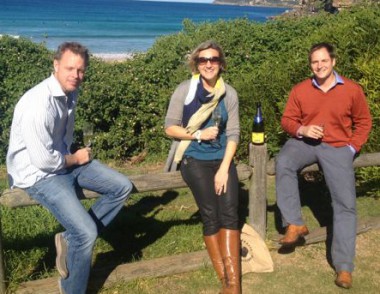
Among the new recruits is Marlin Kobacker, formerly of Arup and Cundall, who has joined an old classmate Tom Davies at Edge Environment as associate director, where both studied under Deo Prasad at the University of NSW; Ken Lunty, formerly with Hyder Consulting; Danielle Mulder, as director, previously with KPMG; and Lily Serna, a mathematician of SBS’s Letters and Numbers fame.
Director of the firm Tom Davies says work on life cycle assessment of building products for the Building Products Innovation Council had been completed and now the company was expanding into other sustainability and resilience related areas.
The North West Rail Link was now using the data, Davies says, “and it’s playing out exactly as it should. We’re getting more rigorous information and we’re now in a position that manufacturers who make the effort will be rewarded.”
In the new areas of focus, he said, major work was in resilience for the insurance industry, as part of the Insurance Council of Australia’s Australian Resilience Taskforce, set up to deal help shift trends to more favourable outcomes for its members.
The council has done the same work, quite successfully, in the case of car theft and credit card fraud, spending a proportion of the total cost to the industry on trying to change the trajectory of the problem, Davies says.
“Ultimately we want to see a more resilient built environment. For too long we’ve been building inappropriate houses in inappropriate locations and that’s due to poor land use planning and the fact that resilience isn’t part of the building code.
“We’ve been working with the Insurance Council for three years on a decade long project to promote a more resilient built environment. Our fundamental objective is to develop a rating tool for resilience, just like Green Star and NABERS.”
The question, he says, is “what is robust and what is brittle?” The market will reward the robust just as it rewarded the most sustainable properties under the NABERS and Green Star ratings, Davies says.
It’s a view shared by the Productivity Commission in its report on resilience for business and the economy published earlier this year, he says.
“In essence that’s what we’re seeing – the market will respond and reward you. In my view the industry has been building brick veneer houses with concrete floors and concrete tile roofs and putting them in quite marginal areas, and now we’re beginning to pay for this.”
This style of housing is fine in areas “not prone to flooding and not prone to hail”, he says.
Bushfire planning regulation has been very successful, he says, but we haven’t considered flood storm and extreme heat.
The tool is now just about finished – prototype two that is – a web-based version of the tool that is now being trialled at Lake Macquarie.
Davies doesn’t want to discuss local council actions too deeply as he says it’s a sensitive issue.
But The Fifth Estate has written several articles on how local govenrment areas are dealing with the threat of storm surges and flooding, and the need to warn impending buyers of the risks.
See recent articles:
- Investors warned on waterfront property
- NSW coastal planning in storm of confusion
- Rising sea levels put houses and councils at risk
Among the recent recruits, Ken Lunty, previously with Hyder Consulting, is a specialist in environmental risk compliance.
His background includes consulting work with quite a few local governments, DEXUS, in climate change risk and greenhouse gas and environment.
These sorts of issues are increasingly coming into play at the state level with requirements for climate risk assessment, especially in state significant work.
“It’s not really coming up in development applications at the local government level yet,” Lunty says, but is “fairly high level and not a huge part of the development; it’s one DG [director general] requirement across 50”.
“But it’s good because it makes the designers and engineers think a little bit more.”
Homes
In a private home, however, the high level can become highly specific, especially if a property owner is doing work and wants to ensure the downpipes or stormwater drains they are installing will last for next decade or so.
“Everyone is going to try to build to the [building code] standard because that’s the lowest cost,” Lunty says.
If you want to go beyond the standard, you do a cost benefit analysis.
Should ordinary householders be doing this?
Yes, is the answer. But each area is different. Okay, how about inner city Sydney?
According to Lunty, projections for this area are for a 10 per cent increase in intensity in rainfall by 2050.
But that’s an average, and it doesn’t presuppose that everything will be normal right up until 2050.
[It’s also using data before the latest reviews, each of which seems to be worse than the one before.]
Once you are satisfied with your projections, you then get a stormwater engineer to work out what size of downpipe or stormwater pipe you need, Lunty says.
That’s fairly detailed work, but according to Lunty that’s exactly what companies such as DEXUS are getting to.
“They’re really looking at the tangible risk.”
It’s an important issue for property owners with big roofs, such as sheds and shopping centres, which means there’s a lot of water to potentially collect or allow to shoot over the guttering.
There’s also the added risk of interaction between these events and the public, especially in shopping centres.
Among other recent work Lunty has handled is consultation with 12 councils in Tasmania, centred around Hobart in the south of the state.
Councils are worried about their real estate assets in the same way as real estate investment trusts; the planning frameworks and development approvals are another matter.
What he’s noticed in his work is growing awareness of the problems and issues, and among people who in the past might have been inclined to be sceptical.
“You could see a shift in attitude with people you didn’t think would be engaged.”