


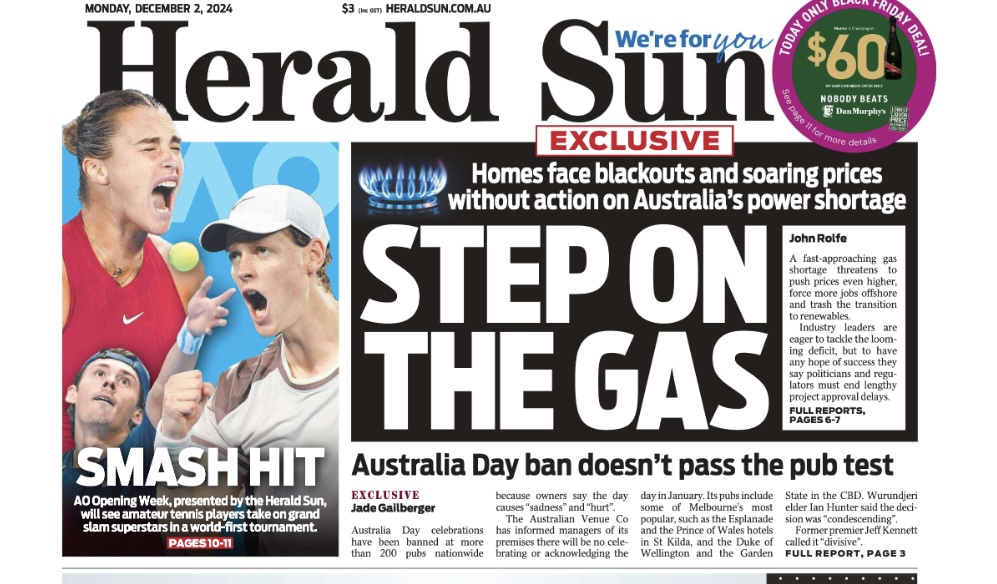
Last week, The Fifth Estate covered alarmist claims from fossil fuel proponents trying to keep gas in the home and commercial kitchens with claims of extreme costs to disconnect from the grid and fears of blackouts.
This week News Corps tabloids Daily Telegraph, Herald Sun, Courier Mail and Adelaide Advertiser continued the battle with a week-long series promoting fossil fuel, masquerading as editorial, reported by The Guardian.
The Courier Mail ran the headline: “Step on the gas – only way to avoid higher bills, blackouts.”
The Daily Telegraph had “Dark Ages – Australia told to step on the gas or lights will go out” and marked as a “special report”. The Herald Sun, which ran the same article as the Courier Mail, claimed it was an “exclusive”.
More recent developments on Wednesday saw the Greens calling on Murdoch media executives to go before a Senate inquiry over accusations of greenwashing after running double page spreads of advertorial “proudly sponsored” by gas infrastructure business APA Group and gas companies Santos, Tamboran and Jemena.
On the first day of the week long coverage, the anti-greenwash campaign group Comms Declare issued a complaint to the Press Council, an independent non-governmental organisation that upholds responsible journalism.
Under Press Council guidelines, “advertorials” must be identified by terms such as “advertisement”, “advertising feature”, “special feature”, “sponsored feature”, and the likeso readers are not led to believe the content is free of commercial influences.
Comms Declare complained that The Daily Telegraph’s front page spread pointed to content sponsored by the gas industry but this was not made clear on the front page, saying another who sees the paper without looking further would likely be misled into thinking it was “unbiased journalism”.
The complaint also adds that the term “coverage” falsely infers that there is a story being “covered” by journalists when, in fact, there are no balanced views and only the gas industry is covered.
Campaign founder Belinda Noble told The Fifth Estate, “Newspapers have been running these “advertising” or “special features” for gas companies for years; what’s different is the front page position, without a disclosure that it’s sponsored content.

“These features are a real regulatory grey area. They are half-editorial, half-advertising, and that produces the most insidious and misleading propaganda in the Australian media landscape.
“We believe the gas and coal industry should be prevented from buying favourable media coverage, and that can only be done with a ban on fossil fuel advertising and sponsorships.”
The Greens are going further
In a statement, SarahHanson-Young, Greens spokesperson for communications and chair of the senate inquiry into greenwashing, said, “This isn’t journalism – it’s fossil fuel propaganda.
“We know that the social licence for coal and gas is rapidly melting as climate change gets worse and the public learns more about who is responsible.”
“We will look to call Murdoch media executives before our Greenwashing inquiry in the new year to explain their disregard for basic journalistic ethics and their longstanding campaign against climate science.”
And News Corp gives nothing
Crikey went a step further, contacting the editors of News Corp’s capital city metropolitan tabloids to ask why none of their papers disclosed that stories were sponsored and whether that practice was sufficient, transparent or ethical. None replied.
But those “interviewed” and quoted included Woodside Energy chief executive Meg O’Neill, APA Group’s managing director Adam Watson, Santos CEO and managing director Kevin Gallagher, and Australian Energy Producers’ chief Samantha McCulloch. A line from Energy Minister Chris Bowen was included at the end.
Another article claimed that grocery producers said that gas increases had impacted their business.
Also, amongst the spread was an article from former foreign minister and high commissioner to the UK Alexander Downer, titled “High power prices, less reliability and fleeing industry: Welcome to our future
Downer’s article said: “we’re going to continue to use gas” to maintain current living standards. Crikey noted that Downer had no qualifications in anything related to environment and energy. Although he is chairman of a natural hydrogen and helium gas firm called Gold Hydrogen.
Professor Jeremy Moss, climate justice researcher at the University of New South Wales, told Crikey “there is no gas shortage at all in Australia, because we export the vast majority of our gas overseas.”
“So, the argument that there’s a shortage, and because of the shortage, we need to invest in opening up more fields is just completely wrong and mistaken as you might expect from a paid-for advertisement from the [gas] industry.”
Part of Australia and France is going further
At the time of publication, Belinda Noble was in France to better understand how France managed to become the first European country to ban advertisements from fossil fuels under a climate law that came into effect in 2022.
The gas industry was exempt from the law but only until 1 July 2023. Penalties for publications ignoring the laws were fined between €20,000 and €100,000 ($A32,000 to $A163,000), with repeat offenders paying double the amount.
Noble added that more than 40 jurisdictions around the world had some form of ban on fossil fuel promotions, and 17 of which were in Australia. These include:
AUSTRALIA
- Blue Mountains
- Byron Bay (has banned fossil fuel sponsorships)
- Charles Sturt
- Darebin
- Fremantle
- Glen Eira (has banned fossil fuel partnerships)
- Inner West
- Lane Cove
- Maribyrnong
- Merri-bek (has banned advertising and sponsorships on council property)
- Mitcham (banned sponsorships and advertising)
- Mosman (deferred)
- Northern Beaches (rescinded)
- Sydney
- Waratah Wynyard (has banned fossil fuel sponsor signage)
- Wingecarribee (has banned fossil fuel sponsorships)
- Yarra (has banned advertising and sponsorships on council property)
OVERSEAS
- Amersfoort – Netherlands
- Amstelveen – Netherlands
- Amsterdam – Netherlands
- Basingstoke – United Kingdom
- Bern – Switzerland
- Bloemendaal – Netherlands
- Cambridgeshire – United Kingdom
- Coventry – United Kingdom
- Deane Borough – United Kingdom
- Eindhoven – Netherlands
- Edinburgh – United Kingdom
- Enschede – Netherlands
- France – (Countrywide ban)
- Groningen – Netherlands
- Grenoble – France
- Haarlem – Netherlands
- Lancy – Switzerland
- Leiden – Netherlands
- Liverpool – United Kingdom
- Lyon – France
- North Holland – Netherlands
- North Somerset – United Kingdom
- Nijmegen – Netherlands
- Norwich – United Kingdom
- Sao Paulo – Brazil
- Sheffield – United Kingdom
- Somerset – United Kingdom
- Stockholm – Sweden
- Tilburg – Netherlands
- Toronto – Canada
- Utrecht – Netherlands
- Vevey – Switzerland
- Wageningen – Netherlands
- Zwolle – Netherlands
- The Hague – Netherlands