


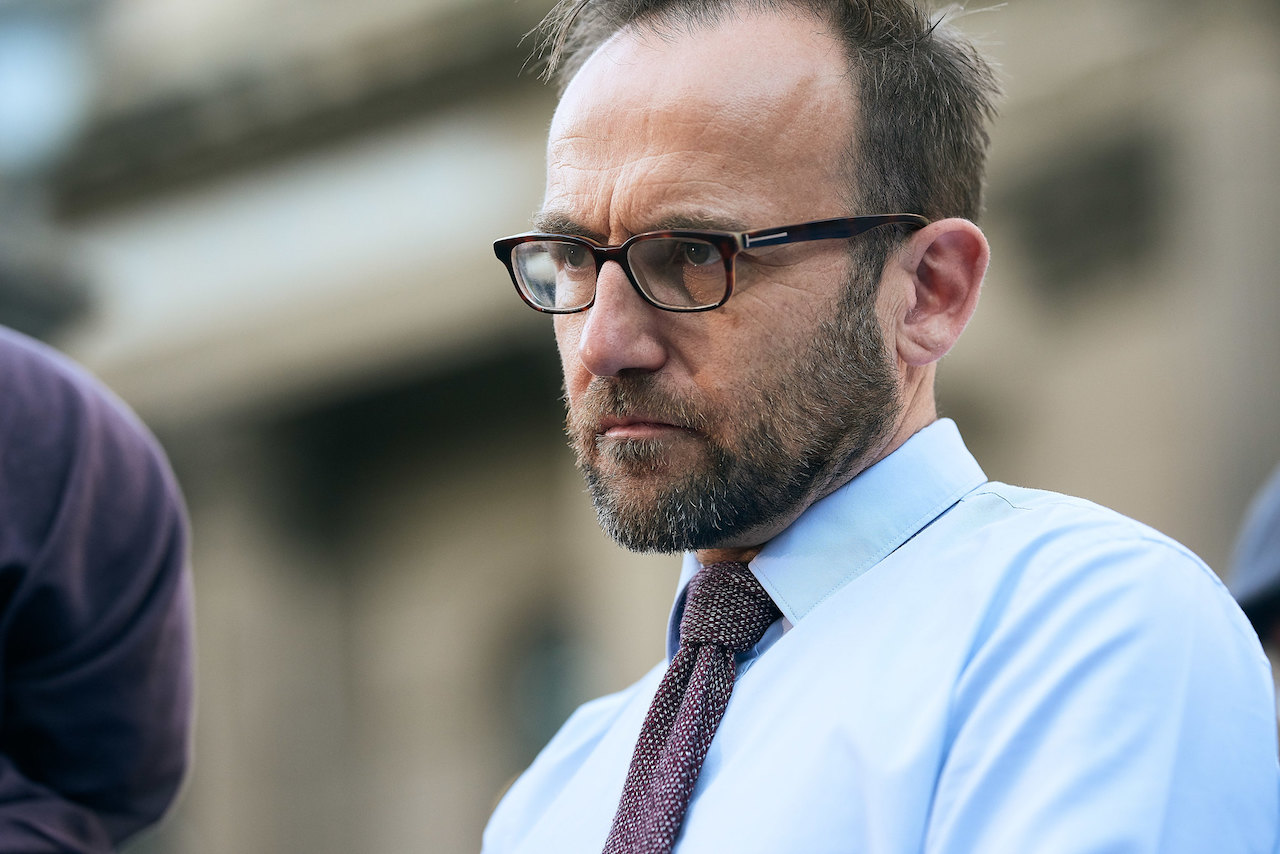
News from the front desk on Friday (part II) – If you’re in the camp that thought the Greens under Richard Di Natale was too focused on playing the sensible middle ground and not enough about standing in front of bulldozers, then you’ll be pleased.
New leader Adam Bandt has come out punching, calling on coal and other fossil fuel companies to pay $1 billion to fight bushfires they contribute to through climate heating, effectively forcing them to pick up their externalities after themselves. There’s some merit in that, and precedent: the user pays system.
He’s also called for stronger policies on linking climate crisis with the “crises of housing, jobs, and inequality”.
And he’s called for a Green New Deal, US style.
Specifically, “dental care inclusion in Medicare, free education, and a ‘manufacturing renaissance’ driven by cheap, clean energy”.
Here’s more of a taste of how he thinks:
“Part of the reason I’m excited about being leader now is that people are feeling the effects of climate very physically. Here in parliament, the rooms smell like smoke. When I dropped my kids off at daycare just a few weeks ago, the air was so dangerous that the warning on my phone showed someone in a gas mask.
“We have a climate and environment emergency, an inequality crisis and a jobs crisis and the government’s only answer is ‘well, get used to it, because it is the new normal’. Well, I refuse to adapt to kids wearing gas masks.”
The Australian called him the Greens’ attack dog. Charming.
But if you think that the “loony left” or “sandal wearing muesli munching hippies” are the only ones pleased with this, think again.
The focus in financial circles are increasingly about climate. The stories in the local media, by volume, are growing exponentially, we guess.
Investors are either pulling out of fossil fuels fast or preparing to. Regulators are urging greater action on climate – Reserve Bank of Australia Governor Philip Lowe recently urged capital spending on energy related areas as ways to bolster the economy.
Outfits that assess financial risk are creating or buying the tools to measure climate risk. The latest to announce a new measurement tool is MSCI with its MSCI Climate Value-At-Risk designed to measure “the potential impact of climate change on company valuations” while “helping to identify innovative low carbon investment opportunities, through security specific modelling”.
It currently covers more than 10,000 companies.
Remy Briand, head of ESG, at MSCI, said: “The world’s attitude to climate change is rapidly evolving due to dramatic environmental, social and governance shifts driving a move to a low-carbon economy. As we reach this inflection point, investors are now publicly expressing a desire to take action and address the urgent reality of climate change themselves, and they are also urging others in the investment industry to do so too.”
Meanwhile, corporates are worried about their reputation if they don’t make a start on “the journey” and signal that they care, they really, really care.
It’s way too early for the word “avalanche”, but this is how it starts.
Part of that movement is that politics is a mess. Again. But getting worse, with two national political parties undergoing leadership challenges this week and growing rumours that Scott Morrison’s tenure as PM is under threat.
If you feel a sense of the ground shifting beneath your feet you’re either standing near a NSW gas fracking site (thanks NSW government) or the movement is all in your head, made so by the dizzying shifts under way.
In our prototype podcast we recorded on Wednesday (yes, we too) Energy Lab leader Piers Grove, who happily played guinea pig, said it was like a huge airliner starting to move backwards. It’s clunky, slow, and a tad dangerous. But it is happening.
Adam Bandt is the pointy end of that airliner. But instead of the usual catcalls and hysteria from the denialists, for people who take environment seriously it’s quite possible there will be silent cheers for Bandt in the boardrooms, among journalist stuck in right wing media and in millions of homes.
Besides, Bandt doesn’t look like a hippie (neither did Di Natale); he’s a lawyer and (which means he knows how to argue); he’s just more impatient. This is a time for impatience.
People who thought the Greens were too moderate or too broad and had given up on them as a force for change will hope that the leadership change means they will pick up more of the heavy lifting.
That’s not to say that Di Natale did not do a good job. He was right for the times. When Di Natale became leader people were scarred by the destructive anger of the Abbott government, and were leery of showing their true colours – especially in the corporate world, property included. Many in property went backwards in their commitments to sustainability.
But it’s a different world now. The time for marketing led environmental and sustainability approach is gone. It has to be full throated and deeply embedded, especially for property. Property is the fastest, cheapest way to reduce carbon. It is barely out of the starting blocks if you look past its elite.
And there is a noticeable rise in critics ready to call out the recalcitrant image seekers. Including a far more searing arc lamp shone the way of those big burly property owners who think they still can do just “what the law requires”.
Under Di Natale, the Greens did the best that could be expected under the most hostile, crazed and fabricated attacks against climate science you could imagine, especially from the Murdoch empire.
Writing about Di Natale in Crikey, political analyst Guy Rundle says they did better than acknowledged. “In the five years of his leadership, the Greens have stabilised as a party and consolidated their position as a genuine third force.
“The idea of the ‘Green fade’ was typical of the parochial intellectual mediocrity of the press gallery, which hadn’t bothered to look elsewhere to see how Green parties — such as the German Greens — fared as they went into their second, third, fourth decades.”
And he reminds of the stability The Greens gave to Julia Gillard in government, which allowed her to pass every bit of legislation.
Our thinking has always been that The Greens would only eventually lead themselves out of relevance as the major parties take on the existential role of saving the planet. In the end we’ve always thought, we will all be Greens.
Clearly that’s still something on the wish list but the movement under way feels seismic.
We’re making that call anyway.
Former Greens senator Scott Ludlam agrees whatever is happening is big. Ludlam, one of our favourite pollies (he was a guest at one of our salons in Perth a few years ago) these days lives in NSW’s south coast near the ground zero town of Cobargo, and when we spoke he was hoping the forecast heavy rain would finally end the continuing fire threat.
Ludlam says climate change has been “knocking over one prime minister after another” but that finally climate denial has become untenable and politics is now volatile and unpredictable.
The underlying problem for pollies, he says, is that we have a situation of state capture, where a particular block of industry has such a tight grip “not just on the executive of parliament but on all resources-based industries” that democracy “not really operating”.
In this environment, the role of The Greens is critical.
“We’re pushed into a corner but that makes our roles more important than ever.
“We don’t take their money, we don’t take their orders and we don’t drink their Kool-Aid.
“We’re pretty resilient, given what’s been thrown at us over the years.”
Meanwhile, there’s a sense of chaos festering beneath the surface in Canberra.
PM Scott Morrison is fielding pressure from the extreme coal lobby on one hand and the moderates who care about climate and want him to shift his rhetoric – and action.
The Nationals must feel stuck between a rock and a hard place given the leadership choice they have between the soporific Michael McCormack and the increasingly unhinged Barnaby Joyce (did anyone see his selfie video he posted before Christmas?), you can see why the Nats stuck with McCormack.
At least he’s shifted his narrative a bit too. This is not a time for crazed anti-climate deniers. Everyone’s noticed the shift from, “climate change isn’t real” to, “yes climate change is real but it’s not our fault and we can’t do anything about it”.
Like the first and second world wars when the Aussie PMs said, “sorry folks, seeing as we can only contribute a few percentage points to your war effort, it’s not worth the trouble”. Not.
Morrison, though, is nothing if not keen to keep his job. So when new national resource and water minister Keith Pitt made a play on Thursday for “clean” coal and nuclear, it took just a few hours for Morrison, who’s head must be spinning as hard as ours right now, to say no to the nuclear option.
And he seemed to be hedging his bets on the so-called clean coal option that Pitt called for, as well.
Last we heard nuclear is extremely expensive and dangerous. But doubtless it is extremely attractive to the purveyors of nuclear power stations who must be lining up in the corridors in Canberra behind the coal lobbyists and wondering how to shunt them out the door a bit faster.
Imagine diverting that nuclear power station money to improving the grid and supporting community solar. Especially for people who don’t own their own homes and are currently losing sleep because their houses are too hot and the landlord either won’t put in airconditioning or it’s too expensive to use. See Poppy’s personal view on this.