


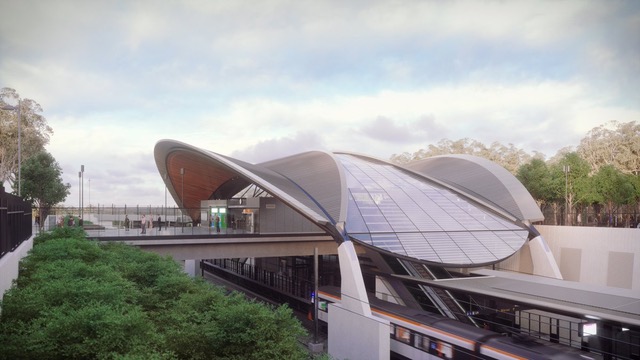
Infrastructure is no longer just about engineering. A growing number of major transport projects are turning to leading architects to make the humble train station or light rail stop into a thing of beauty.
Among architects bringing their aesthetic sensibilities to public transport are Grimshaw Architects, which designed the Southern Cross Station in Melbourne and is now embarked on a range of other stations including the removal of the level crossings project in Melbourne and Sydney’s Light Rail.
Architectus is another leading architect partnering with Foster + Partners to design six stations on Stage 2 of the Sydney Metro project plus working on Gold Coast Light Rail, Canberra’s Capital Metro, and Parramatta Light Rail. A third is Hassell with the Sydney Metro Northwest and now entrusted to redesign the much-loved Flinders Street Station and, in conjunction with UK firm Weston Williamson, Melbourne’s five new Metro Stations
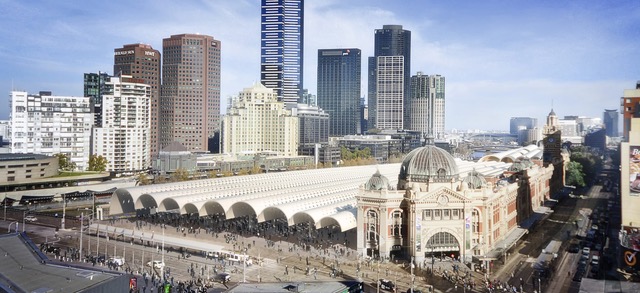
For Grimshaw Architects transport design is nothing new.
The studio opened its Melbourne office when it was appointed to transform Spencer Street Station into Southern Cross Station. More recently it was appointed to a number of other station projects in Melbourne, including level crossing removal projects and the initial concept designs for the Melbourne Metro, on which it continues to advise.
The practice is also working in Sydney, and has been commissioned to design the stations for the Sydney Light Rail project.
Grimshaw partner, Neil Stonell says that key to such work is to understand the “urban influence” of a site like a train station, not just the transport needs.
Melbourne
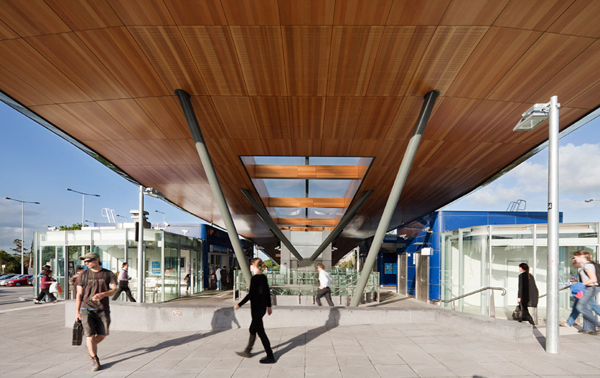
At Nunawading station in Melbourne the context was challenging with “tonnes of traffic” barrelling down six lanes of road beside the station.
The design aim was to create a station that was safer and brighter, and would also stimulate the growth of greater retail and density around it.
Working in a team and sharing importance of design
One of the challenges of projects such as the level crossing removals has been working with a civil engineering contractors who may not have much knowledge of architectural or urban response approaches.
This is starting to change as the government in Victoria has started to place importance on urban design through project briefs.
“So it got easier to manage the conversation,” he says.
The station at Gardiner was the first project that Grimshaw worked on within the “new conversation”.
The urban response and design looked to what the station would be doing for the street, the neighbourhood, and for future development opportunities around it – the “value capture” aspect.
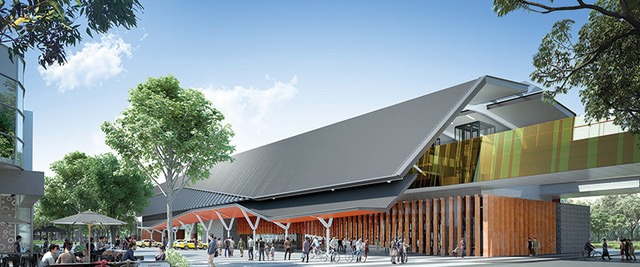
Currently the practice is working on three stations in Melbourne’s outer ring including at Mernda, a greenfields site, which means “dealing with a future density that’s not known.”
Dealing with the materiality of a place and the need to look at the vernacular of the context and have it reflected in the final result.
The Mernda area for example includes heritage buildings, agricultural buildings and “classic sheds”.
So the design is for a “simplistic” roof like a shed that is shaped to respond to daylight and have a subtle connection to the local environment.
“We try to be responsive to the immediate culture of where it sits,” Stonell says.
Improving design outcomes can also change how people interact with a station.
An Amsterdam station the practice designed in a “gritty” area next to an arena is a case in point.
The existing station was dark, unsafe, regularly vandalised and covered in graffiti.
The new design “uplifted the quality” with features such as timber and skylights to deliver natural light as far into the station spaces as possible.
“If you uplift the quality of the finishes people respect it a little bit more,” he says.
As proof of this, he says the station no longer gets vandalised.
A final thing rail stations need to be, Stonell says, is environmentally responsible.
They need to deal with energy and water and overall sustainability. Southern Cross station’s roof, for example, was an “environmental engineering” approach that enabled the station to be naturally ventilated rather than mechanically ventilated.
On its suburban stations, it looks to ensure there is rainwater capture and storage and energy recovery wherever possible.
It was also responsible for adding requirements around biophilic design to the final Melbourne Metro design guidelines.
The underground challenges
Stonell says that underground stations are hard in terms of dealing with energy, air movement and light.
You want the natural light to go out as far as possible into the station.
A design strategy for underground is to “let some of the surface down” into the space. The ground level context needs to “inform the look and feel”.
Fighting resistance
The critical thing generally with getting architectural approaches across the line is “convincing what are generally engineered-based clients or governments” who may resist such changes in direction because of perceptions around cost.
These perceptions are not accurate, he says. The level crossing removal costing around $100-$150 million each, but actual station is only around 10 per cent of that cost. Tweaks to its quality are a “level of finessing”.
“You’ve got to understand the site and fight for it.”
Stonell says that ultimately the Metro should be something that visitors from overseas will go home saying it is a must-see, “up there with Bilbao or the Paris Metro”.
“That’s an aspiration I think we should have.”
At the same time, transport is a “very pragmatic sector to work for”.
“You can’t be extravagant with the shapes.”
The spaces need to be “very clear, straight forward and unconfusing”, and the architecture then becomes something that “supports, overlays and uplifts” them.
More people means more need for good rail
The real payoff when good design is taken on board is people are more likely to use the public transport.
Southern Cross for example is seeing 75 million passengers annually – the original design brief suggested it would be 35 million by 2050.
The increase in passenger numbers has partly been driven by rising petrol prices and jobs growth in the CBD and Docklands, but Stonell says if the station was still the “nasty” place it used to be, fewer people would be using it.
“If we are going to convince and coerce people out of the car – which we absolutely need to do – we need to make it a quality experience.”
“We need to get people out of their cars and onto trains.”
That means ensuring the experience is not stressful, “vaguely enjoyable” and that people haven’t “suffered in the process” of getting on and off the train.
If the station is well-designed, what they will recall is the quality of the finishes, whether it was beautiful and was it easy to get around.
The predictions of population growth make investing in rail crucial, he says. If Melbourne just keeps adding people to its outer ring, it will end up with “LA-type sprawl”.
However, people want a sense of community and this could mean more people wanting to live in places such as Bendigo, Ballarat and Shepparton, which means they need reliable rail transport.
Sydney Metro a “flagship” for Architectus
Architectus is another practice that is part of the movement. It will be partnering with international firm Foster + Partners to design six stations on Stage 2 of the Sydney Metro project as part of the METRON design consortium, a joint venture led by Arcadis and Mott MacDonald, and including engineer Robert Bird Group.
Architectus principal – rail and infrastructure – Mark van den Enden, says the metro is “truly a city shaping project.”
The six new underground station designs will aim to “integrate harmoniously” with both existing and new commercial and residential over station developments.
“The complexity, coordination and precision required really makes this the pinnacle infrastructure project for an Australian transport architect and a flagship project for Architectus.”
Other major transport infrastructure projects include the Gold Coast Light Rail, Canberra’s Capital Metro, and Parramatta Light Rail.
Mr van den Enden said the practice is critically aware of the role that well-designed transport infrastructure can play in vastly improving how a city functions.
A customer-led design process will be undertaken to understand the “total journey experience” and ensure commuter needs translate into actual design outcomes.
The process will include immersive testing with virtual reality and 1:1 scale prototypes of station environments with the support of design team specialists including customer centred design, human factors experts and behavioural psychologists.

Rail is the new destination sensation
HASSELL is another practice that has brought its design talent to major transport projects.
It is providing all architecture, urban design, landscape architecture and interior design services for the Northwest Rapid Transit consortium comprising CPB Contractors, John Holland Group, MTR, UGL Rail Services, Plenary Group and Alstom.
It has designed eight of the train stations for the Sydney Metro Northwest for the NRT consortium, including two elevated stations.
“Over the years I’ve heard projects like these described as ‘heavy engineering projects’ but it is actually so much more than that. This is transport product for the everyday person, to improve their lives,” HASSELL Principal, Ross de le Motte, says.
“We developed an idea of skylights and, by doing that the station picks up the ambience of that day.
“The prismatic forms we have in those skylights are bouncing light to different parts of the station at different times of the day, so there’s this ephemeral quality of daylight animating the public realm under the station, which I think is going to be phenomenal.”
The practice is also set to transform one of Melbourne’s most iconic destinations – the much-loved Flinders Street Station, and has also been appointed in conjunction with UK firm Weston Williamson to design the five new Melbourne Metro Stations.
It will be interesting to see where this trend leads.
But it’s not just trains that are changing the face of infrastructure.
In Singapore for instance, even waste water treatment plants and pump stations, are looking good.
In Australia, the ordinary stormwater approach of concrete, culverts and massive underground drains is beginning to be replaced with solutions like Sydney’s award-winning Water Park or Melbourne’s Royal Park wetland.
Watch this space – infrastructure and architecture are increasingly becoming the best of mates.
Hate the way we always denigrate our design by saying it can be “up there with the Paris Metro or Bilboa” or “world class” we don’t want to be “world class” we want to be “world best”.