


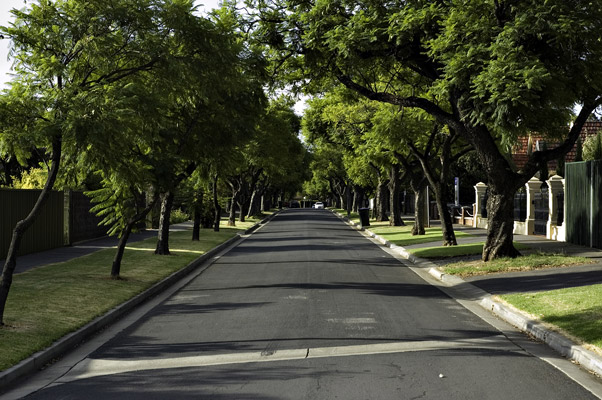
From Griffith University: Research, published this week in top-ranked environmental sciences journal Environmental Research Letters, and funded by City of Gold Coast, surveyed Gold Coast residents to determine their attitudes towards tree planting as part of Council’s Urban Greening 2030 Strategy.
The long-term research project, which will be conducted over five-year intervals, will also look at how property values can be attributed to trees and how it benefits councils across Australia to invest in urban greening.
“When you think about Australian neighbourhoods that are green and leafy, they’re usually wealthy. We call it an ‘environmental injustice’,” says Griffith’s Associate Professor Jason Byrne, of Environmental Futures Research Institute.
“But as cities increase in density they lose trees. Fewer trees mean hotter neighbourhoods and higher electricity bills for cooling. Poorer residents often struggle to pay those bills. This is the first example of a policy that begins to turn that around.”
It is one of the first studies of its kind in the world outside of North America to look at suburban environments and green infrastructure as an aspect of thermal inequality.
The research team aims to contribute to policy responses designed to achieve ‘urban climate justice’ and provides an Upper Coomera case study for all councils in Australia to look to.
Upper Coomera was chosen for the study because it has socio-economically marginalised residents, vulnerable to heat stress due to social and physical characteristics such as roof colour, building materials, yard size and building density.
These elements – combined with land clearing prior to development removing tree canopy cover – trap heat and will continue to do so without extra greening efforts.
The research found about 90 per cent of Upper Coomera residents recognised climate change as an issue and about 70 per cent were concerned about it.
“It concerned them, which was unexpected, and the majority recognised that trees could provide shade but what they didn’t put together was the connection between trees, shade and lower energy expenses,” Professor Byrne says.
“If Council get trees in the right places it will save residents money on energy bills; that’s money saved for schooling, food or transport. It will also benefit Council having healthier and happier residents, neighbourhoods that are more walkable and a safer and more attractive city.”
City of Gold Coast is investigating whether green infrastructure can combat heat island effects as part of its draft strategy.
Of the almost 2,000 residents invited to participate, a total of 230 resident surveys were returned during the 37-day survey collection period, which resulted in a 12 per cent response rate and suitable sample size.
Recent Honours graduate Chloe Portanger, who is also an information analytics specialist for Climate Planning, says Upper Coomera was chosen because it is part of the urban growth corridor in a city where the population is expected to double in the next 30 years.
“We found that people living in townhouses or households with energy efficient appliances and people with a greater concern for society were more likely to be worried about climate change,” she says.
The team hopes to further their work by using thermal sensors in the suburb to measure heat change and analyse that data for Council’s long-term planning.