


The University of Technology Sydney, four Western Sydney city councils and the NSW government have joined forces to find a design for bus shelters that will perform effectively under future climate change scenarios.
The Climate Adapted People Shelter competition aimed to address the thermal performance and user comfort aspects of bus shelters. It is part of a wider collaboration on transport infrastructure between UTS experts, the Adapt NSW program and the four councils.
Bus shelters in eight locations across Western Sydney in high-traffic, high-heat areas were proposed for redesign by entrants.
Institute of Sustainable Futures researcher Dr Brent Jacobs said Western Sydney was projected to experience up to seven additional days above 35 degrees a year by 2030, placing exposed communities, including Sydney’s 600,000 daily bus users, at heightened risk.
Currently, the design of existing shelters in the City of Penrith, for example, means they can reach up to 60 degrees inside during the peak of summer.
Dr Jacobs said the CAPS project tied in with City of Penrith’s Cooling the City Strategy, which recognises the area’s vulnerability to higher temperatures.
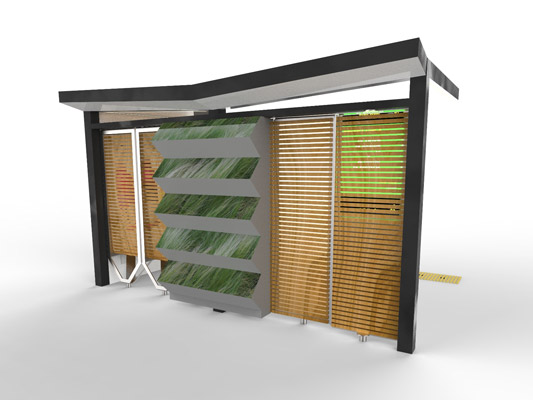
The winning design by MM Creative, the design arm of Micron Manufacturing, redesigned a bus stop opposite Nepean Hospital in Penrith used extensively by frail, elderly and disabled people.
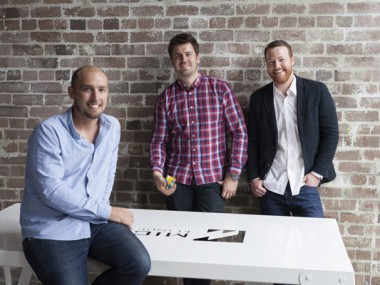
“Commuters told us that that direct sun light and lack of shade led people to wait inside the medical centre behind the bus shelter, which had airconditioning,” MM project manager Liam O’Brien said.
“This often resulted in them missing the bus. The elderly in particular struggle to make the bus when it arrives.”
The design incorporates shade panels, self-wicking planter boxes, a self-ventilating structure, technology providing real-time bus arrival updates, automatically adjusting LED lights and adjustable seating that improves visibility as well as ventilation.
“The central concept is that the bus stop is modular, with different options that can be mixed and matched and adjusted for varying conditions,” Mr O’Brien said.
The team will now work with Penrith City Council to refine, build and install the design as a prototype, with the possibility council will adopt either the entire design or elements of it for the 204 bus shelters in the city area.
The prototype is being supported with $25,000 in funding from the Office of Environment and Heritage and NSW Environmental Trust, and support from Local Government NSW and the NSW Building Resilience to Climate Change program.
Once it is installed, both UTS researchers and council will monitor the shelter’s climate performance and whether it delivers social benefits.
“Council is looking for good quality, robust shelters that stand up well to day-to-day wear and tear,” a spokesman for Penrith City Council said.
“If maintenance or repair of any component is required we will look to ensure that the process is straightforward and relatively inexpensive. Of course it is [also] important that it provides adequate shelter and is a safe place and looks good.”
The spokesman said the design was the beginning of innovation for the council.
“Council has a large number of assets to maintain with bus shelters forming just one component of our overall asset management responsibilities,” he said.
“Having said that, if we want to encourage our community to increase their use of public transport then having quality, safe bus shelters is an important piece toward achieving that.”
Unlike public transport shelters such as those installed in the lead-up to Sydney’s 2000 Olympics, which are specifically designed to deter homeless persons from lying down, the spokesman said the council was not in the business of making life more uncomfortable for homeless people.
“They are citizens too,” he said, adding that there were many reasons people use bus shelters aside from waiting for a bus, including taking a break from walking or waiting for someone.
Penrith mayor Karen McKeown, who headed up the judging panel, said the potential to make the winning design a reality had “far-reaching benefits for people across our region, the state and beyond”.
“We were highly impressed with the entries,” Ms McKeown said. “The designs were of a first-class standard, offering smart, innovative solutions that can turn bus stops into places of true shelter for our communities.”
Other members of the judging panel included representatives from Parramatta, Inner West and Canterbury-Bankstown councils, the Greater Sydney Commission, Samsung, Stockland and Macquarie University.
The CAPS competition attracted 27 teams with 90 participants. There are four further awards being announced on Friday – the People’s Choice winner, and individual award winners chosen by the three other participating councils.