

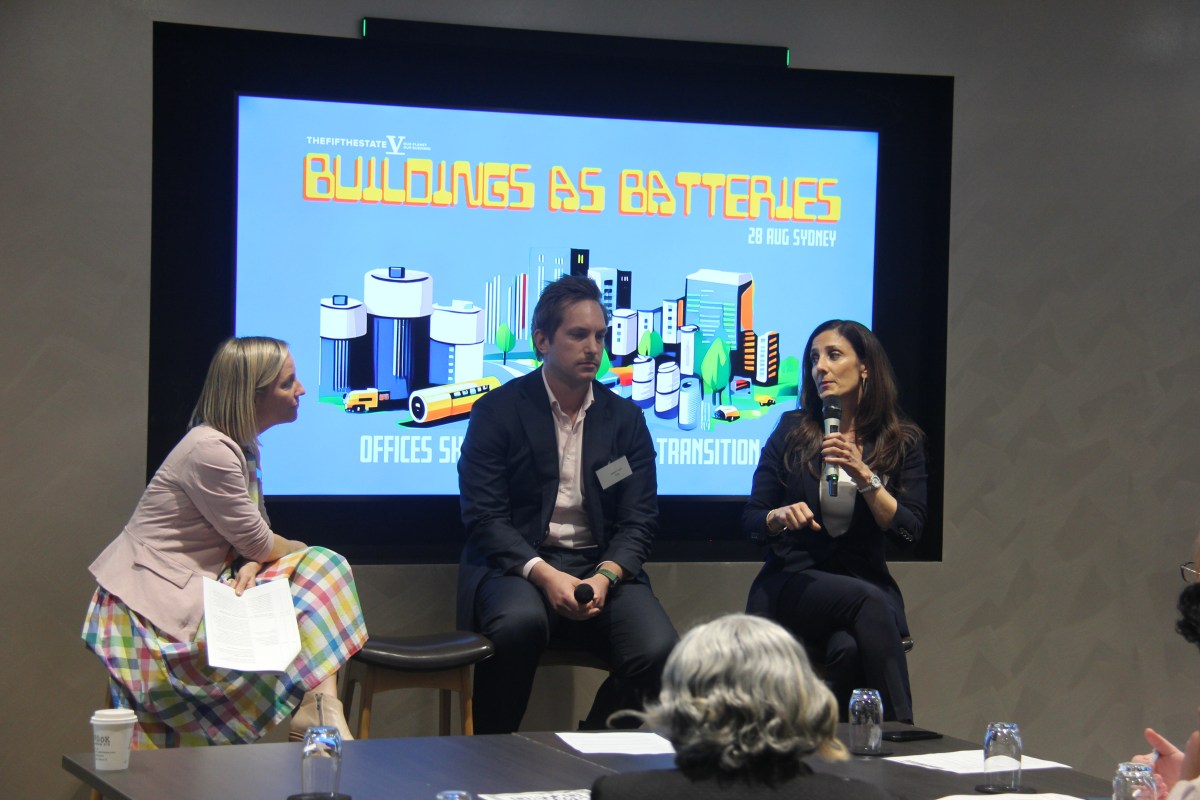
Once upon a time, the energy system was mostly a linear supply chain from power plant to power point, with a mass of poles and wires and substations in between. The emerging energy future is looking very different, according to Melissa Doueihi, head of strategy and innovation, Endeavour Energy and Jason Layt, acting head of decarbonisation and customer strategy, AGL.
In a discussion moderated by Alison Scotland, chief executive of the Australian Sustainable Built Environment Council, both Melissa Doueihi and Jason Layt highlighted the major shift that’s seeing neighbourhood scale become the new marketplace for creating and distributing wattage.
As an operator of poles, wires, streetlights and substations, Endeavour Energy is preparing for rapid change in its core patch of Western Sydney and surrounds. Doueihi said it is already thinking about precinct-scale innovation with some of the big industrial asset owners such as Goodman.
“We need renewable energy zones,” she said.
Endeavor is part of a consortium that is building a sizeable renewable energy zone in the central west of NSW.
The key to unlocking the opportunity is distribution, something Doueihi said is not being sufficiently considered. [This can be seen in policies at both federal and state level where the problem of how to shift energy beyond traditional poles and wires persists.]
There are a lot of resources sitting on rooftops, and there needs to be more focus on how the distribution network can help unlock that to support the national transition in a cost-effective way.
As Doueihi noted, there are a lot of resources sitting on rooftops, and there needs to be more focus on how the distribution network can help unlock that to support the national transition in a cost-effective way.
Retailers are of course a big part of that equation, and Jason Layt said it is something AGL is already looking at. Distributed energy resources bring with them a lot of opportunity, and a vast amount of complexity, including working out how to match supply with demand and how to assign pricing properly.
“Ultimately, I think the way that we use energy has to change,” Layt said.
We have had generations who grew up reaping the benefits of cheap, reliable electricity underpinned by fossil fuels, however, the externalities that came alongside that are no longer supportable. Layt said getting the last percentage of organisations in the economy to recognise the need for transformation is difficult – but we are on the right track.
“It’s going to take a whole of industry effort to get to the end picture.”
One of the challenges is that those who have the most roof space available for installing PV – industrial and logistics property owners among them – aren’t seeing the value in producing more energy than they need.
If these buildings can become mini generators for a larger tranche of nearby buildings though, then we are moving towards that distributed renewable grid
Right-sizing PV to match the building load is sensible from a development costs efficiency perspective, where the thinking is only about the individual site.
If these buildings can become mini generators for a larger tranche of nearby buildings though, then we are moving towards that distributed renewable grid.
This is the kind of thinking behind Endeavour’s perspective on the role of industrial asset owners in Western Sydney such as Goodman. Doueihi believes there is probably also a role for government in enabling local energy systems to emerge.
The pricing conundrum
For AGL this kind of picture brings up the pricing conundrum. How does the energy get priced? What kind of contract model for customers would be needed?
Rooftop PV can provide a massive share of the national energy supply – however, the times of day it is pumping out the electrons is only part of the time consumers demand supply.
So, ensuring a good fit between supply and demand will also spotlight the value proposition for battery storage too, which is an area where AGL is actively working with customers.
There could be rethinks also around time of use pricing as part of moving the demand needle, because as both Layt and Doueihi pointed out, changing the way energy users behave is a crucial element in the mix.
New contract models for customers that find a middle ground between conventional Green Power arrangements and the long-term lock-in of a corporate PPA may also be part of the emerging future.
Data centres – the spanners in the works
Two factors that are not yet part of the general energy discourse that may throw a spanner in the works also need some serious thinking.
One is data centres and their massive energy demand, which is set to increase as more of us engage with the AI tools that are suddenly everywhere.
According to Doueihi, the energy market projections produced by bodies like Australian Energy Market Operator do not adequately consider how this affects short, medium, and long term demand projections
According to Doueihi, the energy market projections produced by bodies like Australian Energy Market Operator do not adequately consider how this affects short, medium and long term demand projections. Even the big operators like Transgrid are still yet to work out what it means for their business and operations planning.
“This is a conversation and a solution that needs to be had across the whole value chain,” she said.
This is going to require the full spectrum of tools: policy, commercial models, technology, engagement by those who have the roof space and behaviour change on the part of energy users
The second factor is that enabling technologies including storage, demand response platforms and microgrid systems are still evolving.
Similarly, the role of EVs in the energy mix is somewhat opaque, as uptake has not progressed as expected and how to plug them in and make them both an energy provider as well as an energy consumer in the district energy grids notion is still just a concept bubble.
As Layt observed, electricity is a “real time commodity”, so we need to find ways to shift surplus energy generated during the day to be used for peak demands at night.
This is going to require the full spectrum of tools: policy, commercial models, technology, engagement by those who have the roof space and behaviour change on the part of energy users.
The days of coal-fired cheap, reliable energy are behind us – the bold new adventure of reliable, secure, distributed, decarbonised energy awaits.