

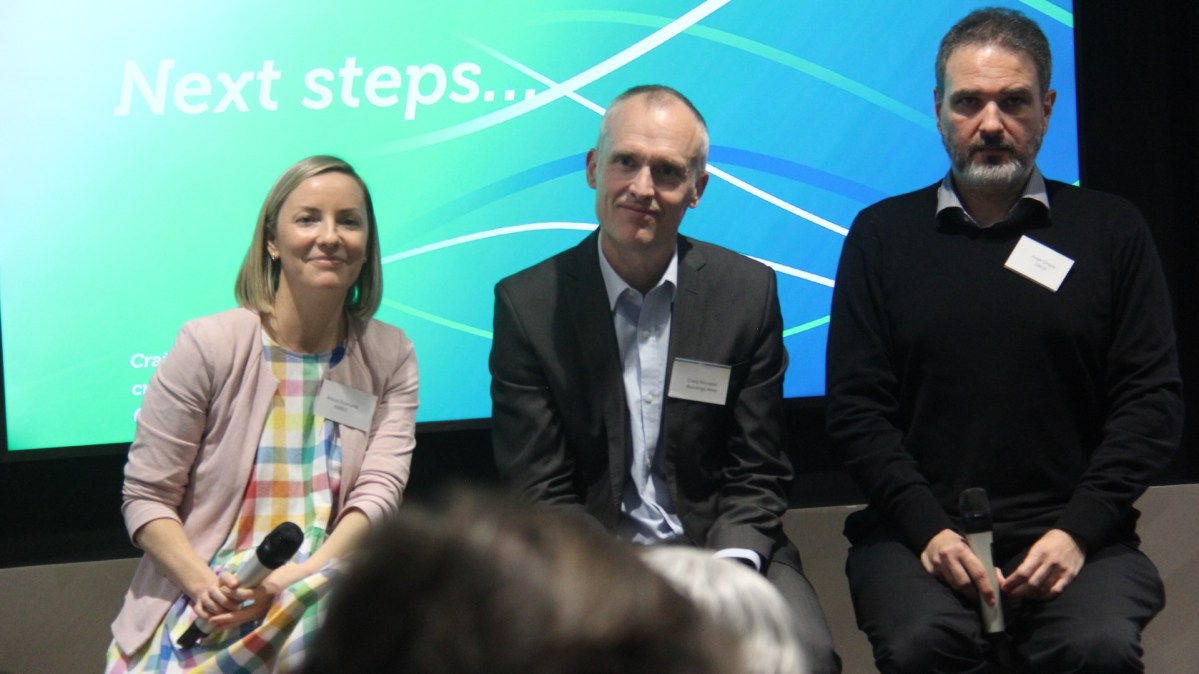
The Green Building Council of Australia’s chief impact officer Jorge Chapa joined Australian Sustainable Built Environment Council chief executive office Alison Scotland and Buildings Alive’s Craig Roussac to discuss the policies for industry and government we need. Tina Perinotto editor of The Fifth Estate moderated the session.
According to Jorge Chapa, Craig Roussac has helped define what makes a good grid-interactive building in existing structures.
This was now a top priority for the industry and the Green Building Council of Australia (GBCA). “Matching renewable generation with consumption will be crucial in the next decade,” he said
And against all the odds, the grid was decarbonising faster than was expected.
The next update of the GBCA’s Green Star rating tool would address this, along with a leadership challenge, designed to reward those using Roussac’s techniques, he said.
But it’s not an easy task, Roussac said.
“Building owners aren’t energy companies. There are many distractions, but I’ve never seen such as huge commercial opportunity go to waste.”
So who are the experts and what are the skills needed to communicated to property owners?
What helps, said Roussac, is to communicate to stakeholders that “we’re doing the right thing with your money, saving energy and helping the environment.
“So just helping the environment…a lot of investors go, yeah, that’s nice, but actually, what are you doing about our money?
“So drawing the connection between lower carbon and lower costs is a new line that we should use – not save energy, because it depends on what energy? If you can buy energy at negative costs, saving it doesn’t make any sense.
“So we need NABERS, we need the Green Building Council, we need these things to really help communicate the good work that then people will do. But it’s hard to get the attention at the board level.
Stakeholders need to be told that “we are doing the right thing with their money, saving energy and helping the environment.”
This requires help from bodies such as NABERS and the Green Building Council of Australia “to help communicate the good work people are doing.” Despite this, it is hard to get attention at the board level, he said.
That’s the communications story but what about the doing story? What or who can make it happen?
Ben Waters from Presync wanted to know if the current renewable energy target was fit for purpose because it says that coal plus renewable electricity certificates equates to “renewable electricity”.
Roussac said no, it was designed before this was an issue and by 2030, we will have a new one which will need to look at interval energy, the physical reality of the situation.
doing now. Once upon a time it didn’t matter and full credit to anyone involved with NABERS or whatever, but for the last 10 or 15 years it’s been emerging as a thing and we still have the old tools that were designed 25 years ago.
“We need to change them and there’s going to be an opportunity for someone to make an enormous amount of money.”
Can we expect help from the reporting frameworks?
Can we expect help from the reporting frameworks?
Gavin Dietz, previously CEO at Wattwatchers, asked if the new Australian Accounting Standards Board reporting framework expected to come in early in 2025 will make a difference.
Unless the framework had granular policies such as measuring emissions at intervals of 15 minutes to 30 minutes, it was unlikely to “have the desired effect,” Roussac said.
“We need a premium approach. Many tech companies are already smart about this, focusing on time matching and shifting loads in data centres. They’re 20 years ahead of this industry.
“Regulations, aside from the EU, suggest Australia might have a guaranteed origin system to replace the Renewable Energy Target by 2030, but we need it sooner because people are investing in renewables as we want them to.”
Chapa said that the financial accounting standards would in theory will drive what Roussac wants, but current carbon accounting methods such as the greenhouse gas accounting protocol “haven’t fully recognised this issue.”
“They’ve consulted on it but haven’t figured out how to manage it effectively.”
“Various standards are emerging…eventually, we’ll move from a global or yearly net perspective to a more granular one.”
While infrastructure and calculation methods aren’t there yet, greenhouse gas accounting protocols and other initiatives are taking this into consideration, Chapa added. “No one has fully committed to it yet, but they’re all considering it.”
But is it greenwashing?
Simon Carter, head of ESG for industrial property owner ESR, said there is a lot of talk about the grid decarbonising and people saying “Don’t worry about that, the grid will take care of it.
“It seems to be quite a prevalent assumption. I’m hearing it all over the place. Is that a big mistake? And you are you going to call greenwash with the AEMO scenarios there? And is part of this equation, to really challenge those decarbonisation curves for grid electricity. Do you strongly believe it could end up very different?
“We know that solar panels don’t work at night; we know that. Let’s not pretend… and let’s not tell ourselves nice comforting things – and let’s make some money out of it because you can.”
Roussac said: “I strongly believe that we shouldn’t just assume something will happen because someone said it would, like 82 per cent renewables by 2030. It would be nice if it happened, but why is it going to happen?” I would call greenwash on anything that [misdirects]
“We know that solar panels don’t work at night; we know that. Let’s not pretend… and let’s not tell ourselves nice comforting things – and let’s make some money out of it because you can.”
Better design on a national level
Alison Scotland, who heads the Australian Sustainable Built Environment Council gave a high level view of various sectors in the built environment.
“For example, NABERS doesn’t currently reward great interoperability. It needs to encourage work on thermal shells because the best energy savings come from the energy you don’t need.”
Scotland added that education on efficient design was a huge part of the market that NABERS is focused on.
The country had a “broad spectrum of capacity and capability.”
“The best energy markets are holistic and look at the whole package. I’m excited about the potential to modify this market into something more holistic.
“Work is being done with the Property Council, ACOSS (the Australian Council of Social Services), the Energy Efficiency Council, and the AI Group to inform policymakers about the national energy market [on] how we change it from a set of rules to something that operates holistically.”
A lot of work needed to be done nationally, Scotland said. “We need a hierarchical approach.”
Solutions would involve focus on thermal performance, buildings using gas, a nationally agreed approach to electrify and how it can impact emissions reduction.
Government needs to drive outcomes
Microgrid Power’s Geoff Anson said from the floor that two things would drive rapid changes moving forward: commercial operators and government intervention.
“Commercial operators are too worried about immediate issues like roof leaks to invest significantly.”
“Commercial operators are too worried about immediate issues like
roof leaks to invest significantly.”
The government needs to step in and change legislation, but they will probably only do that if they fear being voted out.
So how influential can we be in pushing the government forward?
Roussac said the government was primarily interested in making things interesting for the fossil fuel generation.
But the industry had a big role to play, by using electricity when it is cheap and not driving “enormous profits” to the gas industry” .
How fast are we going?
“Change happens like biodiversity—slowly and then suddenly,” Chapa said. “Two years ago, if you had asked if there was a genuine drive for electrification in the building department in this country, the answer would have been no.”
“Today, the largest gas-using state for real estate, Victoria, has funded electrification through conventions. Change does happen. Unfortunately, the government often defaults to the least bad option.”
“Sometimes we win, sometimes we lose, but overall progress tends to move forward.”
What are the other forces at play?
In South Australia, the National Construction Code standard has been frozen to 2019 standards for 10 years, meaning new estate will have substandard houses in terms of energy efficiency. (Opposition leader Peter Dutton later promised to also freeze the NCC if he became prime minister as a way to tackle the housing crisis.)
Chapa adds that “it’s disgraceful to suggest we stop building good houses to reduce the cost of living.”
This could apply to many things: “why have a structurally sound house?” It was crucial to communicate business issues and the need to build better houses properly
“Thanks to CSIRO’s data on NatHERS ratings, we see many houses built to new standards.”
“National consistency is an economic argument,” Scotland added. “The HIA (Housing Industry Association) believes performance can be offset by putting PV (photovoltaic) on everything, but that’s not enough.”
Other options for buildings outside buffer tanks and thermal storage
One attendee online asked what other options existed for buildings outside of buffer tanks and thermal storage? How were building operators responding?
There were three main components, Roussac said. “Thermal storage is environmentally benign, using materials like dark sand.”
While batteries were expensive, they can store energy, whereas thermal storage cannot, he said. Building controls were also crucial, and large commercial buildings usually had sophisticated controls to manage comfort and energy use.
Other strategies included using fresh air as battery by flushing the building at optimal times and shifting load based on energy cleanliness and cost.
“Using control systems is the starting point for most buildings.”
Tosh (Anthony) Szatow, who leads growth and innovation at Flow Power commented that aiming for net zero without demand shaping and time matching would be more expensive.
According to Roussac, taking some risk is worthwhile. “I’d invest my money if I could buy shares at midday and sell them at five o’clock…Flow Power provides these opportunities, and other retailers do too.”
“As Jorge says, it takes someone to succeed and make a big profit for others to follow. We need more players to get on board.”
Szatow added: “There’s a lot we can do now,” and while bringing wind online had a four to five year lead time, solar was easier. The catch was that demand and battery storage must be managed. “The more demand is managed, the easier this transition becomes.”
Scotland said that the government was aware as of this as well, pointing to the Energy Performance Advisory Group, which was looking to integrate demand with system. The Consumer Energy Resources Expert Advisory Group was also looking at how to take advantage of these opportunities.