


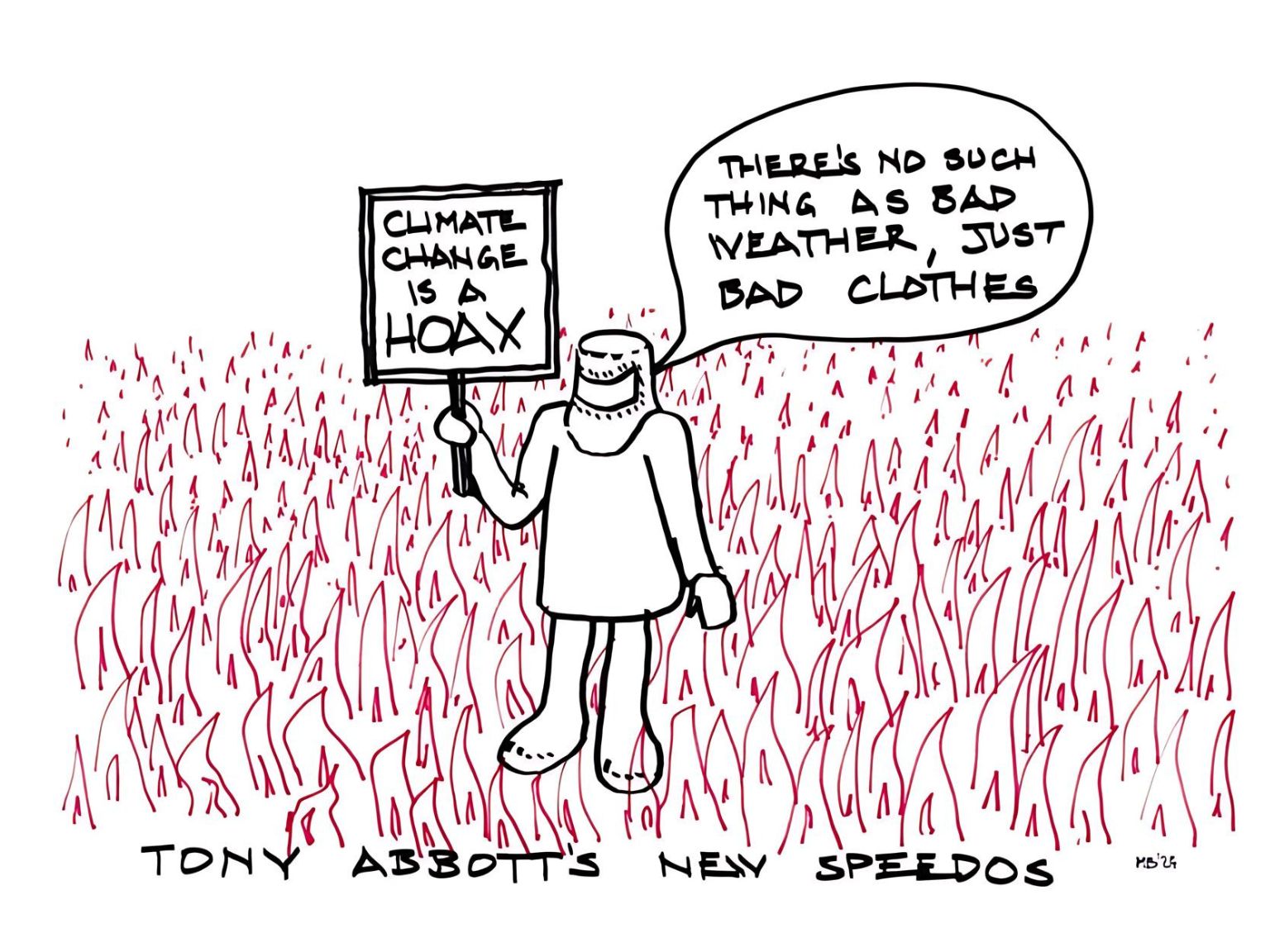
We recently considered the socially corrosive consequences of policy failure, particularly how it might undermine the core of our democratic governance. But how could this come about?
Drowning out all other news of a flawed but worthy government plodding cautiously forward was probably the desired effect when the opposition leader, Peter Dutton, recently announced that, if elected, he would commit to building seven nuclear power plants around Australia.
Reaction was predictably swift, loud, and indignant – the typically longed for attributes of those suffering “popular attention deficit disorder”.
Spinifex is an opinion column open to all our readers. We require 700+ words on issues related to sustainability especially in the built environment and in business. Contact us to submit your column or for a more detailed brief.
Recalling the numerous right wing crazies, whose slime tracks have only recently been scrubbed from the floors of our national parliament, wilful iconoclasm is a reliable method to cure the twin diseases of policy vacuity and political irrelevancy.
The obvious objections included national and state bans on nuclear power; community concerns; the lack of any policy detail, the 10–20-year period to build each reactor to satisfy a putative shortfall within the next five years, etc.
Then there were matters of detail. Reprising the dubious marketing of unproven “carbon sequestration” as a means to keep the coal industry alive, “small scale reactors” were initially proposed, again an unproven technology in an industry notorious for its slow technological development.
Some objectors had the temerity to be concerned about disposal of waste, misdirection of nuclear products to nefarious ends, the consequences of accidents, and so on.
Oh yes, then there’s the cost. Nuclear power is one of THE most expensive power generation methods that will guarantee dramatically increased energy prices for an electorate already suffering acute cost of living pressures yet is expected to vote for it!
Apparently, the very sober business community was stunned. The policy stability of long-term sustainability targets, institutional investment commitments, and broad community support and acceptance, now risks being completely undermined.
Some cynics suggest this was precisely the intended effect. Slowing accelerating investment in lower-cost sustainable power generation would help extend the life and value of oil and natural gas reserves, which are otherwise rapidly becoming stranded assets.
To be fair, some commentary offered cautious support, which was still nevertheless highly qualified.
Despite these predictable concerns, the policy details were largely confined to “trust us, we’ll tell you when we are elected”.
Whiskey Tango Foxtrot!!!
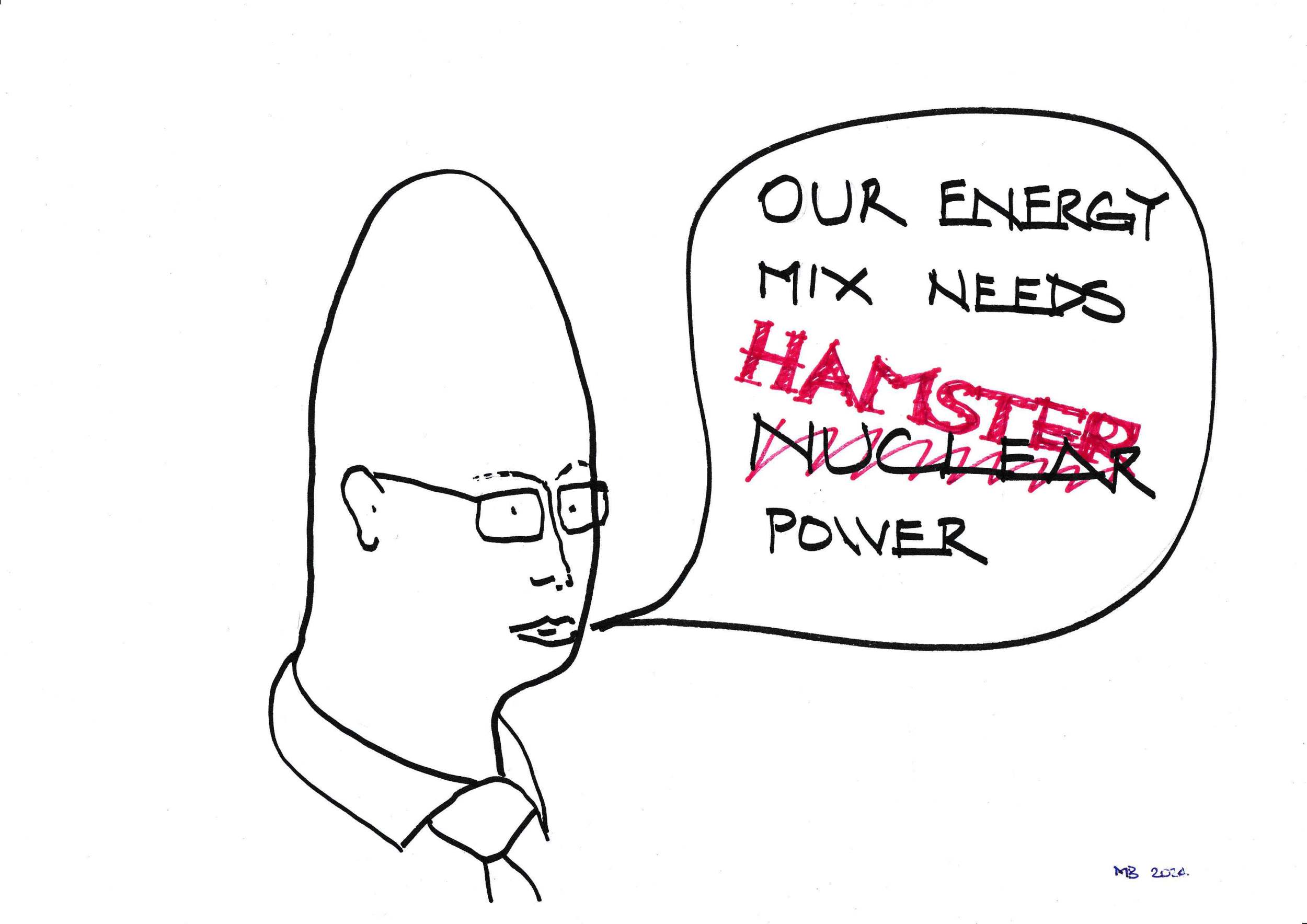
Alternative power options
The announcement effectively invited everyone and anyone to contemplate afresh what is largely settled – how we might power ourselves into this new century.
So, in this spirit but acknowledging its absurdity, this author suggests one alternative – “Hamster Power”.
Consider; their natural proclivity to run in circular treadmills could be harnessed en-masse to generate electricity at many scales, from the domestic to industrial.
For example, a “hamster bank” could be located at the back of individual suburban garages.
Befitting a circular economy (pun intended), when fed on household scraps and notoriously fecund, they would be entirely self-sustaining.
While the living generated more hamsters (during treadmill breaks), the dead could be composted to grow more food that would generate more household scraps.
Local production of electricity would save considerably on the costs of upgrading domestic transmission and distributions networks, and, there’d be no ghastly wind turbines (though the faint pong of children’s pets would hang over our cities).
Over time, genetic engineering would produce larger and more powerful hamsters, though mental development would need to be suppressed lest they develop “hamster consciousness” and unionise.
Scaling up and fed on agricultural waste, such as chaff, warehouse-sized “hamster power stations” could serve whole industrial estates. Office buildings could have “hamster banks” installed in under-used basements.
Oh, stop it, you say. Okay…
Errr…get back to it; the trust thing???
Reflecting on the dangers of cyberthreats, Jacquelyn Schneider considers the most alarming concern “…how they erode trust people place in markets, governments, and even national power”.
Trust, which she defines as “the firm belief in the truth, ability or strength of someone or something”, is at the very core of democratic governance.
She cites political scientist, Max Warren’s, observation that “extensions of trust … enable coordination of actions over large domains of space and time, which in turn permits the benefits of more complex, differentiated and diverse societies”.
These conditions of “generalised trust” are features of democratic societies and contrast with “particularised trust” only between “known others” which is a feature of “primitive, isolated and autocratic societies” (emphasis added).
Trust is also “a basic ingredient of social capital – the shared norms and interconnected networks that … lead to more peaceful and prosperous communities”.
“The modern market, for example, could not exist without the trust that allows for the delegation of responsibility to another entity”.
“The generalised trust at the heart of social capital allows voters to delegate responsibility to proxies and institutions to represent their interests”.
These perspectives are, perhaps, the most useful in examining and understanding the fundamentally alarming consequence of the coalition’s nuclear announcement.
A particular feature of the announcement is the extent to which it directly contradicts the overwhelming contemporary evidence and advice about the dubious utility of nuclear power in Australia’s energy mix.
In essence, the coalition is proposing to the electorate, don’t trust the weight of this evidence, trust us instead.
We have previously reviewed very briefly the example of other autocratic states, such as Russia, that are distinguished by the same claim.
In place of generalised, informed, shared, empowered and evidence-based agreement – what we sometimes call truth – by a population ruled by itself, such states have developed elaborately manufactured and enforced “truths” that enable and justify oppressive stratagems of control.
Likewise, the deny, deny, deny approach of Trump in public life is, at core, a claim on truth. As Mythbusters were fond of parodying “I deny your truth and substitute my own”; and almost exact definition of the “particularised trust” explored by Schneider.
Yet, the coalition seeks to undermine the very networks of trust that inform and underpin how our own democracy works, replacing it with its own “particularised trust” of a kind reminiscent of Russia and Trump.
So, when in response to the very real concerns about his nuclear power announcement the leader of the Opposition says, “just trust me”, for the sake of our democratic underpinnings, DON’T do it: he’s crossed a red line, and is therefore unfit to govern our still-functioning democracy.