


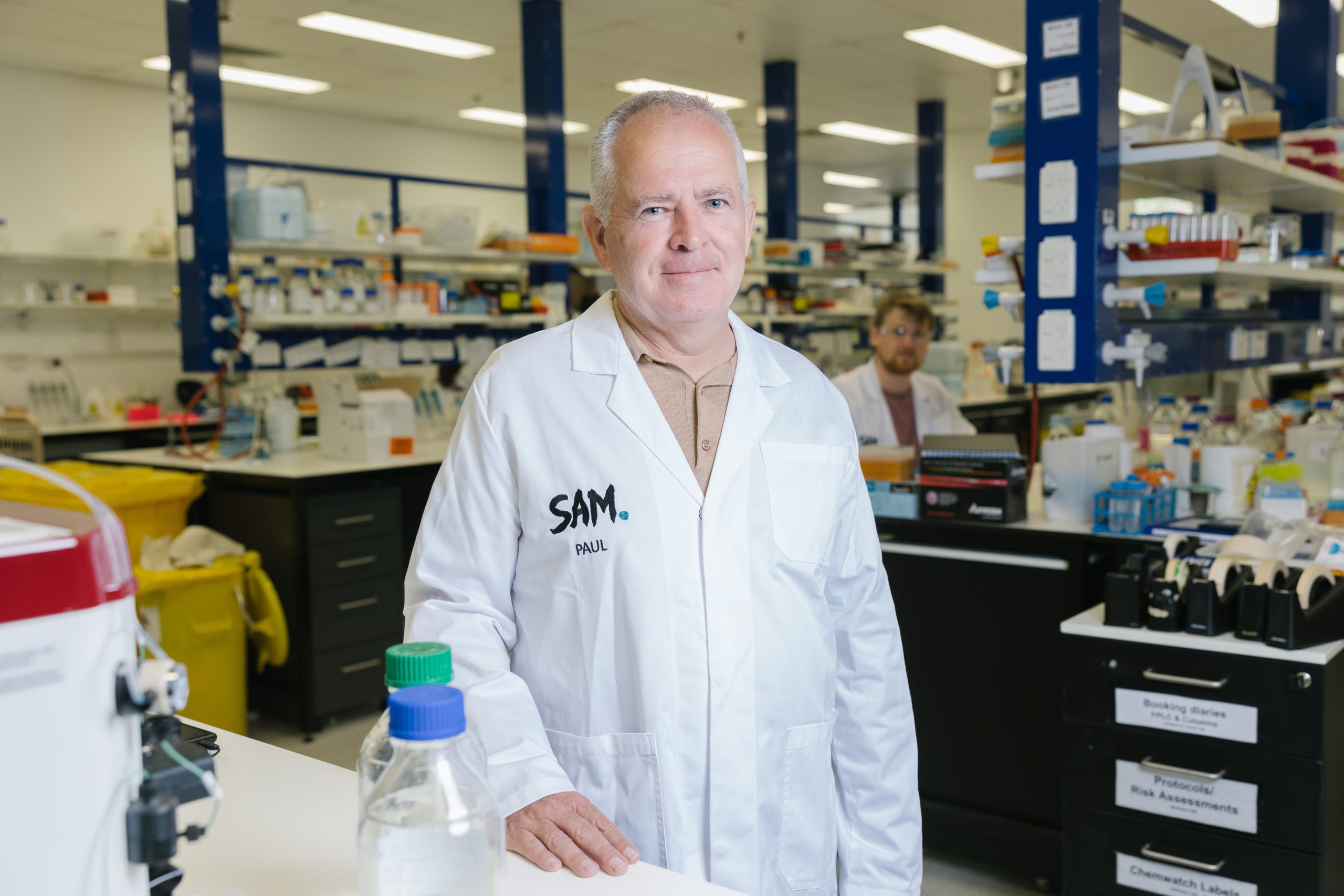
A new recycling facility near Canberra claims it will be able to create infinite, virgin-grade plastic without fossil fuels.
Samsara Eco will open a recycling research and development facility in Jerrabomberra, at Queanbeyan about 300 kilometres south west of Sydney, near the Australian Capital Territory. It claims it will make plastic recycling viable to new virgin-grade standards without using fossil fuels.
The company says this will reduce the amount of fossil fuels needed to create new plastics and divert plastics from landfills and oceans.
It will also deliver a solution that can replace current recycling methods – which manage less than 10 per cent of plastic waste produced.
Paul Riley the company’s chief executive who founded the company three years ago with the objective to address one of Australia’s biggest environmental challenges said:
“You can’t solve the climate crisis unless you solve the plastics crisis. Plastic is one of the greatest inventions of the 20th century and provides enormous utility because of its durability, flexibility, and strength. Yet, it’s also an environmental disaster with almost every piece of the 9 billion tonnes ever made still on the planet.”
The facility, due to be operational late next year, will be in the commercial innovation hub within the Poplars Innovation Precinct – which will provide a home base for the facility to focus on the company’s scientific research for commercialisation.
The precinct is a proposed development that would also contain a 10-hectare retail and services precinct already in stage one of development, with tenants such as Aldi supermarkets, 7-Eleven, KFC, and McDonalds.
The company claims the technology will produce a circular “infinite” process that is carbon neutral, environmentally friendly and requires nothing more from the planet or everyday consumers in terms of time, energy, resources, and money.
The company’s “enzyme library” now contains enzymes that can tackle challenging plastics, including coloured, multi-layered, mix-layered, mixed plastics and textiles like polyester and nylon.
Riley said that plastic monomer could be achieved in one to two hours of processing.
“Unlike other plastic management solutions, our technology can take any feedstock — clothing, coloured plastics — and you’ll still end up with a clean, clear monomer equivalent to a brand-new monomer. Our objective is to build out our enzyme library so that we can address more and more mixed plastics.”
The company hopes to reach its key milestone of recycling 1.5 million tonnes of plastic annually by 2030.

The project has already garnered the support of the developers of the Poplars Innovation Precinct, the Queanbeyan-Palerang regional council, and the local community, along with the Australian National University, which is home to the company’s several research laboratories, and which will help the company scale up operations for commercialisation.
“In total, we’ve raised about $65 million to date, and the facility is a $25 m facility. The four labs will assist us in commercialising the product, accommodate around 40 people initially, and will have two lines on the factory floor to accelerate commercialisation,” Riley said.
“This will process different plastics and be a proof of concept for partners for the building of the facility offshore. It’s the next step towards having a full-scale facility with our technology.”
In addition, big industry names such as the Woolworths Group, CEFC, Wildcard Ventures, and Main Sequence have invested in the technology and other investors include Temasek, Breakthrough Victoria and DCVC (a deep tech venture capital company) which joined the investment pool following a $56 million Series A funding in 2022.
Fashion retailer Lululemon and electronics manufacturer Kanematsu Corporation have partnered with the company.
The company will focus on three sectors: fashion, automotive and packaging and seek to develop facilities in North America, Europe, Southeast Asia and eventually in Australia.
“What’s currently pulling us to market is that our relationships are predominantly international partnerships. Europe and North America’s legislative environment really support this sort of technology” Riley said.
For instance, the US government was supporting decarbonisation and growth in North America.
And in Europe, there’s legislation in place for minimum recycled content that supports and drives investment into the advanced recycling space.
“Australia needs to be more ambitious in that regard,” Riley said.
“We’ve seen that self-regulation in Australia hasn’t worked, and we’ll need to be more ambitious to drive for minimum recycled content across fashion and packaging.
“We’ve had fantastic growth out of our ANU lab, but the plastic problem is growing fast. As we gear up towards commercialisation, access to our first R&D facility will enable us to accelerate the capabilities of infinite recycling and scale our solution, which breaks down plastics in minutes, not centuries.”
If successful, the Queanbeyan-Palerang Regional Council claimed that its region will become home to a world-class leader in infinite recycling and decarbonised plastic management.
Mayor Kenrick Winchester said securing the facility was a key anchor of the Poplars Innovation Precinct and will help achieve the council’s vision for the precinct.
“Samsara Eco’s innovative technology has the potential to put Queanbeyan and Jerrabomberra on the international stage as countries all over the world look for ways to reduce waste and work toward net-zero carbon emissions. We hope that securing Samsara Eco is the first of many new and exciting initiatives for the precinct, and we look forward to the employment opportunities the precinct will provide.”
The council hopes Poplar would attract tenants from defence, space, cyber-security, information technology and scientific research sectors to the new precinct.
Other estates are expected to include an education precinct that will house Jerrabomberra High School and a proposed council innovation hub.
David Maxwell, director of Poplar Developments, said “With an expanding network of connections to a range of universities and growth in the scientific research and high-technology industries, the precinct will be uniquely positioned to accelerate Samsara Eco’s next phase of growth.”
I love this news of course, but from where will the 1.5 million tonnes of plastic per year be sourced? We generate a lot of plastic in Brisbane too, surely it’s not/never economical to truck or train the plastic generated here, to Canberra? Hope to see a facility in Queensland in my life time which, as I am 75, is not a very long time.