


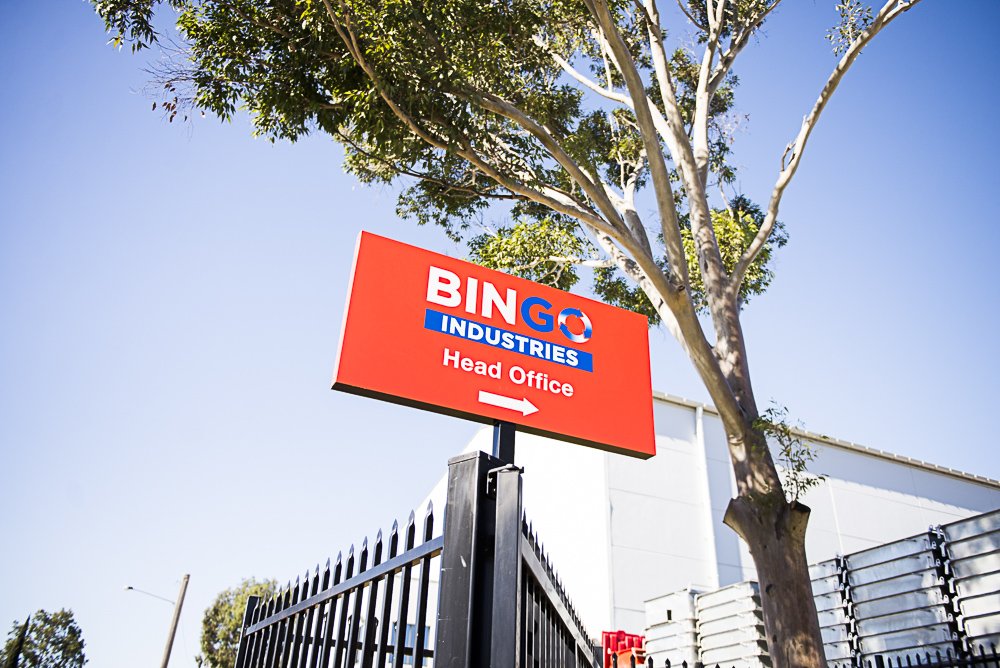
If you need to plan ahead in the jobs market you could do worse than look at the circular economy. Right now there’s a $2.6 billion buyout proposal on the table for Bingo Industries, a company overhauling its business model to recover as much material as possible. Here’s a cross section of what’s happening.
Just a 5 per cent increase in Australia’s recovery rate would add an estimated $1 billion to GDP, a roadmap released by the CSIRO said last week.
The roadmap highlights the hidden gems in our landfills. Not recycling plastic loses Australia $419 million annually, paper $115 million and lithium an eye-boggling $2.5 billion.
“Australia is among the world’s best in advanced manufacturing and environmental research, and that unique science can turn industry and environment into partners by making sustainability profitable,” according to CSIRO chief executive Dr Larry Marshall.
Some businesses are already making profit out of the circular economy. Bingo Industries, for example, is reaping the benefits of transitioning to a circular economy business model from its roots in waste management services and recycling centres.
Bingo Industries head of sustainability Nik Comito says the business has a strong financial incentive to keep material out of their landfills because the longer it keeps an asset from going to landfill the les it costs in landfill levies.
It’s the company’s ability to find efficiencies in a sector that’s been otherwise slow to innovate that’s seen as the reason there’s now $2.6 billion buyout proposal on the table from a major private equity consortium led by CPE Capital. Shares in the business have skyrocketed.
Comito says the business has been evolving rapidly since it was listed on the ASX four years ago. A focus on vertical integration, including the acquisition of Dial-a-Dump in 2018, has allowed the company to innovate and invest in the infrastructure it needs to recover more materials.
At its landfill in NSW’s Eastern Creek that takes “dry” waste only (no organics) it’s invested roughly $100 million in “state-of-the-art” technology that will have the facility recovering more than 90 per cent of material.
It’s also created a new income stream to take construction waste, separate it into different waste streams, and sell it back to the customers in the construction supply chain.
The company’s internal innovation hub is looking at other upcycling opportunities, Comito says. While the company is not going to become “a Nike” and start manufacturing its own shoes, he says it will be looking at opportunities to supply recovered material for manufacturers to use.
It’s also embarked on a geographical expansion along the east coast, including into Queensland. Its biggest markets are currently in Victoria and NSW.
Comito says the industry has been forced to innovate in response to China’s Green Sword policy, with the ban on Australia’s waste products creating “some pretty serious problems”. He says it’s also prompted some “green shoots of innovation” in the industry.
It helps that governments are throwing money at the problem, with the federal government’s Recycling Modernisation Fund set to scale up to $600 million in grants once states chip in.
“We’ve seen really positive action from a raft of different stakeholders and that gives us hope. [The circular economy] is not going anywhere, it’s here to stay.”
Consultants are hiring
Consultants are also experiencing increased demand for circular economy-related services beyond the usual life cycle analysis (LCA) workload.
Growing interest in this sort of work has prompted sustainability consultancy Edge Environment to bolster its Circular Economy and Life Cycle Thinking team.
Late last year it brought CircleCo into the fold, a one-woman circular economy consultancy founded by Jenni Philippe.
Philippe has been Edge’s circular economy principal since September last year and says the team has been hiring madly to keep up with the workload, bringing on someone new almost every month.
She says governments, particularly councils, are compelled to understand policy levers they can use. Training and education on circular economy is also in hot demand, as is strategic work to improve the circularity of business models.
Helping businesses apply for government grants is another growing work stream. Philippe says it’s not just the federal government’s grant program; there’s also opportunities with agencies such as Sustainability Victoria’s recycling grants.
In the built environment, the team is working with the likes of GECA and the Green Build Council of Association on circular economy projects.
Specialist circular economy consultancies are also cropping up, such as Coreo, a Brisbane consultancy founded by Ashleigh Morris (a speaker at our Building Circularity) and her sister Jaine Morris.
Blake Lindley has also started his own specialist circular economy business Cirq Solutions. He told The Fifth Estate he hasn’t had much time to dedicate to the business (currently just him) as he is also juggling his role as director at the Australasian Circular Textile Association.
Started in August 2019, ACTA has “been going bananas”. He says it brings a strategic and collaborative approach to the broader textile industry, “it’s important to realise that clothing is just 40 per cent of the textile we consume”.
This year we will be publishing several much-needed research reports that “will reshape how government and industry perceive the textile opportunity and they can do to take action”.
By being inclusive of large volume homogenous textile products like bedding, building wraps, uniforms and carpets, ACTA is looking to design an effective infrastructure mix to deal with textile waste.
Watch out for more to come in this expanding and exciting sector.
This is good news. Go Bingo. I have a nagging worry about incineration of waste though, that it will be built into recycling and reuse plants – there are proposals to do that in 5 sites in NSW – mostly in Western Sydney and also near Botany Bay. Will incineration be excluded from projects funded by the Recycling Modernisation Fund?